
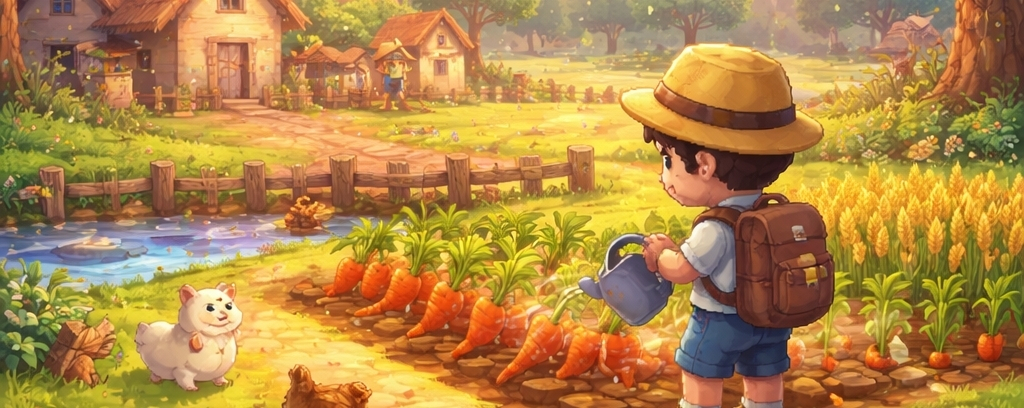
Pixels is often described in a simple way, a casual web3 game built on Ronin with farming, exploration, and an open world. That description is correct, but it still doesn’t really explain what it feels like when you actually spend time inside it. Because once you are there, you stop thinking in features and start reacting to the rhythm of the world itself.
What you notice first is how quiet everything feels. Not empty quiet, but calm quiet. There is no pressure telling you what to understand or what to optimize. You just arrive and start doing small things without even realizing you are being guided into a routine. You plant something, you collect something, you move around, you check spaces, and it all feels very ordinary in a good way.
And that “ordinary” feeling is actually rare in web3 games. Most of them carry an invisible tension. Even if nobody says it directly, you can feel it in the design. Everything feels like it is connected to value. Every action quietly asks a question in the background. Are you playing, or are you earning? Are you exploring, or are you optimizing? Is this a world, or just a system dressed like one?
Pixels doesn’t rush you into that question It lets you exist first.
You just do small tasks, one after another. Nothing feels important at first, but that’s exactly why it works. Because your mind stops trying to analyze everything and simply follows the flow. And slowly, without noticing, you start building a rhythm.
That rhythm is where the game really starts to form its identity.
You come back, you repeat actions, you remember small routes, you notice changes that weren’t there yesterday. At first it feels like nothing special. But repetition has a strange effect on people. The more you repeat something simple, the more it stops feeling like a task and starts feeling like familiarity.
And familiarity has weight.
It makes a world feel like it exists even when you are not paying attention to it. You stop seeing the game as separate sessions and start feeling like it is an ongoing place. Something continues even when you leave. Something waits without demanding anything.
That’s where attachment starts quietly forming
Farming plays a big role in that feeling. It’s one of the simplest mechanics in gaming, but also one of the most human ones. You do something now, and you see results later. That small delay connects time with action in a very natural way. It doesn’t feel like a system. It feels like care. Like you left something behind and it responded to your absence in its own slow way.
But in web3 games, this kind of simplicity often gets complicated because ownership enters the picture. The moment value becomes visible, everything can start feeling heavier. A simple action can suddenly feel like a transaction. A simple object can feel like a price. And slowly, the world can turn into something you calculate instead of something you experience.
Pixels doesn’t fully remove that layer, but it doesn’t push it forward either.
It stays in the background.
First, you learn the world as a place. You understand where things are, how movement feels, how routines form, how other players exist around you. Only after that does the economic side become more noticeable. And because of that order, it never fully replaces the feeling of being inside a world. It just sits on top of it.
That difference is small, but important.
Because when belonging comes before value, everything changes in how you perceive things. You are no longer just looking at systems. You are inside a space you already recognize. So even when trading, rewards, or ownership appear, they feel like part of life inside the world, not the reason the world exists.
And that is probably where Pixels feels most intentional.
It doesn’t try to impress you with complexity. It builds trust through repetition. Through small actions that don’t demand too much attention. Through a world that continues whether you are deeply focused or just casually checking in.
Over time, that creates something subtle but strong. A sense that returning is normal. Not exciting, not forced, just normal. You come back, and things are still there. You continue where you left off, even if nothing dramatic happened.
And maybe that is the real strength here.
Not hype, not intensity, but continuity. A feeling that the world doesn’t reset around your attention, it simply carries on.
Pixels ends up feeling less like a web3 experiment and more like a quiet routine that slowly becomes part of your day. Something you don’t overthink Something you just return to.