
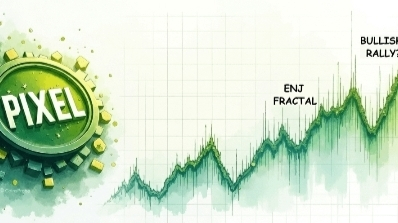
The chartists are at it again. They are drawing lines on a screen, connecting the dots between Pixels and a rally from a bygone era. The narrative is seductive. It suggests that the PIXEL token is mirroring the early bullish fractals of Enjin Coin, implying that a similar parabolic rise is inevitable. I have received the pitch decks. I have sat through the presentations. But after two decades in this industry, I treat such comparisons with the same suspicion I reserve for a banker selling a "sure thing" derivative. The market is looking for a saviour in the pixels of a retro-style game, hoping that history will rhyme. It might. But often, history just stutters.
THE ILLUSION OF THE PATTERN
Let’s be honest about what we are actually looking at here. The comparison to Enjin Coin is not an analysis; it is a marketing crutch. Enjin rose to prominence during a different epoch of crypto, a time when the mere concept of non-fungible tokens was novel enough to drive speculation. To suggest that PIXEL is walking the same path ignores the rotting infrastructure underneath the current market. We are in a high-interest-rate environment where liquidity is a fleeing bird, not a flooding tide. Yet, the speculators see a pattern. They see a consolidation phase that looks like 2020. They see volume spikes that mimic the early days of gaming tokens. It sounds tidy. On paper, at least. But when you peel back the marketing, the glue starts to melt. The reality is that technical fractals are often just coincidences dressed up as analysis. The market structure that supported Enjin’s rise has vanished. The retail frenzy that fuelled those pumps is currently nursing wounds from the last bear market. Believing in a fractal is believing that the market has no memory of its own pain.
THE RETENTION TRAP
The core problem Pixels claims to solve is the "play-to-earn" fatigue, or rather, the transition to "play-and-earn." The industry has been struggling to answer a simple question: why would anyone play a blockchain game if they aren't being paid? Traditional games rely on fun. Crypto games rely on greed. Pixels attempts to bridge this by creating a social farming experience. It sounds promising until you realise the economic foundation is built on digital serfdom. The "bigger problem" they are tackling is user retention in a mercenary ecosystem. In the traditional gaming world, you play because the mechanics are rewarding. In the Web3 world, the mechanics are often a thin veneer for financial extraction. Pixels relies on a loop of planting, watering, and harvesting. It is addictive in the way that checking a savings account is addictive. But once the yield diminishes, as it always does in these systems, the "fun" evaporates. The challenge isn't getting users to sign up; it's preventing them from leaving when the token price flattens.
THE SILENT EXIT OF LIQUIDITY
What most casual observers miss is the distinction between active users and active wallets. In the crypto gaming sector, these two metrics are often conflated to paint a rosy picture. I look at the data and I see people rotating in and out not because they love the game, but because they are chasing the next airdrop or yield farm. The deeper idea behind Pixels was to create a persistent world, a "forever game." However, the reality is a transient population. The "catch" that the marketing team glosses over is the reliance on the Ronin Network. While Ronin solves some gas fee issues, it isolates the ecosystem. It creates a walled garden. If you are not already a degen in the Axie Infinity or Ronin sphere, the friction to enter is surprisingly high for a casual game. The liquidity is circular. It is the same capital rotating from one game to another, wearing a different mask each time.
THE GRIND MECHANIC DISGUISED AS GAMEPLAY
To understand how the system works, you have to look past the art style and see the extraction mechanism. Players manage resources like land and energy. They use PIXEL tokens to speed up processes or acquire cosmetic upgrades. On the surface, this resembles standard free-to-play mechanics. But the undercurrent is different. In a standard game, paying money saves you time. In a crypto game, paying money is an investment that demands a return. The architecture of Pixels forces a decision: grind for hours or pay to compete. This creates a bifurcated player base. You have the speculators hoping to earn, and the gamers hoping to play. These two groups have opposing incentives. The system functions by balancing these competing forces, but the equilibrium is fragile. It relies on a constant influx of new capital to pay out the existing grinders. It is a hot potato simulation wrapped in 16-bit graphics.
THE INFLATIONARY SPIRAL
The economic layer is where my scepticism turns into cynicism. The PIXEL token is the lifeblood of this economy, used for minting, upgrading, and marketplace fees. The theory is that as the game grows, demand for the token will outstrip supply. This is the standard Web3 fairytale. However, the reality is often an inflationary spiral. Games like this are effectively monetary printers. They emit tokens to reward players. If the game is successful, the emission rate increases. If the emission rate increases without a corresponding explosion in new buyers, the price crashes. The token acts as a governance tool and an in-game currency, but it lacks the hard utility that forces long-term holding. Why hold PIXEL if you earn it and immediately sell it to pay rent? The economic model assumes players will reinvest. Most won't. They will exit. The "flywheel" is actually a leaky bucket.
THE SOCIAL FABRIC IS FRAYING
There is one design decision that distinguishes Pixels from the endless clones: its focus on social connectivity and land ownership. This is where the model gets interesting. By forcing players to collaborate, trade, and socialise to advance, the game tries to build a "moat" of community. In theory, this is brilliant. In practice, it is messy. Social bonds are difficult to monetise. When the financial incentive dries up, the social fabric often tears. People do not stay in a Discord server to chat about farming if their digital crops are worthless. The project differentiates itself by trying to be a social platform first. Yet, it falls into the same trap as its predecessors. It confuses engagement with investment. The moment the financial returns dip below the minimum wage, the social graphs dissolve.
THE BRIDGE TO NOWHERE
The hard problem Pixels faces is not technical; it is psychological. The game migrated from Polygon to Ronin to escape high fees and find a gaming-focused audience. This was a massive technical and logistical hurdle. But the real challenge is the "value proposition." How do you convince a player to spend hours clicking buttons when the average return is plummeting? The team has to constantly invent new narrative arcs, new items, and new mechanics to keep the hamster wheel spinning. It is an exhaustion race. The developers are fighting against the inevitable boredom of their player base. They have to outrun the token inflation with new content. In my experience, this is a race that is rarely won. The content creation cadence slows down, the treasury runs dry, and the players drift away to the next shiny object.
THE COLD SHOWER
The success of Pixels will not be decided by a fractal chart or a nostalgic comparison to Enjin. It will be decided by the sustainability of its treasury and the patience of its community. The rally the speculators are praying for requires a surge of external capital that simply does not exist in the current macro environment. We are witnessing a transition from speculative mania to a demand for real utility. A "bullish fractal" is not utility. It is a hope. And hope is a terrible investment thesis. The project might survive, but the token price is a separate beast entirely. It is tethered to forces far beyond the control of the developers or the player base. When the liquidity dries up, the chart will look less like Enjin 2020 and more like a long, slow bleed into irrelevance. That is the history lesson nobody wants to read.