
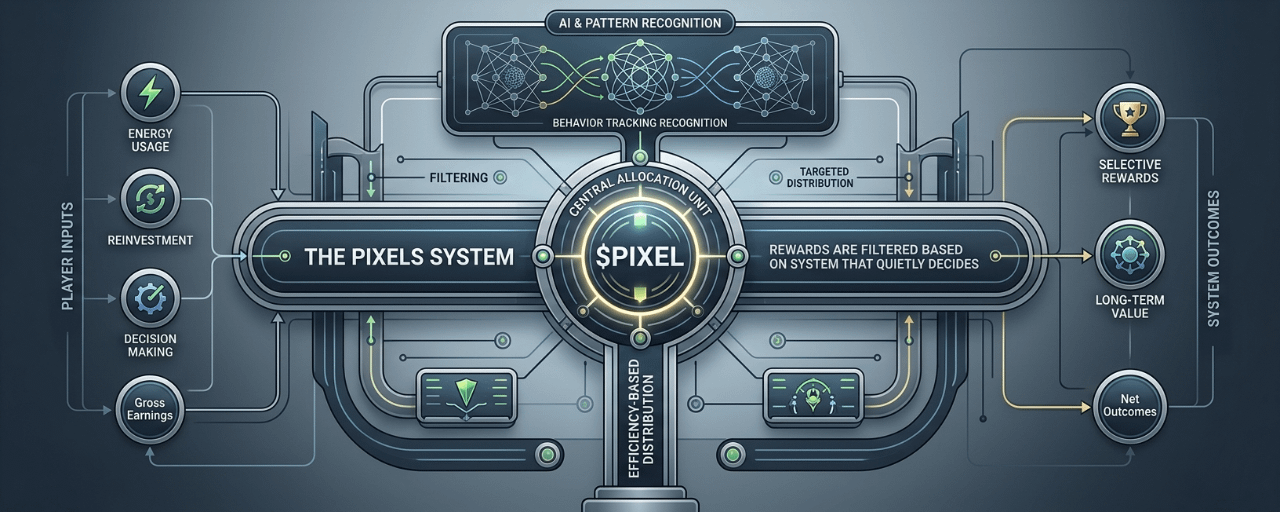
The first thing I noticed was not what the game gives, but what it withholds. Most systems in this space are designed to attract attention quickly by making rewards visible and easy to extract. The more users feel like they are earning, the longer they stay. But that approach creates a predictable problem, because it rewards activity without questioning its quality, and once that gap exists, it is usually bots that exploit it first.
Pixels takes a different direction. It does not try to maximize distribution, it tries to control it. That difference becomes clearer when you look at the energy system. Every action that generates resources or $PIXEL consumes energy, and once that energy runs out, your ability to act stops. On the surface, this looks like a simple pacing mechanic, but in practice it creates pressure on every decision you make inside the game.
When your activity is limited, actions are no longer equal. You start to think about allocation instead of repetition. Some players use energy immediately and follow obvious loops, while others begin to question which actions actually convert into meaningful value. That shift in thinking is where outcomes start to diverge, even if time spent in the game is the same.
The second layer appears when you look at how energy can be extended. Refilling requires resources and often involves $PIXEL, which means increasing your earning capacity is not free. It introduces a loop where players reinvest in order to sustain their activity level. At that point, the system stops being linear. It becomes a structure where gross earnings and net outcomes are not the same, and the difference between the two depends entirely on how efficiently a player operates.
Pixels does not force players to calculate this, but it clearly benefits those who do. That is where the system starts to feel less like a game and more like an environment that filters behavior over time. The longer you stay, the more it rewards decisions rather than effort alone.
This is also where Stacked starts to make more sense. At first, it looks like an expansion layer, but it feels more accurate to describe it as scaling the same reward logic beyond a single ecosystem. If Pixels already filters behavior internally, then Stacked applies that filtering across multiple environments, focusing not on increasing rewards, but on improving how rewards are distributed.
The AI layer becomes relevant here because it allows the system to recognize patterns that are difficult to track manually. It can identify which players contribute to retention, which behaviors signal long term value, and where reward allocation is inefficient. When those signals are clear, rewards stop behaving like emissions and start functioning like targeted distribution.
That shift changes how $PIXEL positioned. Instead of being limited to a single loop, it becomes part of a broader system that connects behavior to value across different layers. Most tokens rely on growth, but a system like this depends more on selectivity and efficiency.
The part I am still watching is whether this level of control can hold as more external systems connect to it. Managing behavior inside one ecosystem is already complex, and expanding that logic introduces new variables. But if it works, then this is not just an improvement in rewards, it is a change in how rewards are designed to function in the first place.