
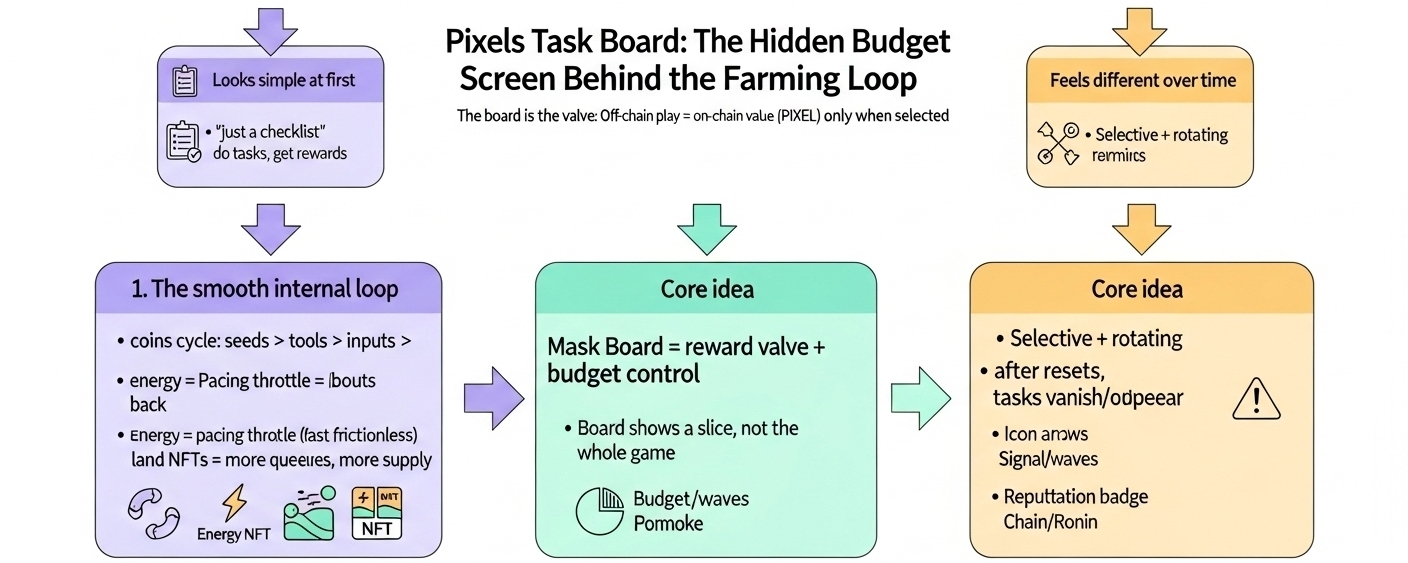


In Pixels, the Task Board starts out looking like a simple checklist, but the longer you play the more it feels like a control panel for the economy.
You can run your farm perfectly—seeds in, crops out, crafting queues humming, coins cycling, energy draining and refilling—and still notice something odd: some items pile up with no purpose, some crafted goods stop getting requested, some routines burn energy for days yet never connect to anything beyond the off-chain coin loop. Nothing is “broken,” it’s just… selective.
That selectiveness becomes obvious after resets. Tasks you relied on yesterday can vanish. New ones appear. A crop or recipe matters for one cycle, then disappears like the system already got what it needed. The board never shows the whole game. It shows a slice, and that slice changes.
Land NFTs sit underneath all of this as the quiet foundation: they give you space and production capacity, letting you scale output and run longer queues. But more land mostly means more supply. And supply alone doesn’t guarantee value, because value only shows up when your activity is routed through the right channel.
Coins and energy make the world feel smooth and constant. Coins circulate inside the system—buying seeds, tools, inputs—then returning back into the same loop. Energy isn’t just stamina, it’s pacing: a throttle that decides how much of the loop you can push in one session, keeping play fast and frictionless.
But the key boundary is this: off-chain play doesn’t become on-chain value unless it’s surfaced through the Task Board. Your inventory and efficiency don’t matter by themselves. The board is the valve between what you do and what actually settles on Ronin. If your activity isn’t selected, it stays trapped in the internal coin cycle no matter how optimized you are.
That’s why tasks start feeling less like “choices” and more like allocations. RORS—Return on Reward Spend—sits under the system, budgeting rewards so payouts aren’t pure outflow like older P2E models. Some actions exist mainly to keep demand alive: seeds in demand, crafting relevant, farms producing, world not stalling—even if they never convert to PIXEL.
Then there’s the layer you can’t click but can feel: Stacked. You start noticing patterns around resets, rotations, and which play styles seem to get better boards. Behavior signals—consistency, timing, who sticks around—seem to influence what gets rewarded next.
Finally, reputation gates the exit. Earning isn’t the same as withdrawing. The system treats participants differently based on quests, assets, and consistency, so two players can do similar work and still face different withdrawal reality.
Over time you stop “playing the farm” and start “reading the board.” Not because someone told you to, but because the game quietly teaches you where value
is allowed to flow.
