
Look, I’ve been around long enough to recognize the pattern, and I felt it again recently logging into Pixels. That subtle shift. Not dramatic. Not loud. Just… quieter.
Web3 gaming isn’t dead. But it’s definitely tired.
I noticed this a few weeks ago when I logged in out of habit, not excitement. I planted crops, waited, harvested, crafted same loop. And for a second, I caught myself thinking, why am I doing this today? That question doesn’t show up during hype cycles. It only appears when the system is exposed.
And Pixels is right there now sitting in that “tired middle.”
Technically, the foundation is still intact. Built on Ronin, it’s designed for low-cost, high-frequency interactions. That matters. The loop is simple by design: farming, crafting, social interaction. No overcomplication. But simplicity cuts both ways. When incentives weaken, simple loops don’t hide flaws they highlight them.
I remember a friend let’s call him Arif who went all in during the peak. He treated Pixels like a second job. Optimized every tile, tracked yields, calculated ROI per crop cycle. At one point, he was making decent returns. It made sense.
Then emissions slowed. Prices dropped. Activity cooled.
I checked in with him recently. He still logs in… but slower. Less urgency. He told me, “Now it feels like work without the salary.”
That stuck with me.
Because that’s the transition phase most Web3 games fail to survive.
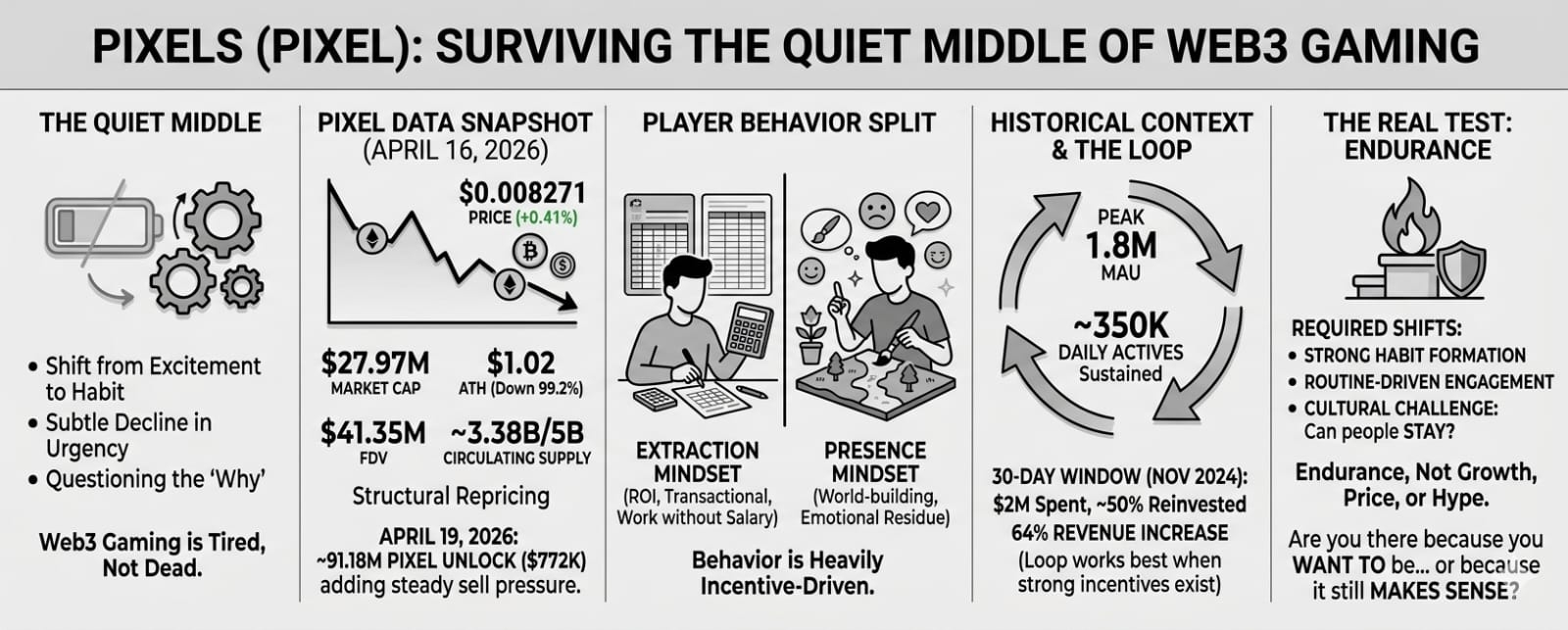
Let’s ground this in actual numbers. As of April 16, 2026, PIXEL is trading around $0.008271, up slightly (+0.41% in 24h). Market cap sits at $27.97M, with a 24h trading volume of $19.24M still relatively liquid, which tells you speculation hasn’t fully left. FDV is higher at $41.35M, reflecting future dilution pressure. Circulating supply is about 3.38B out of 5B total (~67.6%).
That dilution matters more than most people admit.
Back in early 2024, PIXEL hit an ATH of $1.02. Today, it’s down roughly 99.2%. That’s not just “bear market pain.” That’s structural repricing. More tokens unlocked, emissions distributed, hype normalized. The chart isn’t broken it’s adjusted.
And it’s not done adjusting.
There’s another unlock coming on April 19, 2026 around 91.18M PIXEL (~$772K), about 1.82% of total supply. Spread across advisors, ecosystem rewards, private investors, team, treasury. This isn’t catastrophic, but it adds steady sell pressure. And when you stack these over time, they reshape behavior.
Here’s the deeper issue: behavior in Web3 is heavily incentive-driven.
Pixels tried to counter that with “world-building.” You can see it players decorating land, socializing, doing things that don’t maximize returns. That’s what I call emotional residue. It’s a signal that people might actually care.
But it’s inconsistent.
Some players are living in the world. Others are extracting from it.
And once extraction becomes the dominant mindset, it’s hard to reverse. I’ve seen this cycle across multiple projects. When users start thinking in spreadsheets instead of stories, engagement becomes transactional.
I did this myself, honestly. At one point, I tracked my daily yield, compared crafting margins, and optimized energy use. It felt productive. Efficient. But also… empty.
Because efficiency isn’t the same as attachment.
Pixels is trying to balance both. And that’s where the tension lies.
Historically, the game showed strong traction. It peaked around 1.8M MAU in 2024 and reportedly hit 1M DAU in early 2026, with around 350k daily actives sustained. That’s not trivial. Also, in a 30-day window (Nov 2024), players spent about 10.65M PIXEL (~$2M), with ~50% of rewards being reinvested into the game. That loop drove a 64% revenue increase.
That’s a healthy feedback cycle when it works.
But those metrics were during stronger incentive phases. The question now is whether that loop holds under weaker conditions.
Right now, engagement feels… slower.
And in Web3, slow is dangerous.
Without constant inflow, systems have to rely on intrinsic value. No hype, no narrative, no price momentum to carry them. Just the experience. And that’s where many projects quietly fail not with a crash, but with silence.
Pixels hasn’t reached silence. But it’s closer than people admit.
The farming loop still functions. The economy still circulates. But the “why” behind daily activity is weakening. And when players start asking that question consistently, retention becomes fragile.
So what actually needs to happen?
From what I’ve seen, Pixels doesn’t need more complexity it needs stronger habit formation. Not reward-driven habit, but routine-driven engagement. The kind where logging in feels natural even without immediate payoff.
That’s hard.
Because it requires shifting player psychology from extraction to presence.
And that’s not something tokenomics alone can fix.
There are some recent efforts adjusting reward structures, improving in-game sinks, refining pacing. These are necessary, but not sufficient. The deeper challenge is cultural: can Pixels become a place people stay, not just pass through?
Right now, it’s both. And that’s unstable.
If rewards spike again, activity will return. That part is predictable. But if the goal is long-term survival, Pixels has to prove it can hold attention without constant incentives.
That’s the real test.
Not growth. Not price. Not hype.
Endurance.
I’ve seen projects survive worse conditions but only when players genuinely cared. Even a little. Even inconsistently.
So I’m still watching Pixels. Not because it’s perfect, but because it hasn’t faded yet. And in this space, persistence itself is data.
But I don’t assume it’ll make it.
Because most don’t.
So let me ask you when you log into Pixels now, are you there because you want to be… or because it still makes sense?
And if that answer changes, how long do you think the system holds?

#BitcoinPriceTrends #CZ’sBinanceSquareAMA #CantorFitzgeraldDonates$10MilliontoCryptoPAC #GoldmanSachsFilesforBitcoinIncomeETF