@Pixels #pixel $PIXEL I’ve spent enough time watching crypto systems evolve to recognize when a product is trying to manufacture engagement versus when it’s quietly aligning itself with how people already behave. Pixels sits in that second category, but not in an obvious way. On the surface, it looks like a harmless farming game wrapped in Web3 rails. Underneath, it feels more like an experiment in how far low-friction activity can carry a tokenized system before capital starts demanding more from it.
What stands out to me isn’t the theme or even the gameplay loop. It’s the restraint. Most crypto projects I’ve studied over the years front-load intensity. They rely on urgency, emissions, or narrative spikes to create the illusion of traction. Pixels does something different. It stretches time. The loop is deliberately repetitive, almost uneventful, and that’s not accidental. It’s a recognition that most users don’t want to think too hard about what they’re doing. They want something they can return to without cognitive overhead.
That design choice immediately shapes the kind of capital that flows into the system. Fast capital, the kind that rotates aggressively through narratives, doesn’t find much to hold onto here. There are no obvious catalysts baked into the day-to-day experience. What replaces that is slower, more passive participation. Not necessarily long-term conviction, but a form of low-attention capital that mirrors the behavior of the players themselves. People log in, perform a few actions, log out. The capital behaves the same way—present, but not deeply engaged.
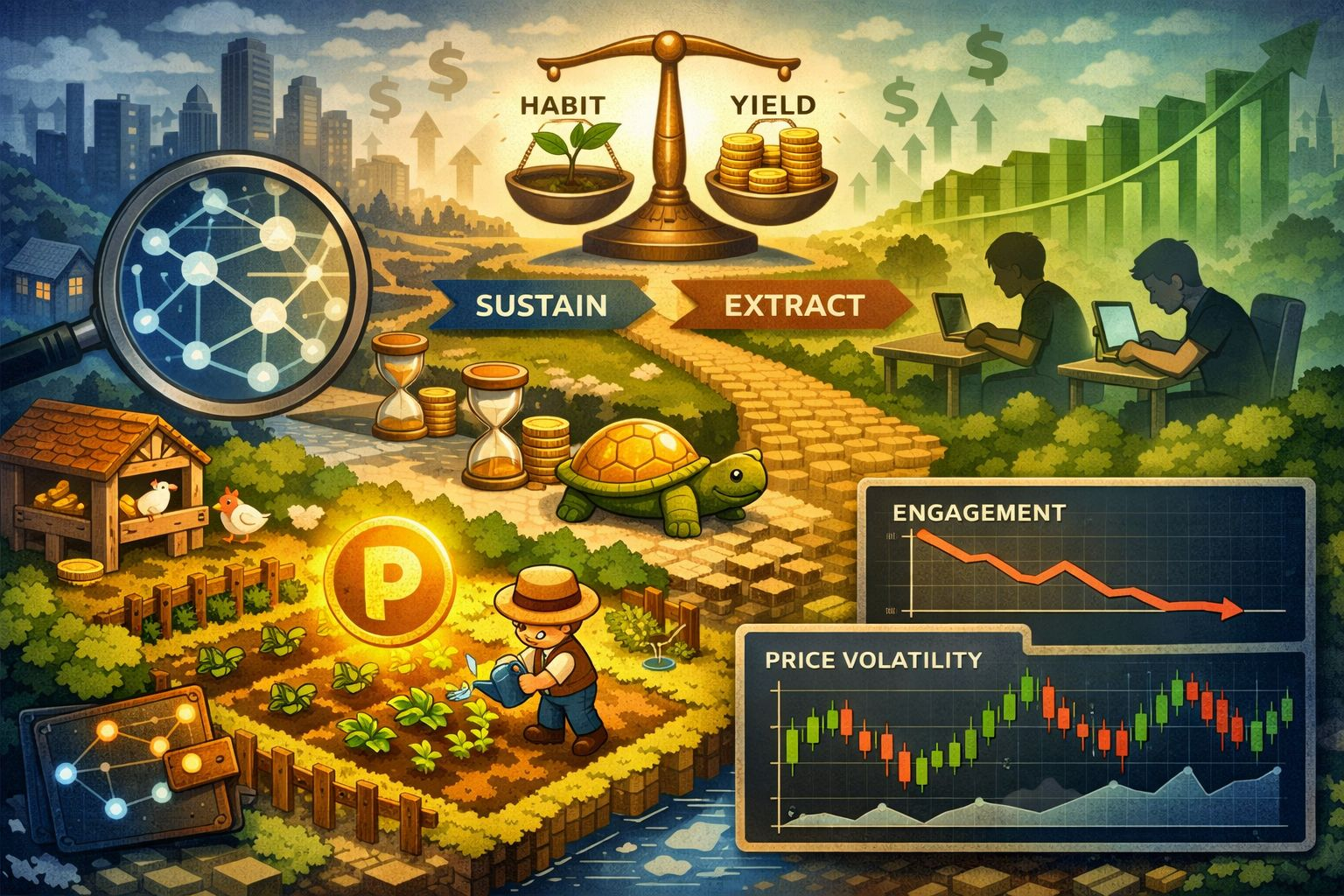
The interesting tension is how that interacts with token dynamics. A system built on routine rather than intensity has to be extremely careful with how it introduces rewards. If incentives are too strong, the loop breaks. It stops being casual and starts attracting extractive behavior. If they’re too weak, participation drifts. Pixels seems aware of this balance, but it doesn’t fully escape it. You can already see hints of this in how users optimize their time. Even in a relaxed environment, optimization creeps in. It always does.
From a market perspective, that’s where things become more revealing. I tend to look less at price charts in isolation and more at how they correlate with usage patterns. In systems like this, price volatility often isn’t driven by external narratives as much as internal saturation. When too many users begin treating the system as a source of yield, even indirectly, the pressure builds quietly. It doesn’t show up as a sudden collapse. It shows up as a gradual thinning of engagement quality.
You’d likely see this in on-chain data before anywhere else. Wallet activity might remain stable, even grow, but the depth of interaction per user flattens. Session times shorten. Actions become more mechanical. The system continues to function, but it starts losing its original texture. That’s the point where a casual loop risks becoming a disguised extraction layer, even if that was never the intention.
What I find more honest about Pixels is that it doesn’t aggressively fight this transformation. Many projects over-engineer solutions to “fix” user behavior, usually by adding complexity or gating mechanisms. Pixels leans in the opposite direction. It keeps things simple, even when that simplicity exposes it to inefficiencies. That tells me the priority isn’t maximizing short-term retention metrics, but preserving a certain kind of user experience, even if it comes at the cost of tighter economic control.
There’s also something subtle happening in how progression is structured. It’s not built around moments of achievement as much as continuity. You don’t play to win something definitive. You play to keep going. That might sound trivial, but it has real implications for how value is perceived. In most tokenized systems, value is tied to milestones—unlocking, earning, upgrading. Here, value is more diffuse. It’s embedded in the act of staying within the loop.
That creates a different kind of risk. When value is tied to continuity, any disruption to that continuity—whether from market conditions, technical issues, or shifting user attention—has an outsized impact. There’s no strong anchor to pull users back in. No major milestone they feel compelled to reach. Retention becomes a function of habit rather than ambition, and habits are fragile when external conditions change.
I’ve seen similar patterns in previous cycles, though not always in gaming contexts. Systems that rely on passive engagement tend to look stable until they aren’t. The shift isn’t dramatic. It’s subtle. Fewer users return each day. Liquidity becomes slightly thinner. Spreads widen just enough to be noticeable. Nothing breaks, but everything feels a bit less alive. It’s the kind of decay that doesn’t trigger headlines but shows up clearly if you’ve been watching closely.
At the same time, there’s a resilience in this model that shouldn’t be ignored. Because the system doesn’t rely on high-intensity engagement, it’s less exposed to the boom-and-bust cycles driven by hype. It doesn’t need constant narrative reinforcement to survive. In a market where attention is increasingly fragmented, that’s not a trivial advantage. It means Pixels can exist in the background, continuing to function even when it’s not the center of conversation.
The trade-off is that it may never fully capture the kind of capital that drives explosive growth. And that might be intentional. Not every system needs to scale aggressively to be meaningful. Some operate better as steady-state environments, where the goal isn’t expansion but persistence. The question is whether the underlying token structure can support that kind of equilibrium over time.
If I were looking at this purely through a market lens, I’d pay close attention to how new users enter the system versus how existing users behave. Growth alone doesn’t tell you much. What matters is whether new entrants adopt the same low-intensity patterns or whether they approach the system with a more extractive mindset. That difference shapes everything downstream, from liquidity flows to price stability.
What keeps me interested in Pixels isn’t whether it succeeds or fails in the conventional sense. It’s what it reveals about the limits of designing for “real” behavior in a financialized environment. There’s a tension that never fully resolves. The more accurately you model how people behave, the harder it becomes to sustain strong economic incentives without distorting that behavior.
Most projects try to solve this by leaning harder into incentives. Pixels seems to accept it as a constraint. It doesn’t try to turn every user into a power participant. It allows for disengagement, for partial attention, for inconsistency. That makes it feel less efficient, but also more aligned with reality.
The way I think about it now is less as a game or even a product, and more as a pacing mechanism inside crypto. It slows things down. It absorbs attention without demanding it. In a market that constantly pushes for acceleration, that’s an unusual role. And it suggests that the real question isn’t whether Pixels can scale in the way other projects try to, but whether systems like this quietly redefine what sustainability looks like when constant growth is no longer the default expectation.