
Pixels, usually written as **PIXEL**, is one of those Web3 games that sounds simple on paper and much messier in practice. It lives on the **Ronin Network**, the gaming chain that rose to prominence after Axie Infinity turned Ronin from a side project into a serious piece of blockchain gaming infrastructure. That matters, because Pixels didn’t launch into a vacuum. It arrived in a market already burned by speculation, token churn, and a long list of “play-to-earn” experiments that promised more than they delivered.
The pitch for Pixels is straightforward enough: a social casual open-world game built around **farming, exploration, and creation**. No heavy combat loop. No complicated raids. No need to memorize a thousand abilities before you can plant a seed. You make a character, move around, work the land, gather resources, build things, and interact with other players. That simplicity is part of the appeal. It’s also part of the risk. Casual games can survive on charm, routine, and community. They can also die quietly when the grind stops feeling worth it.
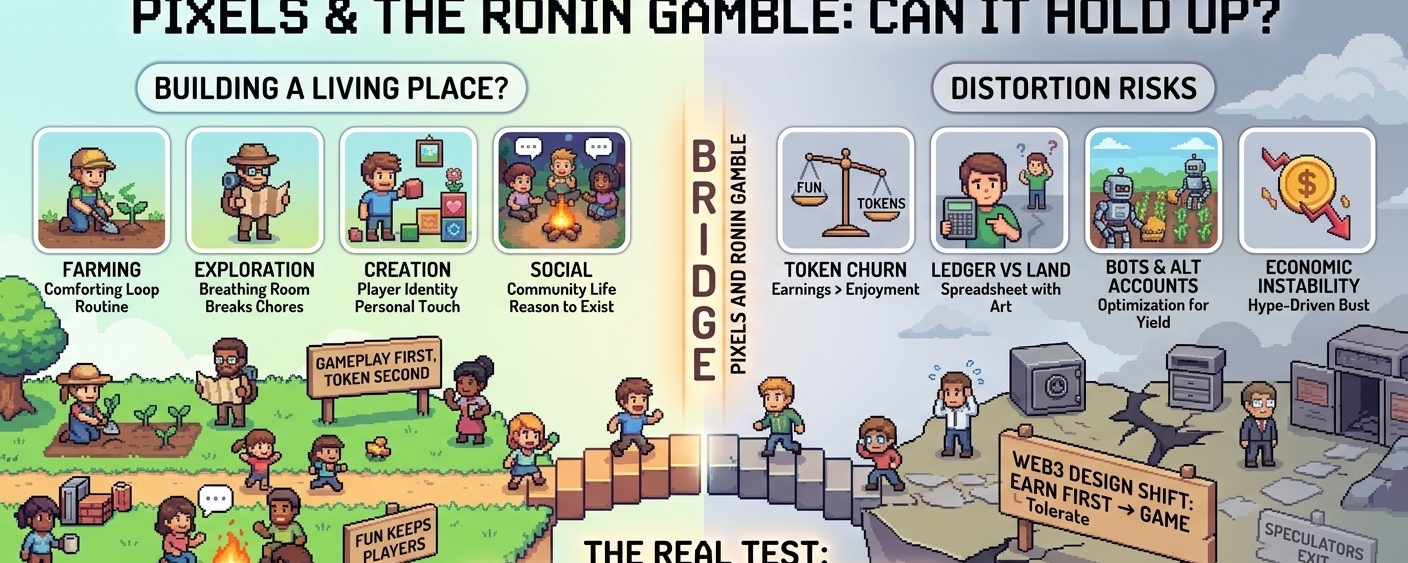
Here’s the thing: Pixels did not become interesting because it invented a new genre. It became interesting because it tried to make a Web3 game feel less like a spreadsheet with art and more like an actual online world. That distinction is huge. For years, blockchain games leaned too hard on token rewards and too little on playability. Players weren’t there for the game. They were there for the exit. Pixels, at least in its better moments, seems to understand that if the game isn’t fun without the token, the token won’t save it.
The project’s background sits inside the broader history of Web3 gaming, and you can’t really talk about Pixels without talking about the boom-and-bust cycle that shaped the whole sector. The first wave of blockchain games sold ownership and earning as if that alone were a genre. Then came the reality check. Most users didn’t want a second job disguised as entertainment. When token prices fell, so did retention. A lot of games collapsed under the weight of their own economics. Pixels entered a market that had already learned, painfully, that “players are users” is not the same thing as “users are players.”
Ronin’s role in this is not cosmetic. The chain was built for game-scale activity, low-fee transactions, and a smoother user experience than general-purpose networks typically provide. That’s the practical part. The symbolic part is just as important. Ronin gives Pixels access to a community that already understands wallets, assets, and on-chain gaming without needing a full blockchain education before the first quest. That lowers friction. And friction is where most crypto games die. People won’t tolerate clunky onboarding forever, not even if the token chart looks exciting for ten minutes.
Pixels itself grew out of a long development arc rather than a sudden viral moment. Early versions were simpler, and like many browser-style farming games, the mechanics leaned on routine and social repetition. Over time, the game expanded its systems, its world, and its player economy. That’s when things got more complicated. Once you add ownership, rewards, and tradable assets, every farming action stops being just a farming action. It becomes a decision with monetary implications. That can attract committed players. It can also distort behavior. People start optimizing for yield instead of enjoyment. Then the world gets full of bots, alt accounts, and people who care more about the ledger than the land.
Current updates around Pixels have generally focused on expanding gameplay depth, tightening progression, and stabilizing the in-game economy. That’s the real work, the boring work, the stuff that usually gets skipped in the announcement thread because it doesn’t make for flashy screenshots. A social casual game only works if there’s enough to do over time. Farming needs to connect to crafting. Crafting needs to connect to exploration. Exploration needs to reveal something worth seeing. Creation needs to feel personal, not just transactional. If one of those pillars is weak, the whole thing starts to wobble.
The game’s current state also reflects a broader shift in Web3 design. The old obsession with “earn first, game later” has given way to a more cautious model: make the game tolerable, then layer in ownership. That’s not a fix-all. But it’s closer to reality. Pixels appears to be one of the projects trying to live in that middle ground. It wants blockchain utility without letting blockchain become the whole story. That sounds sensible. It also sounds harder than people think. Every on-chain system introduces extra complexity, and complexity is expensive, not just in development time but in player patience.
There’s also the matter of the economy. Web3 games always run into this wall eventually. If rewards are too generous, inflation eats the system. If rewards are too stingy, players leave. If asset scarcity is too artificial, the market feels manipulative. If it’s too open, value collapses. Pixels has to balance all of that while keeping a casual audience engaged. That’s a nasty balancing act. The casual player doesn’t want to study tokenomics. The serious player absolutely will. And the speculator? They’ll leave as soon as the chart stops moving.
Historically, farming games have always worked because they’re repetitive in a comforting way. The loop is the point. Harvest, upgrade, expand, decorate, repeat. That formula has legs because it gives players a sense of progress without demanding constant adrenaline. Pixels borrows from that tradition, then adds social layering and blockchain ownership on top. The result can be pleasant. It can also feel strangely heavy for a genre that’s supposed to be light. The best casual games disappear into the background of your day. The worst ones ask too much and reward too little.
The open-world angle is where Pixels tries to stretch beyond a standard farm sim. Exploration gives the game breathing room. It prevents the whole experience from becoming a loop of chores. Creation gives players identity. Social mechanics give the world a reason to exist after the novelty fades. Without those, the game would be just another economic machine in a cute outfit. With them, it has a chance to become a living place. Chance, not guarantee. That word matters.
From an industry perspective, Pixels is also part of a much larger test: can Web3 games retain users once the incentive layer becomes less attractive? That question has no clean answer yet. Most blockchain games still struggle with long-term retention because the audience is split between players and market participants. Some want fun. Some want yield. Those aren’t always compatible. Pixels is interesting because it seems to understand this tension better than many of its peers. But understanding a problem doesn’t mean solving it.
The competitive field is crowded, even if many of the names come and go faster than anyone wants to admit. Traditional farming and life-sim games have the advantage of polish, familiarity, and years of live-service experience. Meanwhile, other Web3 titles are chasing the same promise of social ownership, composable assets, and player-driven economies. Pixels needs to stand out on actual gameplay, not just on-chain architecture. That’s the standard now. The market has grown tired of technical novelty dressed up as design.
There’s a historical irony here. Blockchain gaming once sold itself as a revolution against centralized game economies. But a lot of the early implementations ended up feeling more centralized than the games they were trying to replace, just with tokens attached. Pixels has an opportunity to avoid that trap by keeping the game first and the chain second. Still, that’s easier said than done. Once a token is part of the loop, every design choice gets dragged into economic analysis. Even the fun stuff starts wearing a price tag.
Looking ahead, the future for Pixels depends on a few things. First, whether the game can keep improving the core loop without bloating it. Casual players don’t want a manual. Second, whether the Ronin ecosystem continues to attract enough active users and builders to keep the environment lively. A game can’t thrive in a dead neighborhood. Third, whether the team can keep the economy stable through market cycles that have very little patience for long-term design. That last one is the killer. Crypto doesn’t care about your roadmap. It cares about liquidity, sentiment, and momentum, and all three can turn on a dime.
My prediction? Pixels has a better shot than most Web3 games that launched on pure speculation, because it’s anchored in recognizable game structure rather than abstract token mechanics. But that doesn’t make it safe. It means the project has a real foundation to work with. Big difference. If the developers keep tightening the game, improving onboarding, and resisting the temptation to overcomplicate the economy, Pixels could remain relevant as a niche but durable social game. If they chase growth through rewards alone, it’ll end up in the same graveyard as a hundred other crypto titles nobody talks about anymore.
The current update story is less dramatic than the marketing wants it to be, and that’s probably a good thing. Real game development is mostly iteration, balancing, bug fixes, and ugly trade-offs. Not every update needs fireworks. In fact, the best ones usually don’t. For Pixels, the question isn’t whether it can generate headlines. It already can. The real question is whether it can keep people playing after the headlines fade.
And that’s where the project gets tested for real. Not in the announcement thread. Not in the token chart. In the daily routine. In the small decisions. In whether a player logs back in because they want to, not because they need to extract value before someone else does.