
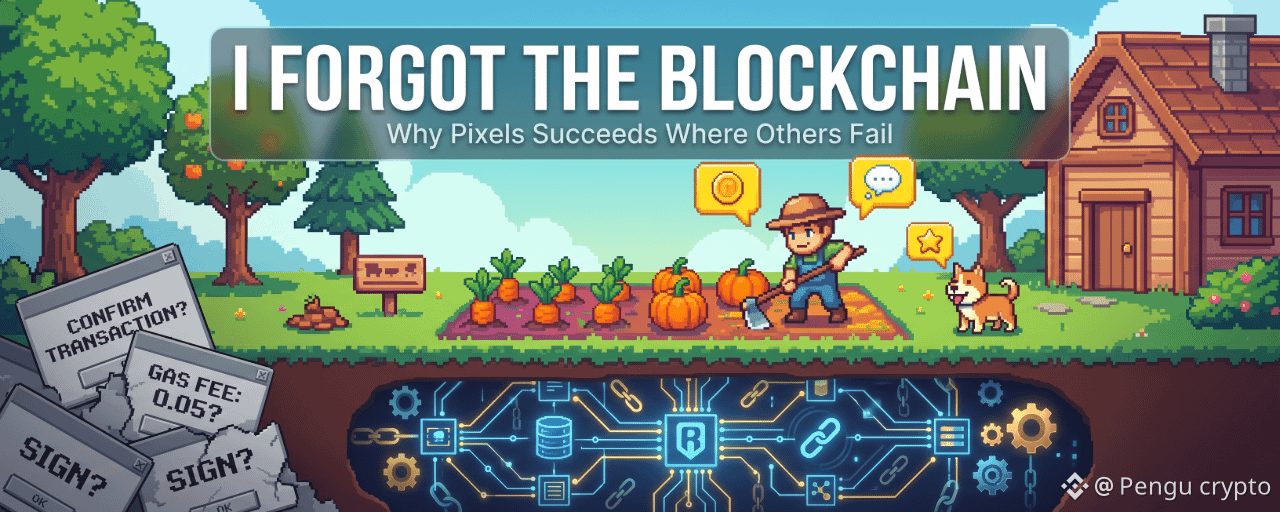
Most Web3 games remind you constantly that you're using blockchain. Every action has a confirmation. Every transaction has a fee. Every five minutes something is asking you to sign something, approve something, wait for something. You never forget where you are.
I forgot where I was about ten minutes into Pixels.
That sounds like a small thing but honestly it's not. I've been in this space long enough to know how rare that feeling is. Usually the tech is right there in your face, almost proud of itself. Look, it's decentralized. Look, you own this. Look, here's another wallet prompt. It becomes noise after a while, but it's always there.
Pixels doesn't do that. You plant something, you walk somewhere, you talk to someone, and the blockchain is just... running quietly underneath all of it. You don't feel it. You don't think about it. It's infrastructure the same way you don't think about the server when you're loading a webpage.
And the more I sat with that, the more I realized this is actually the hardest thing to build.
Anyone can make a Web3 game that shows you the blockchain. That's easy. Slap a wallet connection on the login screen, show token balances everywhere, make every craft or trade a visible on-chain event. Done. Most teams stop there because it checks the box of being "truly decentralized" or whatever the pitch is that week.
But hiding complexity without removing the value underneath it? That takes real engineering and even more restraint. Because the temptation is always to show your work. To prove the tech is real. Pixels resists that temptation almost completely.
The Ronin Network plays a big role here. Transactions are fast and cheap enough that you don't experience them as friction. There's no moment where the game stops and the blockchain starts. It's one continuous thing. That's not an accident, it's a deliberate infrastructure choice that most projects either can't afford or don't prioritize.
But here's where it gets interesting for me.
The invisibility of the tech is also what makes the economy work differently. When you're not constantly reminded that everything has a price, you stop calculating everything. You stop thinking "is this worth a transaction fee" before every small action. You just act. And when people act naturally inside a system instead of calculating their way through it, behavior changes. Retention changes. The whole feel of the ecosystem changes.
This is actually what Stacked is built around too. The idea that rewards should feel natural, not mechanical. That the right reward at the right moment doesn't feel like a reward at all, it just feels like the game working the way it should. When you separate the reward design from the visible blockchain layer, you get something that feels human instead of something that feels like a system optimizing you.
Most Web3 games got this backwards from the start. They led with the economy and hoped gameplay would follow. Pixels buried the economy inside the experience and let people find it on their own terms.
I don't think that's a coincidence. I think it's the whole thesis.
Because the games that last aren't the ones with the best tokenomics on a whitepaper. They're the ones where people forget they're supposed to be extracting value and just start living inside the world. Once that happens, the economy takes care of itself. The $PIXEL utility is real, the Stacked infrastructure runs underneath it all, and the blockchain is there doing exactly what it's supposed to do.
You just never have to think about it.
And maybe that's the whole point.
