
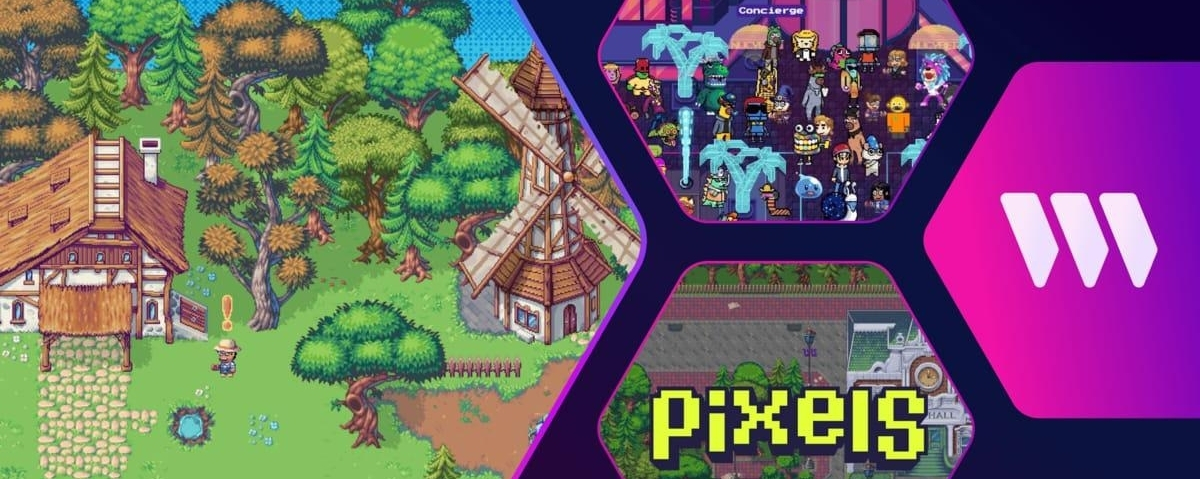
Not all projects catch your eye immediately, some require some excavation before they begin to sink in. And that was my experience with @Pixels Pixels. I did not jump into it due to hype or price action. Rather, it was introduced as I was examining GameFi ecosystems that do retain users in the long term. And when I began to take a closer look, $PIXEL started to shine in a manner that most of the projects do not.
In its essence, Pixels does not simply attempt to be a play-to-earn game. It is creating what appears to be a stacked ecosystem, with various layers of the gameplay, resources, staking, and progression being interlinked. This is important since in the majority of GameFi projects, these aspects are independent. Players get tokens, sell them and go. However, in this case, $PIXEL is built in such a way that it does not push users out of the ecosystem.
The first thing that I saw was how natural the earning and reinvestment loop is. Rather than getting rewarded through farming and leaving, players are motivated to invest their pixel in upgrading assets, enhancing efficiency, and establishing a stronger foothold in the game. The mere change in design transforms behavior. It transforms short term players to long term players.
Another aspect in which pixels excels is the staking aspect. Staking is out of place in most ecosystems - it literally seems like an external DeFi tool that has been introduced to bring in liquidity. but here staking is a component of the system. It favors advancement, harmonizes incentives and fosters a sense of ownership. You would not feel that you are locking money when you stake PIXEL, but you are contributing to your development in the ecosystem.
What is even more interesting is the way in which the stacked nature of the ecosystem further develops. It’s not static. The role of pixel is increased as additional features, assets, and mechanics are added. This will provide a dynamic environment in which the early participants will be able to evolve and develop with the platform. You cannot say that about GameFi, where numerous projects do not last long and become stagnant.
In a bigger picture, it appears that the idea of retention is what the pixel has figured out: retention is more than hype. Any incentives can be used to attract users, but to retain them a well-designed system is necessary. The depth of the gameplay, the utility of tokens, and the staking integration make pixel more than a token reward - it becomes part of the experience.
The accessibility of the ecosystem is another factor that should be taken into consideration. You do not have to be a high level trader or highly technical to know the basics. You can enter, play, and earn PIXEL and slowly figure out how to maximize your strategy. The fact that it is very accessible contributes to adoption massively, as Web3 gaming grows to reach more people.
The more I analyzed the project of Pixels, the more I understood that the project is not seeking a short-term focus, but long-term. The economy is designed in such a manner that it promotes circulation rather than extraction. Those who remain active are not only rewarded in the form of tokens, but also in terms of progress and impact within the ecosystem.
Naturally, risks are inevitable in any project, and it remains early in many aspects. But the groundwork here being laid is different. The fact that players, token utility, and ecosystem growth align provides $PIXEL with a better foundation than most competitors in the space.
To me, the best part about Pixels is that it is not loud, but rather quietly tackling some of the largest issues in the GameFi. The further I read about it, the greater it seems to be a long-term project and not a short-term hype. And in the present market that is the type of ecosystem to keep a close eye on. #pixel