

I have seen too many crypto projects promise transformation and then deliver something people visit once, maybe twice, and quietly forget. After enough time in this market, that pattern becomes hard to ignore. The gap between a strong story and a durable product starts to feel painfully obvious. That is the place I am coming from when I look at Pixels.
I am not really interested in hype anymore. I am more interested in behavior.
Do people come back when nobody is forcing the narrative? Do they build habits around the product? Do they stay because the experience actually gives them something, or because the incentives are still doing most of the lifting? That is the real question for me. And with Pixels, that question matters even more because it sits right at the intersection of two audiences that usually want very different things.
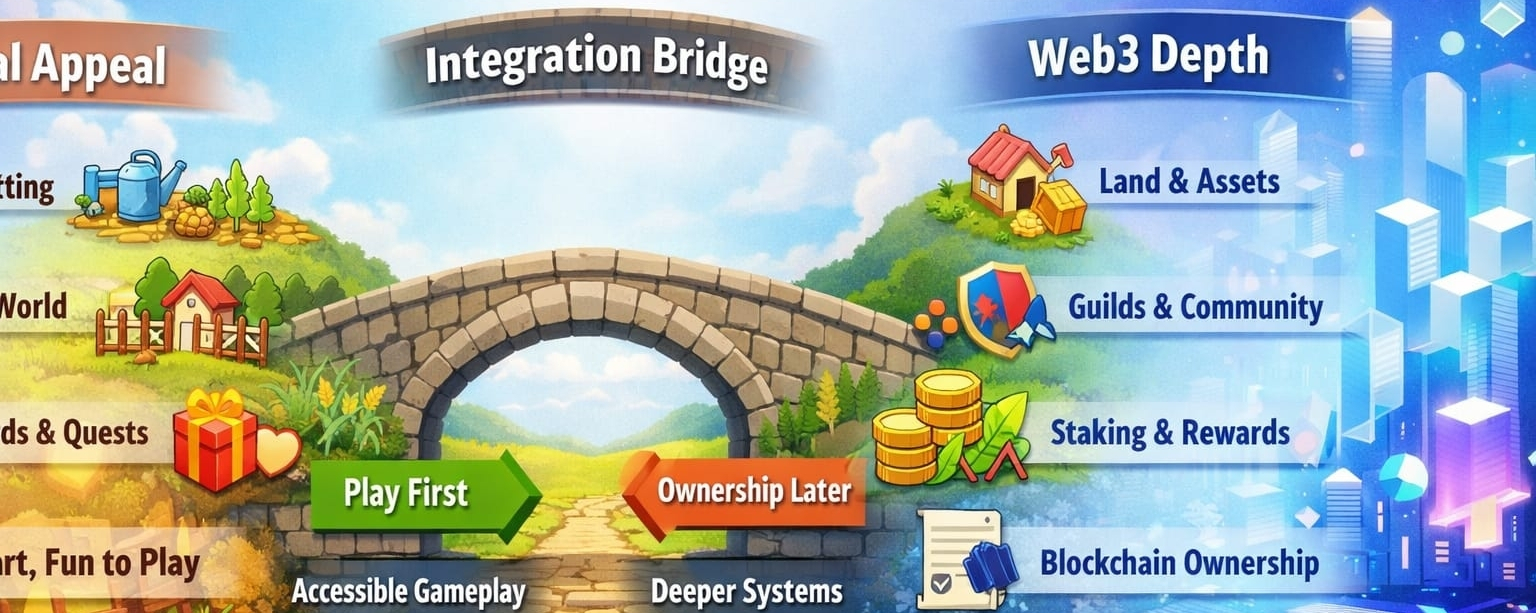
What makes Pixels interesting is that it does not immediately feel like a crypto project trying too hard to announce itself as one. That is one of the first things I noticed. On the surface, it feels familiar. Farming, collecting, exploring, upgrading, decorating, checking in on progress, moving through a world that is soft and social and easy to understand. That matters because Web2 casual gamers are not usually looking for token mechanics. They are looking for comfort, rhythm, and something they can slip into without having to decode an economic system first.
Pixels seems to understand that.
The experience is simple in a way that works in its favor. You do not need a lecture before you begin. You do not need to believe in on-chain ownership to understand why tending a farm, building up your space, and returning to complete little loops can feel satisfying. That kind of design matters more than people admit. Casual players tend to come back for recognizable patterns. Small progress. Repetition that feels rewarding instead of exhausting. A world that asks for attention but not too much of it.
That is part of why Pixels can appeal to Web2 users. It does not open with complexity. It opens with familiarity.
And honestly, that is smarter than what most Web3 games did.
A lot of crypto games tried to force users to care about the blockchain before they cared about the game. That never made much sense to me. People do not emotionally attach to infrastructure. They attach to experiences. They attach to rhythm, identity, social presence, and routine. Pixels feels more aware of that. It lets the first layer be light. Play first. Understand later. That is a much healthier sequence.
But then there is the other side of it.
Web3-native users are usually not satisfied with surface-level comfort alone. They want more than a pleasant loop. They want ownership to matter. They want participation to carry some weight. They want systems they can position themselves inside, not just interfaces they can click through. And this is where Pixels becomes more than a casual farming game.
What I keep noticing is that the project has built a second layer underneath the soft visuals. Land ownership. Resource dynamics. guild structures. Token utility. Staking. Shared production. Player roles that extend beyond just showing up and planting something. That deeper structure is what gives Web3 users a reason to take it seriously. They are not only looking at whether the game is cute or accessible. They are asking whether the system actually gives them a stake in something persistent.
That part matters.
Because if the blockchain layer is only there to decorate the narrative, people eventually feel it. They can tell when “ownership” is just branding. They can tell when the token is louder than the product. They can tell when the chain adds complexity without adding trust, continuity, or real participation. So the part I pay attention to is whether Pixels uses blockchain as structure or as theater.
I think the answer is mixed, but not empty.
At its best, the blockchain side of Pixels gives shape to the world. Land is not just a cosmetic badge. It affects how players participate. It changes access, opportunity, and social coordination. Guilds are not just chat rooms with a logo. They create a more organized layer of collective behavior. Ownership, when it is tied to actual in-game function, starts to feel less like a speculative prop and more like a rule set that players can build around.
That is where Pixels is stronger than a lot of its peers.
It is not simply saying, “Here is an NFT, now call this innovation.” It is at least trying to connect digital ownership with recurring behavior. And that is the right direction. If ownership does not affect how a world is lived in, then it is mostly decorative. Pixels seems to understand that it has to do more than that.
Still, this is where my skepticism stays active.
Because there is another question underneath all of this. Are people returning because the world itself is becoming part of their routine, or are they returning because the reward architecture is still carrying too much of the emotional weight? Those are not the same thing. A game can look healthy on the surface and still be dependent on incentives underneath. It can look active while the reasons for that activity remain fragile.
That is what makes crypto gaming so difficult to judge honestly.
In Pixels, I can see the strength of the product loop. There is a very clear rhythm to it. You check in, perform tasks, gather resources, make progress, interact, optimize, return. The loop is easy to understand and easy to repeat. For casual users, that is powerful because habit usually forms around clarity. Confused experiences do not create retention. Familiar ones do.
But familiar loops also have limits.
If the loop becomes too mechanical, then the player may stay active without becoming truly attached. They may continue participating while never really crossing into emotional ownership. That distinction matters to me more than most metrics do. Activity alone is not enough. Even retention, in a raw sense, is not enough. I want to know what kind of retention it is. Is it loyalty, routine, curiosity, status, social belonging, or just efficient farming behavior under a reward system that still feels worth exploiting?
That is where I slow down.
Because Pixels clearly knows how to design repeat behavior. I do not think that is in doubt. What is less clear is how much of that behavior comes from genuine attachment to the world itself. The world has charm. It has familiarity. It has social softness. It has enough moving parts to keep people checking back in. But charm and structure are not automatically the same as permanence.
And permanence is what I care about now.
I have been around this market long enough to know that a clean narrative can survive for months. Sometimes longer. But if people are not really living inside the product, if they are not building identity around it, if they are not trusting the system enough to remain even when sentiment cools, then eventually the weakness shows up.
That is why Pixels is more interesting to me as a behavioral case than as a pure gaming headline.
It is trying to do something difficult. It is trying to be inviting enough for Web2 users without alienating them with crypto language. At the same time, it is trying to be deep enough for Web3-native users who want more than just a polished casual game. Most projects fail at one side or the other. They either become too abstract for normal players or too shallow for crypto-native users who expect systems, scarcity, and meaningful participation.
Pixels, at least from where I stand, has done a better job than most at balancing those two entry points.
A casual gamer can enter because the world feels simple, warm, and legible. A Web3-native user can stay interested because there is a deeper framework under the surface. That dual appeal is not accidental. It comes from sequencing the experience well. You do not have to care about the chain immediately. You can begin with the habit loop. Then, if the product holds your attention long enough, the ownership layer starts to matter more.
That is smart.
But I still think the long-term test is unforgiving.
If the broader market cools down, if token excitement fades, if the reward conversation gets quieter, does Pixels still feel like a place people want to return to because it has become part of their routine in a real sense? Does it still feel alive when stripped of some speculative energy? That is the standard I keep coming back to. Not because I want to be harsh, but because I have seen too many projects look durable while the incentives were loud and then lose their shape the moment sentiment changed.
What makes me pause is that Pixels still sits close enough to that line that I cannot ignore it. The strengths are real. The design is thoughtful. The accessibility is real. The ownership layer is more meaningful than the empty blockchain wrappers I have seen in countless other projects. The social and habitual structure are there. But I am not fully convinced the emotional bond has become stronger than the economic pull.
Maybe it will. Maybe that is exactly what this project is still growing into.
And that is why I take it seriously.
Not because I think it is perfect. Not because I think every part of the system is already proven. But because there is at least something real underneath the branding. There is an actual attempt to build a product that different kinds of users can enter for different reasons without immediately breaking the experience. That alone separates it from most of the market.
So when I ask myself whether Pixels deserves real attention, my answer is yes.
Not blind attention. Not narrative-driven attention. Real attention.
Because what makes Pixels appealing to both Web2 casual gamers and Web3-native users at the same time is not just aesthetics, rewards, or branding. It is the way the project layers comfort on top of structure. It gives one audience a familiar world they can ease into, and it gives the other a system they can read more deeply. That balance is rare. And even if I still carry skepticism around how much of the retention is truly organic, I can at least say this much with confidence: Pixels feels closer to a lived product than a clean crypto story, and that distinction matters more than ever now.
