
I've been thinking a lot about a game for the past few days, wondering why... why do most play-to-earn games initially peak in popularity... and then slowly fade away, even when the mechanic seem right on paper?
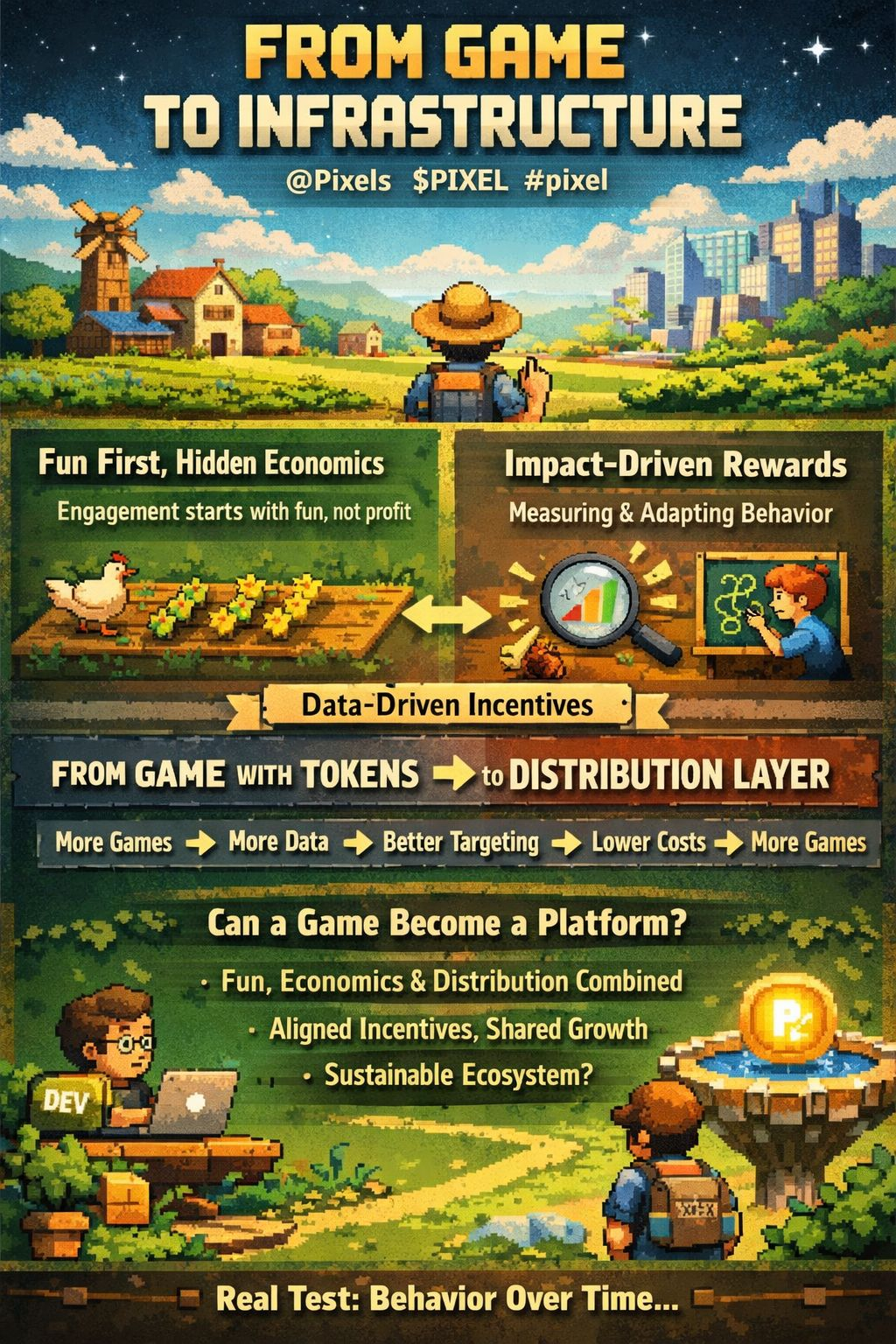
I used to think... it was just bad design or insufficient funding. But more I look at systems like Pixels, the more it seems like the real problem actualy lies deepers - a lack of consistency. Not between the tokens and the players but between what system rewards and what actually creates long-term value. seems to be built to fill that gap, but not in any obvious way. At first glance, it still feels like a farming game. Simple loops, familiar action, nothing revolutionary on surface. But underneath, a different kind of structure is building - one that feels closer to infrastructure than just gameplay. Fun first - idea sounds simple, almost expected, but I think it's doing something subtle. It’s not rejecting economics, it’s just hiding it in a way that prevents engagment from starting with profit. Because once profit becomes primary gateway, everything else becomes secondary. Then comes the rewards system. This part is pretty interesting, and honestly, a little unsettling if you think about it too long. Instead of rewarding activity, it’s trying to mesure impact. That sounds great in theory, but it means system is constantly learning, adapting and filtering itself. Much like ad network but instead of targeting users with content, it’s targeting their behavior with incentives. So rewards are no longer just outputs - they’re signals. And these signals are what influence behavior over time. Which begs the silent question — who’s adapting faster here, player or system?
To be honest… Publishing Flywheel adds another layer to this. More games → more data → better targeting → lower acquisition costs → more games. On paper, it’s perfect. Almost over-perfect — all at once awesome. But if it works, it will completely change the role of Pixel. It will stop being a “game with tokens” and become a distribution layer, where games are connect to existing economy and user base. This is not a small change. It is closer to infrastructure. And I think this is where it becomes difficult to put the whole thing in a specific category. Because if you follow logic behind it, you will see that Pixel is not just trying to fix the “play-to-earn” approach. It is trying to redesign the way game developed. Instead of relying on upfront marketing costs and uncertain player retention, it relies on data-driven incentives and a shared economic layer🚀
If I may say honesty... there is a tension right in middle of all this. The more perfect the system is at optimizing behavior, the greater the risk of locking players into predictable patterns. And when players feel it - really feel it - their experience can change. Not saddenly but gradually. From play… to feedback. Still, I don’t think the goal here is to manipulate in a negative sense. Rather, it seems like attempt to align incentives in such a way that the system can sustain itself without constant outside intervention. A kind of closed loop, where value is created, distributed and recycled internally. Whether it will work at all on a large scale is a different question, though. Because ultimctely, the test is not in theory. It’s in behavior. Do players stay when rewards are stable? Do developers create new things when the frenzy dies down? Does the system work well when the growth rate slows down?
Maybe that’s the real test here.
It’s not whether Pixels is a good game, but whether a game can evolve into a platform where fun, economic and distribution don’t compete with each other but rather reinforce each other enough to keep whole system going… Anyway, time will tell.....🤔