
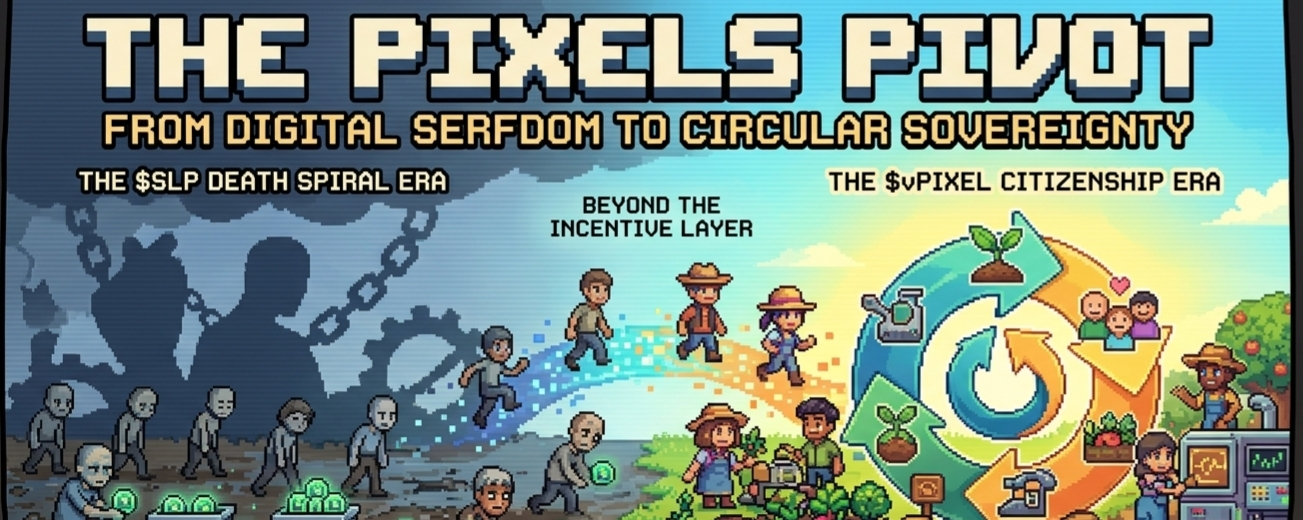

I’ve spent the last few years watching the GameFi space with a mix of fascination and dread. We were promised a revolution where players owned their time; instead, we got digital sweatshops. Most "games" were just fancy skins over a Ponzi—a liquidity extraction machine where the first one to dump won.
But I’ve been watching Pixels closely. I’m not just monitoring the price action on Ronin; I’m obsessed with the intent. They aren’t just building a farming game; they are attempting to solve the fundamental "Incentive Layer" problem that has plagued Web3 since the Axie era.
The Autopsy of the Death Spiral
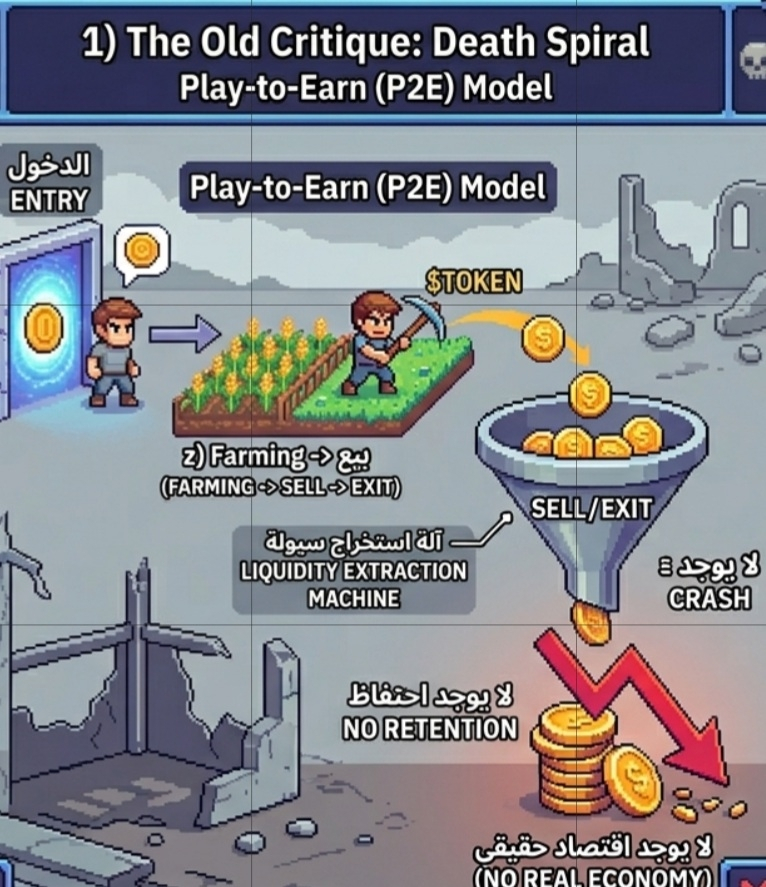
To understand why I’m leaning into Pixels, you have to acknowledge why the old model failed. The $SLP era taught us that when users enter purely for Profit Optimization, they treat the game like a mine.
Farming → Selling → Exiting.
Retention = 0. * Real Economy = Non-existent.
Old-school GameFi was a race to the bottom. If a game’s only value is the dollar amount it emits, it isn’t a game; it’s a high-yield savings account with extra steps and higher risk. Pixels recognizes this. They aren't trying to "fix" P2E; they are trying to bury it.
The Philosophy of the "Liquidity Router"
On the surface, Pixels looks like a cozy 8-bit farm. It’s deceptive. Under the hood, I see a Liquidity Router.
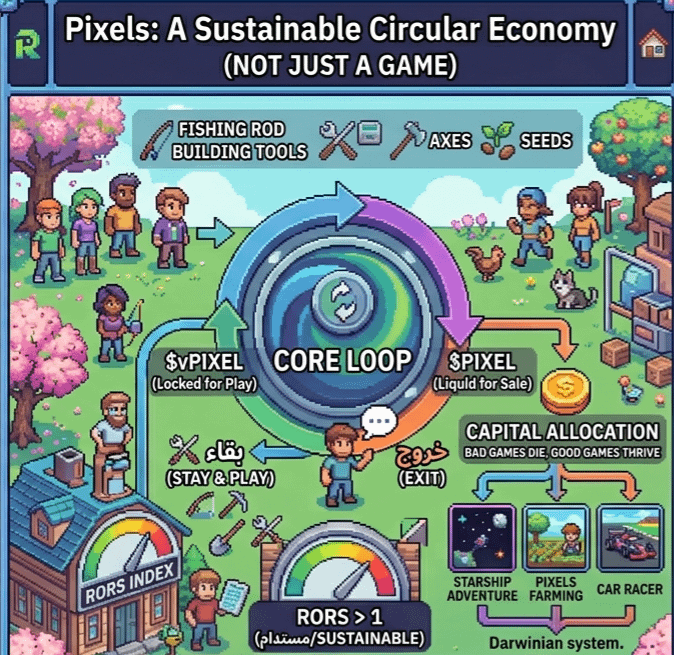
The old way was: One Game + One Token = Total Systemic Risk. The Pixels way is: Multiple Games + One Shared Economy.
By acting as a hub for different experiences, they are attempting to stretch the lifespan of the ecosystem. It’s about Capital Allocation. When you stake $PIXEL, you aren’t just "Yield Farming"; you are essentially acting as a decentralized VC. You back a game—if it attracts players and generates revenue, you win. If it’s garbage, you lose. This is a Darwinian filter for quality, something Web3 desperately needs.
The $vPIXEL Friction: Psychological Engineering
The dual-token model ($PIXEL and $vPIXEL) is where the technical meets the philosophical.
$PIXEL is your liquid exit.
$vPIXEL is your "Proof of Presence."
By locking value inside the game, they’ve created Liquidity Friction. In most crypto projects, friction is seen as a bug. Here, I argue it’s a feature. It forces a choice: Do you want a quick buck, or do you want to belong? This "locked" utility dampens sell pressure, but more importantly, it shifts the player’s mindset from "Mercenary" to "Citizen."
The RORS Metric: The Line Between Ponzi and Economy
I’m particularly focused on their RORS (Return on Reward Spend) metric. It’s the most honest KPI in the space.
Does every $1 spent on rewards bring back > $1 in ecosystem value?
If RORS < 1, you’re just subsidizing your own demise. If RORS > 1, you have a sustainable circular economy. This isn’t just "tokenomics"; it’s actual fiscal policy. I’m watching this number like a hawk because it determines if we are playing a game or just watching a slow-motion bank run.
The Temporal Shift: Slowing Down the Pulse
The most profound thing about the Pixels experience is how it feels "out of sync" with the rest of crypto.
The market is loud, aggressive, and 24/7. Pixels is slow, quiet, and repetitive.
In Web3, we’ve conditioned ourselves to treat Time as an Asset to be optimized. We ask, "How do I maximize my ROI per minute?" Pixels dares to suggest that Time is an Experience. When I’m moving through that world, the "Optimization Mode" in my brain starts to quiet down. For a moment, I’m not a liquidator; I’m just... there.
The Hard Truths (The Trade-offs)
I’m not a moon-boy; I see the risks. This system is insanely complex. It requires the perfect coordination of players, devs, and stakers.
If the games aren't fun, the capital allocation fails.
If the friction ($vPIXEL) is too high, players feel trapped.
If the RORS stays below 1, no amount of "cozy vibes" can save it.
There is no safety net here. Pixels is a massive experiment in human behavior. It’s an attempt to see if we can turn "extractive users" into "invested participants."
My Final Take: The "Maybe" That Matters
The old GameFi mantra was: Enter → Extract → Exit.
The Pixels mantra is: Enter → Invest → Play → Recycle → Maybe Stay.
That "Maybe" is the most honest thing in this entire industry. It acknowledges that value isn't just a number on a chart; it’s the sense of place, the quality of the experience, and the sustainability of the math.
I’m not here for a quick flip. I’m here because Pixels is asking the right questions. They are moving from an Economy to a Sense of Place. Whether they succeed or fail, they’ve already proven that the future of Web3 isn't in better "farming"—it’s in better "being."
I’m watching. I’m skeptical. But for the first time in a long time, I’m actually interested in the game, not just the candle.
