

I'll be honest. When someone first described Pixels to me as "a farming game on blockchain," I almost stopped listening. I'd heard that pitch before. Play-to-earn games that promised ownership but delivered disappointment — tokens that crashed, farms that felt like unpaid jobs, communities that evaporated the moment the hype did.
But here's what nobody tells you about Pixels: the farming loop doesn't feel like work because *you're not working for someone else's economy.* You're building your own.
That distinction sounds small. It isn't.
---
**The Problem With Most Gaming Economies**
Traditional games have trained us to accept a particular bargain. You grind, you earn in-game rewards, and those rewards exist entirely at the discretion of the developer. The 400 hours you spent building your character? Wiped in a patch. The rare item you farmed for weeks? Devalued when they added a better one in the next update.
You never owned any of it. You were renting progress inside someone else's balance sheet.
Web2 farming games perfected this extractive loop — Farmville made billions while players owned nothing. Every seed planted, every harvest collected, every neighbor helped — all of it generated value that flowed in one direction. Upward. Away from you.
Pixels flips that architecture quietly but completely.
---
**What the Farming Loop Actually Does**
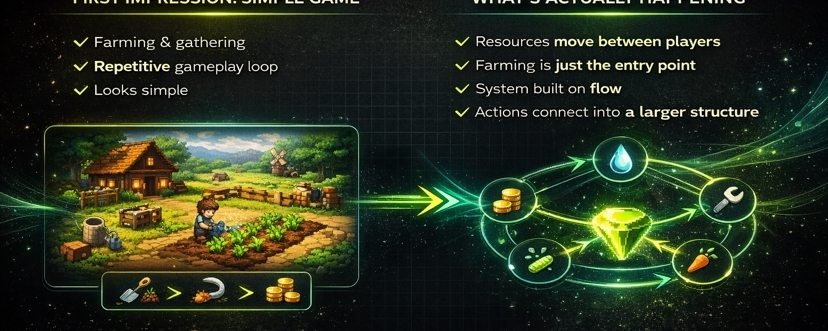
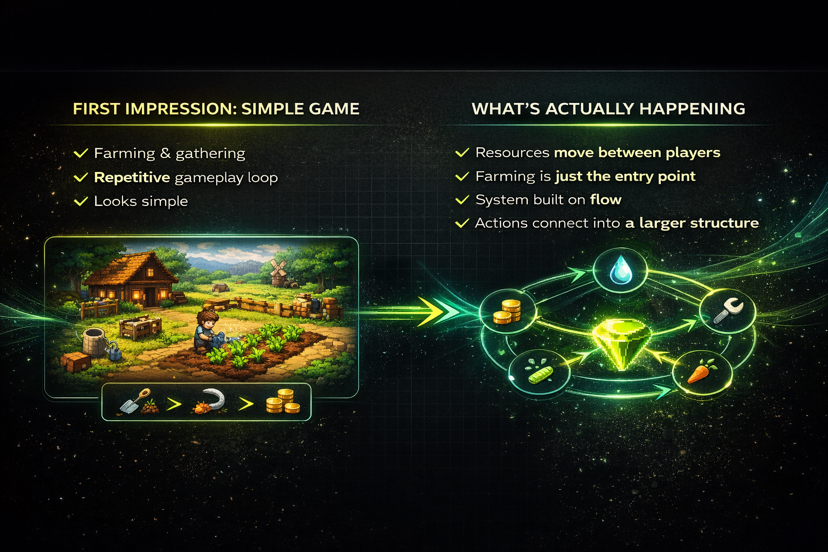
When you plant crops in Pixels, tend your land, craft resources, and trade with other players through @pixelsxyz — you're not just advancing a progress bar. You're participating in a player-driven economy where your decisions have real weight.
Land parcels are owned assets. Resources you harvest carry genuine scarcity. The $PIXEL token — the lifeblood of in-game transactions — circulates through an economy that players collectively shape. What you farm, what you craft, what you sell: all of it influences supply, demand, and the direction of the ecosystem.
What struck me most was the *texture* of progression here. In traditional farming games, the loop feels hollow after a while because the destination is always predetermined — level up, unlock the next thing, repeat. In Pixels, the loop compounds differently. Your farm becomes infrastructure. Your crafted goods feed other players' quests. Your land generates yield that belongs to you — not as a courtesy, but as a cryptographic fact.
That changes how progression *feels.* Psychologically, ownership converts grinding into building. There's a reason people spend weekends renovating houses they own but resent fixing apartments they rent. The underlying activity is similar. The relationship to the outcome is entirely different.
---
**The Economy Is the Game**
Here's what actually matters about the Pixels model: the farming mechanics aren't a distraction from the economy — they *are* the economy. Every harvest is a supply-side decision. Every crafting choice is a micro-manufacturing call. Every trade is a market interaction.
Skilled players aren't just good at tapping crops. They're reading demand signals, positioning their land strategically, timing resource sales around in-game events. That's not grinding. That's economic participation with a low barrier to entry and a surprisingly high ceiling of sophistication.
The $PIXEL token gives this loop continuity outside the game — value that persists, that you can hold, that connects your in-game choices to a broader financial reality. Casual players feel the ownership. Serious players leverage it.
---
**Where I Think This Goes**
I think Pixels is quietly building the proof of concept that the broader gaming industry is terrified to acknowledge: players *want* ownership, and ownership *improves* engagement rather than undermining it. The fear has always been that giving players real stakes would make them too transactional, too mercenary. Pixels suggests the opposite — people invest more deeply when the stakes are real.
The farming loop will get richer. The land economy will mature. The player-driven markets will develop more complexity. And @pixelsxyz will keep demonstrating something the traditional gaming world hasn't figured out yet.
The grind was never the problem. The problem was who owned what you built.
In Pixels, that answer is simple. You do.