

I was scrolling through my feed way too late again, half-awake, half-annoyed, and I saw Pixels trending… again. Same screenshots. Same “this is the future of Web3 gaming” takes. Same recycled optimism dressed up in slightly different words. And I just sat there thinking—haven’t we been here before?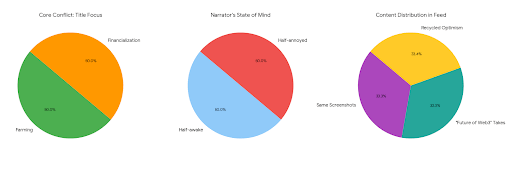
Not with Pixels specifically, but with the whole idea. Farming game. Social layer. Player-owned economy. A digital world that’s supposed to feel alive instead of extractive. It sounds familiar because it is. Crypto has this weird habit of rediscovering the same dream every 18 months, slapping a new chain under it, and pretending the past didn’t happen.
Still, I didn’t scroll past it this time.
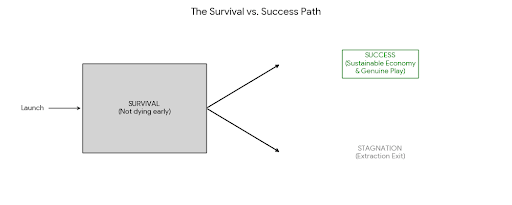
Because Pixels isn’t exactly nothing. It’s one of the few projects that didn’t just pop up during hype season and vanish when liquidity dried up. It’s been building, iterating, migrating—most notably over to Ronin—and actually trying to hold onto players instead of just attracting wallets. That alone puts it ahead of 90% of what calls itself a “Web3 game.”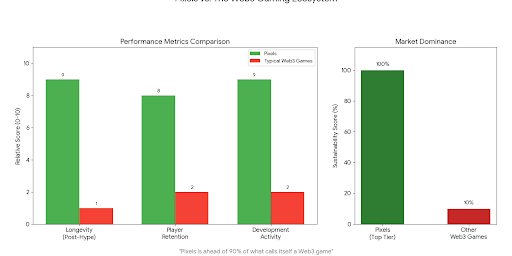
But I’ve been in this space long enough to know that survival doesn’t equal success. It just means you didn’t die early.
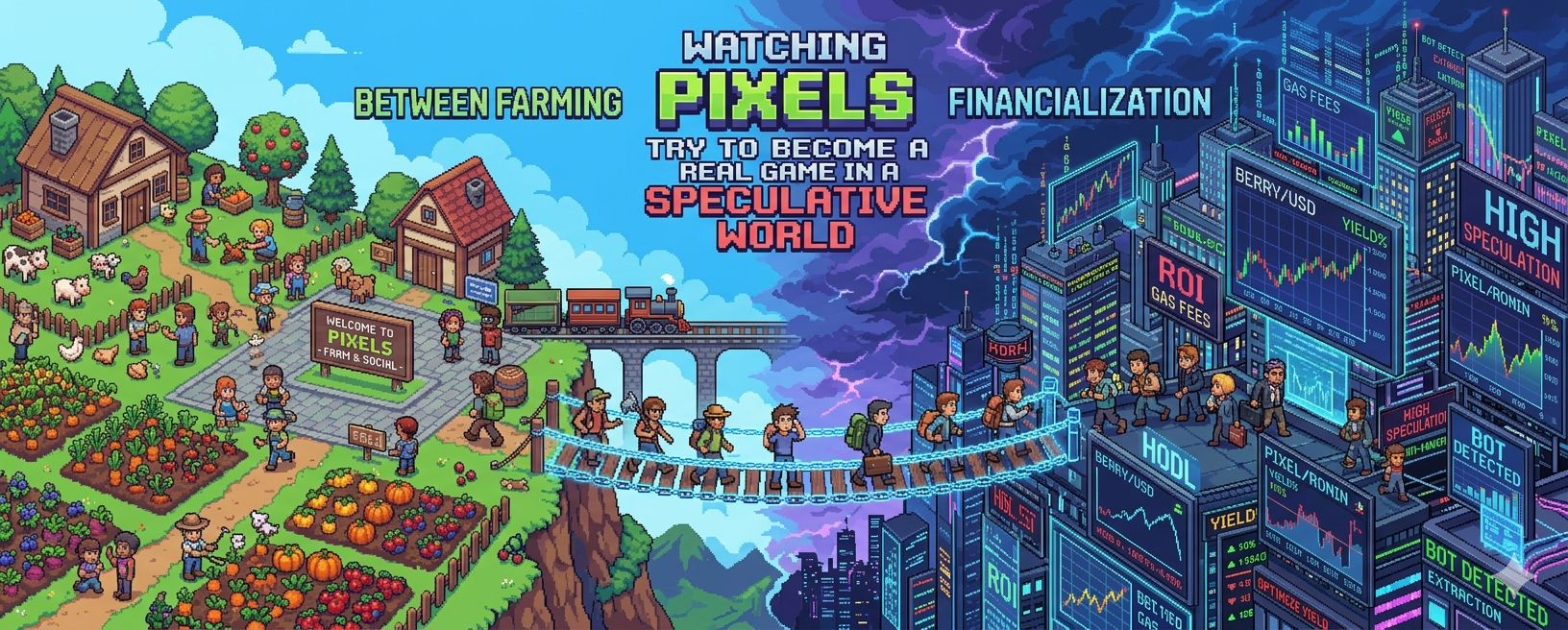
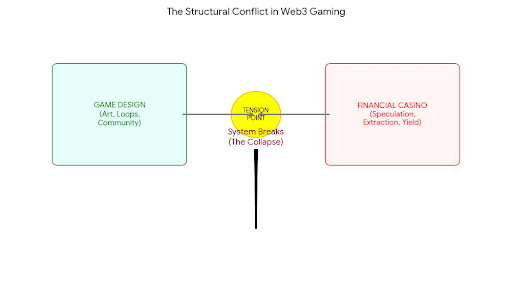
What’s interesting about Pixels isn’t the farming loop or the pixel art or even the token mechanics. It’s the fact that it’s trying to operate like a real game inside an environment that still behaves like a financial casino. And that tension is where things usually break.
Because let’s be honest—most people entering Web3 games aren’t there because they love farming mechanics. They’re there because they’re hoping the crops turn into yield. They’re not thinking about long-term gameplay loops or community building. They’re thinking about extraction, even if they don’t say it out loud.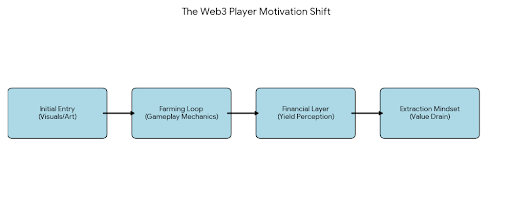
And that’s the first problem.
Pixels talks a lot about being social, casual, and open-world. And yeah, on the surface, it delivers that better than most. You can log in, run around, farm, craft, interact. It feels more like a game than a dashboard, which already makes it rare. But the second you attach a token to those actions, the entire vibe shifts.
Now every carrot you plant has a price. Every action gets evaluated through “is this worth it financially?” And suddenly the relaxed farming sim starts behaving like a job you didn’t sign up for.
I’ve seen this pattern too many times. The moment real money enters the loop, players stop being players. They become optimizers. Min-maxers. Or worse—tourists who show up, extract value, and disappear.
And this is where Pixels is standing right now. It has attention. It has users. But it’s still unclear if those users actually care about the game or just the opportunity around it.
Because attention in crypto is cheap. Retention is expensive.
The move to Ronin helped, no doubt. Lower fees, smoother onboarding, a chain that already understands gaming at least a little better than most. It removed friction. But removing friction doesn’t magically create loyalty. It just makes it easier for people to come and go faster.
And honestly, that’s something people underestimate. Everyone talks about scalability like it’s this heroic feature—faster transactions, cheaper gas, more throughput. But what happens when you actually get it?
You don’t just get more users. You get more stress.
More bots. More opportunists. More people trying to break the system in ways the developers didn’t anticipate. Not because the tech is weak, but because humans are predictable in the worst ways when money is involved.
Pixels has already felt some of that pressure. You can see it in how the economy gets adjusted, how rewards shift, how systems get tweaked. It’s not failure—it’s just the reality of running a live experiment where incentives are constantly being gamed.
And I don’t blame the team for that. If anything, they’re doing what most teams refuse to do—stay present and adapt in real time instead of disappearing behind roadmaps.
But adaptation only goes so far.
Because the bigger issue isn’t technical. It’s psychological.
Crypto users are impatient. Investors even more so. They don’t want slow growth or organic community building. They want numbers to go up. Preferably now. And if they don’t, they rotate to the next thing without looking back.
So Pixels ends up caught in this weird space. It needs time to grow into an actual game with depth and culture, but it’s surrounded by an audience that measures success in weekly charts.
That mismatch kills more projects than bugs ever could.
And then there’s the liquidity problem, which nobody likes to talk about until it’s too late. A game economy isn’t just about creating rewards—it’s about sustaining them. If too much value flows out and not enough flows in, everything collapses quietly.
You don’t notice it immediately. At first, things feel active. There’s trading, farming, crafting. But over time, if new users slow down or spending drops, the entire loop starts to feel… thinner.
Rewards shrink. Activity drops. And suddenly the world that felt alive starts feeling like a ghost town.
Pixels isn’t there yet, but it’s not immune either. No Web3 game is.
And I think that’s what makes me cautiously interested instead of blindly optimistic.
Because for once, this doesn’t feel like a pure hype cycle. It feels like a project actually trying to figure things out while the ground is still shifting under it. That’s messy. It’s inconsistent. But it’s also real.
I’d take that over another polished trailer with zero users any day.
At the same time, I can’t ignore how much of the conversation around Pixels still sounds like every other cycle. People throwing around “next big thing,” comparing it to past successes, projecting growth curves that assume perfect conditions.
But conditions are never perfect in crypto.
Infrastructure gets tested in ways whitepapers never predicted. Networks get congested not because they’re badly designed, but because too many people show up at once doing the same thing. It’s not always a flaw—it’s a signal.
If Pixels actually succeeds in attracting real scale, it’s going to break things. Not permanently, but temporarily. Systems will need to adjust. Economies will need rebalancing. And the community will probably complain the entire time.
That’s normal. It just doesn’t fit into the clean narratives people like to sell.
And then there’s competition, even if nobody wants to admit it. There are dozens of projects chasing the same idea—persistent worlds, player-driven economies, social gameplay. Some are more polished, some are more experimental. Most will fail.
Pixels doesn’t need to beat all of them. It just needs to stay relevant long enough to matter.
Which sounds simple, but it’s not.
Because relevance in crypto isn’t just about what you build. It’s about timing, sentiment, liquidity cycles, and whether people feel like participating at that exact moment.
Right now, people are showing up. That’s a good sign.
But showing up once doesn’t mean they’ll stay.
And that’s the part nobody can predict.
I keep thinking about how different this would be if money wasn’t involved. If Pixels was just a game—no tokens, no speculation, just farming and social interaction. Would people still care?
Some would. But not this many.
And that’s the paradox. The financial layer brings attention, but it also distorts behavior. You can’t remove it, but you also can’t fully control what it does to your ecosystem.
So where does that leave something like Pixels?
Somewhere in between experiment and product. Between game and market. Between genuine attempt and speculative playground.
I don’t hate it. I don’t trust it completely either.
I think it’s one of the more honest attempts in a space that’s still figuring itself out. But honesty doesn’t guarantee success. Effort doesn’t guarantee adoption.
It just gives you a chance.
And that’s probably the most realistic way to look at it.
Pixels might keep growing. It might stabilize into something people actually stick with. Or it might slowly fade as attention shifts, like everything else eventually does.
I’m not betting on extremes anymore.
I’ll watch it. I’ll probably log in again. I might even enjoy it for what it is instead of what it promises.
But I’m not going to pretend I know how this ends.
Because in this space, the difference between “this works” and “nobody cares anymore” is thinner than people like to admit.
And Pixels is walking right along that line.
It might turn into something real.
Or it might just be another place we all visited for a while before moving on.