
What i understand is that.....Calling Pixels a farming game is no longer wrong, but it is incomplete. The surface layer still looks like a game, yet the direction behind it points somewhere much bigger. What is emerging is not only a product built for entertainment, but a system testing how games can find, attractand retain users without depending on traditional advertising.that difference matters, because the real ambition is not just gameplay. It is control over growth.#pixel
For many years studios have relied on outside platforms to acquire players. They pay for visibility, compete in crowded ad markets, and keep optimizing for conversion and retention. The model is familiar but the economics are getting harder. Costs rise margins tighten and control over the user relationship often fades once the player enters the funnel.
@Pixels is trying to change that structure. Instead of paying external platforms to deliver users it is building an internal economy where incentives perform the role of acquisition. Rewards are not just gifts. ... That is the matter. They are meant to be targeted inputs that bring users in, shape behavior and keep value moving through the system.
That makes the project more than a design choice. It makes it a strategic shift
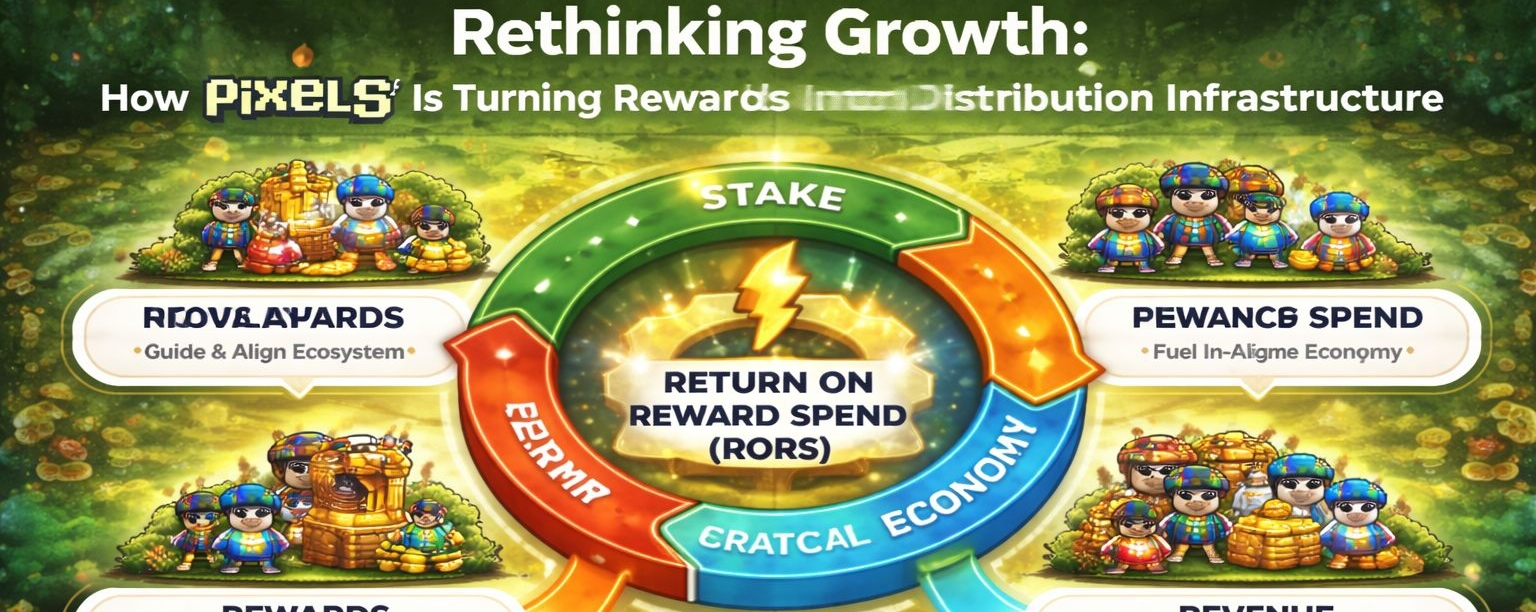
At the center of this model is a metric that adds accountability, Return on Reward Spend, or RORS. Instead of asking only whether users are active or engaged, the system asks whether the incentives create measurable value in return. The question is simple....do rewards produce outcomes that justify their cost?
That framing changes the conversation. It replaces vague sign of participation with a harder measure of economic efficiency.
In traditional growth models, performance is judged by metrics such as cost per install, lifetime value, and payback period. In many web3 systems, rewards have often been distributed with far less precision, based on the assumption that activity would somehow become value later. Pixels is trying to close that gap by treating incentives with the same discipline used in paid acquisition.
If RORS can move above 1 you know, rewards stop behaving like a subsidy and start behaving like a productive asset. That is the point where the system begins to support itself.
The mechanics behind that depend on a loop.
It starts with staking, which plays a more active role than it does in most token systems. Instead of existing mainly as a passive yield mechanism or a symbolic signal of commitment, staking becomes a way to fund growth. Capital locked into the ecosystem becomes usable budget for incentive distribution.
From there, rewards are deployed but not randomly. The goal is to guide specific behaviors, not just create presence. When incentives are tied to meaningful actions such as progression, spending, or long term participation, they begin to shape the quality of the user base instead of only its size.
That distinction is important. Broad rewards create noise.
Targeted rewards create direction.
Once users respond to those incentives, the next step is spend. If players use rewards inside the ecosystem through purchases, upgrades, or repeated transactions, they reinforce the internal economy. At that point, rewards are no longer only outputs. They become drivers of economic activity.
That is where revenue enters the picture. When spending happens, it generates returns that can help offset the original incentives. That feedback loop is what decides whether the system is truly viable.and still the most valuable output may not be revenue alone. It may be information.
Every interaction creates data. Which incentives attract high value users? Which behaviors support retention? Which entry points lead to real engagement? If that data is captured and applied well, it can improve future campaigns, sharpen targeting, and make the whole system more efficient.
In that sense rewards do two jobs at once. They distribute value and generate insight.
This is where Pixels starts to look more like infrastructure than a standalone game. If the system can reliably convert incentives into both economic returns and useful intelligence, it creates a framework that other games could eventually plug into. Instead of building growth strategies from zero, developers could use a system where acquisition, behavior tracking, and monetization are already connected.
That has wider implications for publishing.
Today’s dominant model pushes studios toward dependence on external platforms for user acquisition. Those platforms control pricing, targeting, and data visibility. Pixels is exploring a different model where those functions are brought inside the ecosystem itself. The ecosystem becomes the place where users are acquired and monetized.
If that works value stays inside the system instead of leaking outward to ad networks.
The challenges though are serious and they go beyond design.
Incentive driven systems are vulnerable to misuse. Some users may optimize for extraction instead of participation. Rewards can attract short term actors who have little interest in long term engagement. Too much distribution can create pressure on token value. And badly calibrated incentives can distort behavior instead of improving it.
These are not edge cases. They are central risks.
For the model to work, efficiency must improve faster than leakage. The system needs to identify the users who create value while reducing exposure to those who do not. That requires not only data, but better interpretation of the data.
Without that refinement the loop breaks down.
Depth of engagement matters too. If users only claim rewards without meaningful participation, the economic cycle weakens. For the model to hold, incentives must lead to actions that generate recurring value inside the ecosystem.
That is a much higher standard than simply producing activity.
The ongoing change inside Pixels suggest that the team understands these limits. The focus appears to be shifting from expansion alone to the quality of expansion. Growth is no longer just about adding users. It is about ensuring those users fit the economic structure of the system.L
That shift is crucial. Scale without efficiency usually makes problems larger.
Ultimately, Pixels is testing whether incentives can become a real substitute for traditional advertising. It is asking whether user acquisition can be built into the economy rather than outsourced to outside platforms. It is also asking whether on chain behavior can produce better insight than the fragmented data returned by standard ad systems.
These are difficult questions, but they are the right ones.
If the model works, it could change how games think about growth and turn reward systems into a core layer of distribution infrastructure. If it fails, it will still reveal the limits of incentive based economies and the conditions they need in order to function.
Either results matters.What makes Pixels stand out is not just that it uses tokens or rewards. It is that it treats them as tools for solving a deeper problem, how to acquire and retain users in a way that is measurable and sustainable. That is much bigger than building a successful game. It is an attempt to redesign the economics behind how games grow.