
I’ve been watching Pixels for a while now, not as a player chasing rewards or progression, but as a kind of observer trying to understand what it reveals about coordination in digital systems. At first glance, it looks disarmingly simple—a farming game, soft colors, routine tasks, a familiar loop of planting, harvesting, and crafting. But the longer I keep looking at it, the less it feels like a game in the traditional sense and the more it resembles a living experiment in how distributed systems organize human behavior.
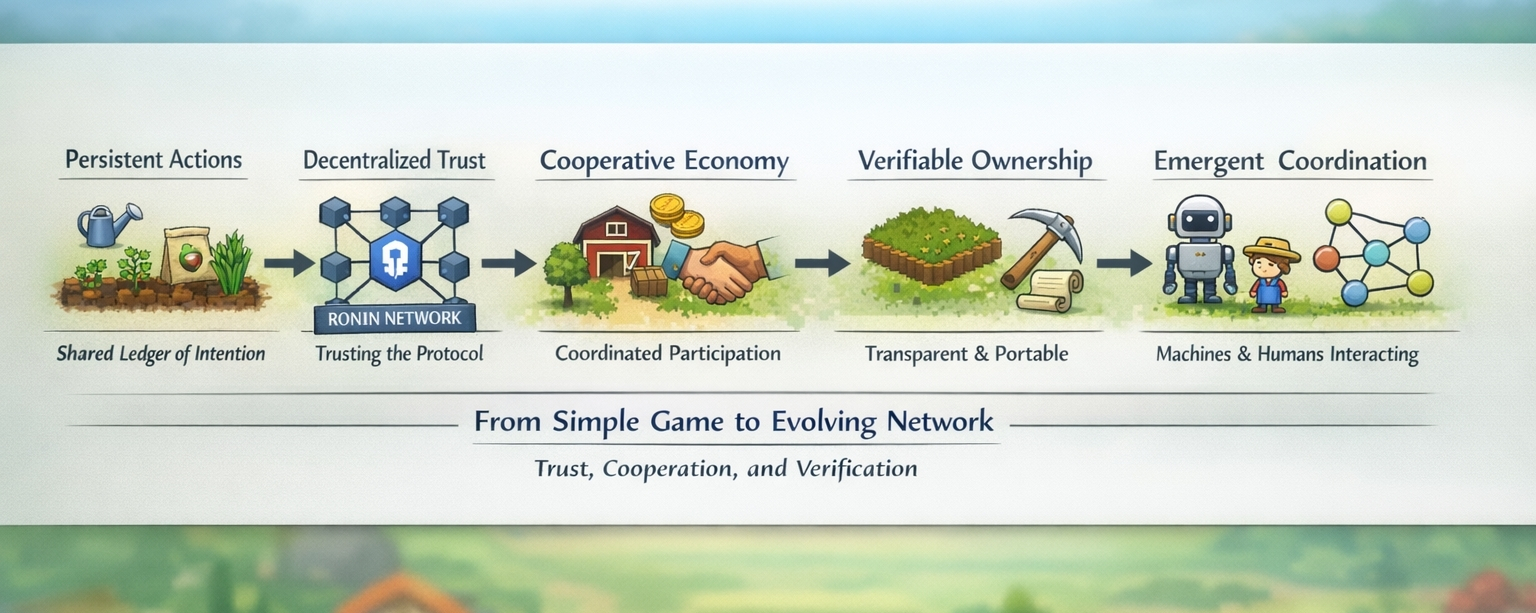
What caught my attention early on wasn’t the mechanics themselves, but the subtle persistence of actions. Every small activity—planting a crop, trading an item, moving across land—feels like it carries a trace beyond the immediate moment. This is where its connection to Ronin Network becomes more than just infrastructure. The blockchain here isn’t simply recording ownership; it is quietly shaping how actions become commitments. It turns what would normally be ephemeral gameplay into something closer to a shared ledger of intention.
I’m noticing that this changes how trust forms between participants. In most online games, trust is mediated by the developer. The system decides fairness, enforces rules, and ultimately controls the environment. In Pixels, that authority feels diffused. The rules still exist, of course, but they are embedded in a network that doesn’t rely on a single point of control. This creates a different psychological relationship between players and the system. Instead of trusting a company, participants begin to trust the consistency of the protocol itself.
What’s interesting is how this affects cooperation. Farming, by its nature, is a slow and collaborative process. It rewards patience, coordination, and shared knowledge. When these behaviors are layered onto a blockchain-backed system, they begin to resemble something closer to economic coordination than gameplay. Players are not just optimizing for fun; they are navigating a system where their actions have continuity and consequence beyond a single session.
I keep looking at how ownership is expressed in this environment. It’s not just about owning assets, but about owning position within a network of interactions. Land, items, and progress become signals—markers of participation in a broader system. These markers are verifiable, portable, and persistent, which subtly shifts how value is perceived. Value is no longer just what the game assigns; it emerges from the interactions between participants over time.
There’s something almost institutional about this. Traditional institutions—markets, governments, organizations—exist to coordinate trust among large groups of people. They provide frameworks for verifying actions and enforcing agreements. Pixels, in its own quiet way, mirrors this function. It creates a space where coordination doesn’t rely on centralized enforcement but on shared rules encoded in the system. The blockchain acts less like a database and more like a minimal institution—one that defines how participants relate to each other.
What I find particularly compelling is how the system handles verification. In most digital environments, verification is invisible. You assume the game is fair because you trust the developer. Here, verification is structural. It’s built into the network itself. This doesn’t make the system perfect, but it changes where certainty comes from. Instead of being granted by authority, it emerges from transparency and consistency.
Over time, this begins to blur the boundary between play and coordination. The farming loop starts to feel like a simplified model of real-world economic systems. Resources are produced, exchanged, and transformed. Participants specialize, collaborate, and compete. The difference is that the underlying rules are more explicit and, in some sense, more neutral. They don’t adapt to individual players; they remain stable, forcing participants to adapt to them.
I’m also struck by how this environment could intersect with autonomous systems in the future. If you imagine AI agents participating in such a network, the implications become more profound. A system like Pixels could act as a sandbox where machines learn to coordinate with humans under shared rules. The blockchain provides a common language of verification, allowing both human and machine participants to trust the same underlying structure.
This raises deeper questions about how networks evolve. If coordination can be encoded into protocols, then institutions themselves may begin to shift from human-managed entities to system-managed environments. Pixels feels like a small, almost playful step in that direction. It doesn’t attempt to solve grand problems, but it demonstrates how simple interactions, when anchored in a persistent and verifiable system, can scale into something more complex.
What keeps drawing me back is the quietness of it all. There’s no dramatic claim being made on the surface. It’s just a game about farming. But beneath that simplicity is a subtle reconfiguration of how people interact, how trust is formed, and how systems can coordinate behavior without relying on central authority.
The longer I observe it, the more it feels like a prototype—not just for games, but for a different kind of digital environment. One where actions accumulate meaning over time, where trust is embedded in structure rather than granted by institutions, and where coordination emerges from the interaction between participants and protocols.
It’s easy to overlook something like this because it doesn’t announce its significance. But sometimes the most important systems are the ones that quietly reshape assumptions. Pixels, in its own understated way, seems to be doing exactly that.