

I’ve spent enough time around crypto projects to recognize a pattern when I see one. A new idea emerges, it promises to reshape an industry finance, gaming, identity, take your pick and then it gets wrapped in a familiar layer of tokens, incentives, and community narratives. So when I first came across Pixels, a social casual Web3 game built on the Ronin Network, I didn’t approach it with excitement as much as curiosity mixed with a bit of fatigue. Farming, exploration, crafting these are not new ideas. Not even in Web3. But something about the way Pixels presents itself made me want to linger a little longer and actually observe what’s going on beneath the surface.
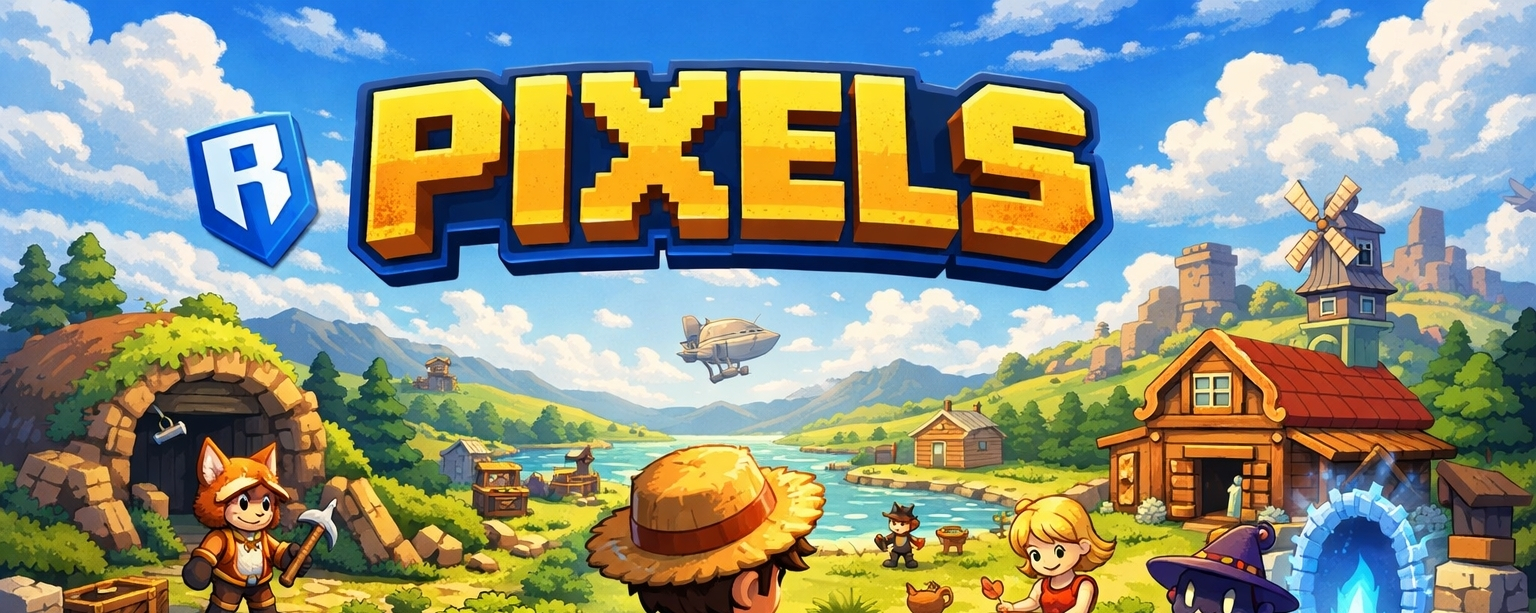
At a glance, Pixels looks deceptively simple. It leans into a retro, almost nostalgic aesthetic, the kind that lowers the barrier to entry instantly. You don’t need to be a hardcore gamer to understand it. You can walk around, gather resources, plant crops, interact with other players. That accessibility is intentional, and it immediately sets it apart from a lot of Web3 games that overcomplicate themselves in an attempt to justify their token economies. Pixels doesn’t try to impress you with complexity upfront. Instead, it invites you in quietly.
But once you step in, the real question becomes: what is this actually trying to solve?
Because beneath the farming mechanics and pixel art, this is still a crypto project. It has a token, PIXEL. It runs on a blockchain infrastructure. It’s part of a broader narrative about ownership, player economies, and decentralized participation. And if you’ve been around long enough, you know that these claims often blur into each other across projects.
The problem Pixels seems to be addressing is one that Web3 gaming has struggled with for years: how do you create a sustainable player-driven economy that doesn’t collapse under its own incentives? Or, put more simply, how do you make a game that people actually want to play not just farm for rewards?
That distinction matters more than most teams admit. The early wave of play-to-earn projects leaned heavily into financial incentives. They attracted users quickly, but those users were often there for extraction rather than engagement. Once the rewards dried up or token prices fell, the entire ecosystem would hollow out. What was left wasn’t a game it was a temporary economic loop.
Pixels appears to be trying a slightly different approach. It still incorporates tokenized incentives, but it wraps them in a more traditional gameplay loop. Farming, resource management, social interaction these are systems that have worked in games for decades without any blockchain component. The idea, it seems, is to build a game that could stand on its own, and then layer ownership and economy on top of it, rather than the other way around.
I find that approach more grounded, but it also raises some questions. For one, if the game is genuinely fun without the token, then what role does the token really play? Is it enhancing the experience, or is it quietly reintroducing the same speculative dynamics we’ve seen before?
The architecture behind Pixels is also worth thinking about. Being built on Ronin isn’t a random choice. Ronin has already proven itself, at least to some extent, as a gaming-focused blockchain, largely through Axie Infinity. That history brings both credibility and baggage. On one hand, it shows that large-scale Web3 games can function within that ecosystem. On the other, it reminds us how fragile those economies can be when they’re overly dependent on continuous user growth.
Pixels seems aware of that history, whether explicitly or not. There’s a noticeable emphasis on social mechanics shared spaces, collaboration, interaction. It’s not just about individual progression. That’s interesting because it shifts the focus from extraction to participation. In theory, a socially embedded game has more resilience than a purely transactional one.
But theory and reality don’t always align in crypto.
One thing I keep coming back to is how often this industry underestimates human behavior. You can design the most elegant token system, but if players find a way to optimize for profit over play, they will. It’s not even malicious it’s just rational. And once that behavior dominates, the experience changes. The game becomes secondary to the economy.
So I watch Pixels with that in mind. The farming loop, for example, is inherently repetitive. That’s not a flaw it’s part of the genre. But when you attach economic value to repetitive actions, you risk turning them into labor rather than leisure. The difference between tending a virtual garden for fun and doing it for yield is subtle but important.
Still, there’s something about the pacing of Pixels that feels… less aggressive. It doesn’t push you into optimization immediately. It allows for a slower kind of engagement. That might not sound like much, but in a space where everything is often engineered for maximum retention and monetization, restraint stands out.
Another aspect that caught my attention is how Pixels handles identity and ownership. In many Web3 games, assets are the focal point—NFTs, land, items, all tradable, all speculative. Pixels includes these elements, but they don’t dominate the experience in the same way. At least not at first. You can exist in the world without constantly thinking about asset valuation.
That might be one of its more subtle strengths. It creates a layer of separation between playing and investing. Not a complete separation, but enough to make the experience feel less transactional. Whether that balance can hold over time is another question.
Zooming out a bit, I think Pixels sits at an interesting intersection in the broader crypto ecosystem. It’s part of a wave of projects that are trying to move past the first generation of Web3 hype. They’re not abandoning tokens or decentralization, but they’re rethinking how those elements integrate with actual user experiences.
The industry, in general, has a habit of starting with the technology and then searching for a use case. That’s how we ended up with so many over-engineered solutions looking for problems. Gaming, ironically, has always been one of the more promising areas for blockchain—not because it needs decentralization, but because it already has built-in economies and digital ownership concepts.
The challenge is making that integration feel natural rather than forced.
Pixels doesn’t completely solve that challenge, but it seems to be aware of it. And that awareness counts for something. It’s not trying to reinvent gaming. It’s trying to adapt existing game design into a Web3 context without breaking it.
Of course, skepticism is still warranted. The sustainability of its economy is an open question. The long-term engagement of players who aren’t financially motivated is another. And then there’s the broader issue of market cycles. No Web3 game exists in isolation from the crypto market. Token prices, user sentiment, liquidity they all feed back into the experience in ways that traditional games don’t have to deal with.
I also wonder about scalability not just in terms of infrastructure, but in terms of culture. Can Pixels maintain its current tone and community as it grows? Or will it eventually attract the same speculative crowd that reshapes its dynamics?
These aren’t criticisms as much as they are uncertainties. And maybe that’s the most honest way to approach a project like this. Not with blind optimism or outright dismissal, but with a willingness to observe how it evolves.
If there’s one thing I’ve learned from watching this space over the years, it’s that good intentions and solid design don’t guarantee outcomes. External factors, user behavior, timing they all play a role. Sometimes the simplest ideas succeed, and sometimes the most thoughtful ones fade quietly.
Pixels feels like it’s trying to be thoughtful. It’s not shouting about revolution. It’s not promising to change the world. It’s building something smaller, more contained a digital space where players can interact, create, and maybe, just maybe, find a balance between play and ownership.
Whether that balance is sustainable is still an open question. But for now, I find it more interesting than most.
Not because it’s radically different, but because it’s slightly more self-aware. And in an industry that often repeats itself without reflection, that alone is worth paying attention to.
