Hey everyone. While everyone's panicking over geopolitical swings and wondering whether Brent will hit $150 or crash to $60, I see a completely different picture. The oil market right now reminds me of water at 80°C — everyone's waiting for it to boil at 100°C, but nobody understands the process is already underway.
Most traders are now playing on emotions from every news story out of the Persian Gulf. Strait of Hormuz blockade, US-Iran negotiations, threats of refinery bombings — and everyone rushes to buy or sell. This is a classic mistake. News isn't the cause of movement. It's just a convenient explanation they feed you after the move has already happened.
Geopolitical Theater and Real Drivers
Yes, Brent is holding around $100 after all this drama with Hormuz. Yes, the risk premium of $10-20 per barrel is real. But let's look deeper.
Iran exports 1.5 million barrels per day to China. That's a serious volume, but not critical for the global balance. Venezuela, Russia — we've been through all these stories before. The market adapts through shadow fleets, flow reorientation, discounts.
More important factor — the structural surplus of 2026. Production growth from non-OPEC+ countries exceeds demand growth from China and India. This is basic math that everyone ignores in the frenzy of geopolitical paranoia.
As for the Russian market — the impact there is negative. MOEX is trading sideways, the oil alpha is gone due to tax changes and inflationary pressure. Oil companies aren't showing the previous correlation with commodity prices.
My Base Case: $85-120 Consolidation
This is where the majority gets it completely wrong. Everyone's looking for directional movement — either a moon shot to $150 or a crash to $60. But I see extended consolidation in the $85-120 range followed by an upward breakout.
Why exactly this range? Too many triggers for volatility in both directions:
- Uncertainty over Strait of Hormuz blockade
- Potential strikes on refineries in Iran, Qatar, UAE
- Trump negotiations (every de-escalation signal knocks off $5-10)
- OPEC+ quota corrections after Q2 results
- Logistical problems with Russia's shadow fleet
Each of these factors can move the market 10-15% in either direction. But combined they create volatility equilibrium, not trending movement.
Crowd Psychology: Classic Mistakes
Right now speculators are building long oil positions during geopolitical flare-ups. This is a typical momentum-trading mistake. Buying on fear, selling on relief.
Institutions are playing contrarian. Banks analysts are already talking about fading the geopolitical effect. Finam writes: "Expensive oil no longer supports equities". They understand that structural factors matter more than news spikes.
Scenarios with Specific Triggers
Base case (65% probability): Consolidation $85-120 through end of 2026. Trigger for upper boundary — escalation in Persian Gulf. Trigger for lower — US-Iran deal or non-OPEC supply surplus.
Bearish scenario (20% probability): Downward break to $75-80 with full de-escalation and return to structural surplus. Trigger — successful Trump negotiations and removal of all Iran sanctions.
Bullish scenario (15% probability): Move to $130-150 with full Hormuz blockade or strikes on critical infrastructure. But this is more of a short-term spike than sustainable trend.
My Positions and Tactics
I'm trading the range. Buying lower boundaries of my box, selling upper ones. Every box on the chart is a potential entry point. Now waiting for acceptable levels around $88-92 for buys.
Not chasing every geopolitical spike. Patiently building positions in value zones. The oil market isn't crypto — different laws apply here. Fundamental cycles, long-term contracts, infrastructure constraints.
My horizon is 6-12 months. Waiting for consolidation to complete with an upward breakout against the backdrop of excess inventory depletion and global demand growth in 2027.
Why the Breakout Will Be Up
Long-term picture remains bullish. Underinvestment in new fields from 2020-2023 is showing. ESG restrictions on oil project financing haven't gone anywhere.
Geopolitical premium will become a structural price element. The world is becoming multipolar, conflicts are the norm. $10-15 geopolitical premium is baked into prices for the long haul.
India and Southeast Asian countries are ramping up consumption. China could again become a demand driver with economic stimulus.
Conclusion
While the crowd trades news and emotions, I'm building positions at technical levels in the key range. Oil is a long-term game where patience wins, not reacting to every tweet from the White House.
The coming months will show who's right — the panic crowd or those who can read market structure. I'm betting on consolidation followed by growth.$BTC $ETH

Artykuł
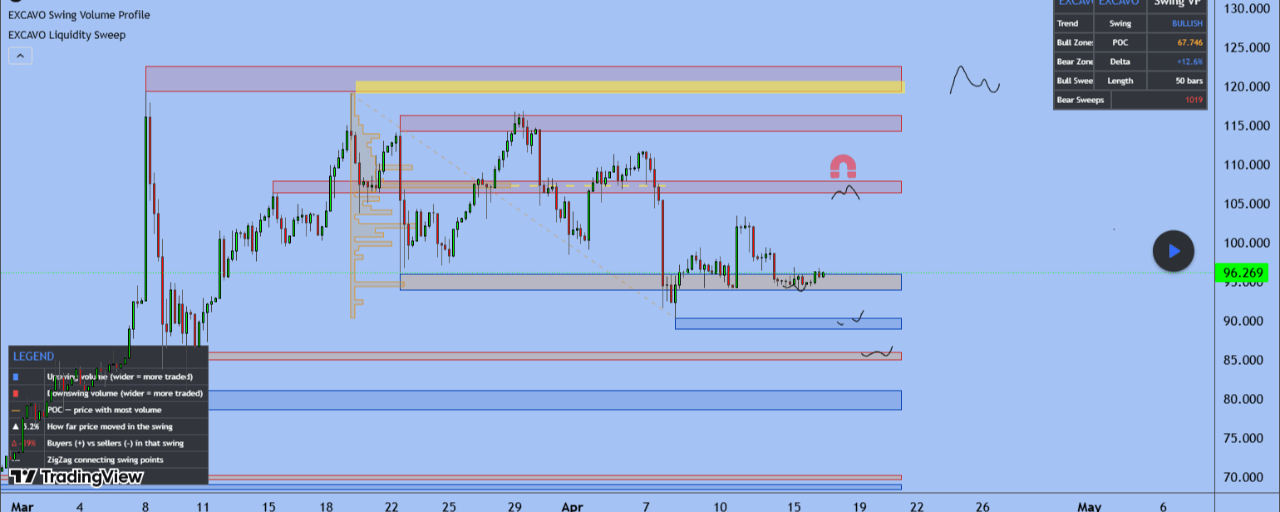
The Anatomy of Oil's $85-120 Consolidation
Zastrzeżenie: zawiera opinie stron trzecich. To nie jest porada finansowa. Może zawierać treści sponsorowane. Zobacz Regulamin