
I’ve noticed something that most people don’t really talk about when it comes to Pixels — everyone treats it like a simple grind. Plant, harvest, earn, repeat. The whole conversation stays stuck on rewards, efficiency, and how to squeeze out a little more value from each action.
But the more time I spend in it, the harder it becomes for me to see it that way.
It doesn’t feel like a farming game to me anymore.
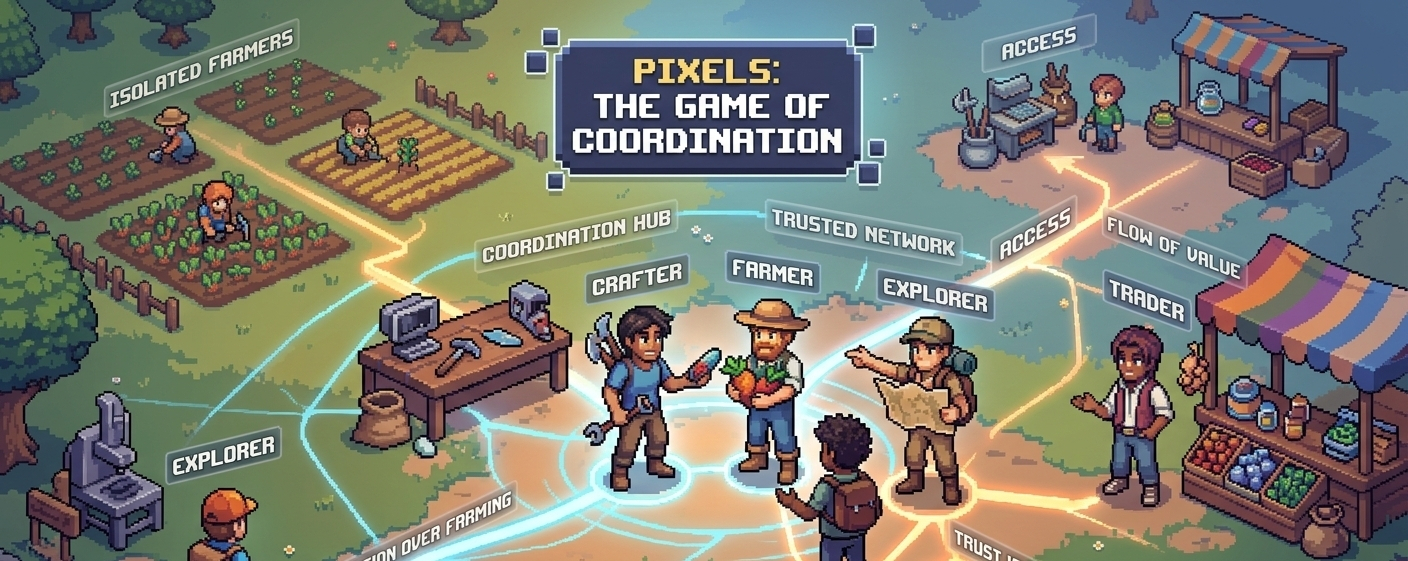
What I’ve started to notice is how everything in Pixels leans on something else. Farming isn’t just about what I plant — it depends on where I am, whose land I’m using, and who else is active around me. Even something as basic as crafting only really works because someone else is gathering what I’m not, and someone else needs what I’m making.
It’s strange when you slow down and really look at it — nothing in the game actually stands on its own.
And once I saw that, the whole system started to feel less like a game loop and more like a web of people quietly shaping each other’s outcomes.
Over time, certain patterns just kept repeating in front of me.
I’d see players grinding for hours and barely moving forward, while others seemed to grow without that same intensity. At first, it didn’t make sense. But then I realized — the difference wasn’t effort, it was positioning.
Some people naturally drift toward active spaces, better land, stronger communities. Others stay isolated, focused only on “perfecting” their own loop. And slowly, you can see the gap widen between them.
Even timing plays a role. When more players show up, everything shifts a little. Spots get crowded. Resources feel tighter. Things that worked yesterday suddenly don’t feel as effective today.
It’s subtle, but it’s always happening.
What really changed my perspective was paying attention to people, not mechanics.
Most players move in patterns — they follow the same routes, chase the same tasks, repeat what seems to work. And without realizing it, they start getting in each other’s way. The more crowded a strategy becomes, the less valuable it feels.
But then there are a few players who don’t follow that flow. They watch. They adjust. They move differently.
And you can almost feel the difference in how the game responds to them.
That’s when it clicked for me.
Pixels isn’t just about what I do — it’s about how I move around everyone else.
Once I started looking at it that way, I stopped obsessing over small optimizations and started paying attention to behavior, movement, and timing. I began asking simpler questions: Where are people going? What are they all chasing right now? And what happens if I don’t follow them?
And weirdly, that shift made everything feel clearer.
Because in a system like this, the real edge doesn’t come from grinding harder.
It comes from understanding the people you’re quietly playing alongside.
