
I did not think about marketing when I was playing Pixels.
I noticed something else first. After being inactive for a few days, coming back did not feel like starting over. Some actions immediately felt relevant, others did not. The system had already adjusted before I made any move.
That is not how most games behave.
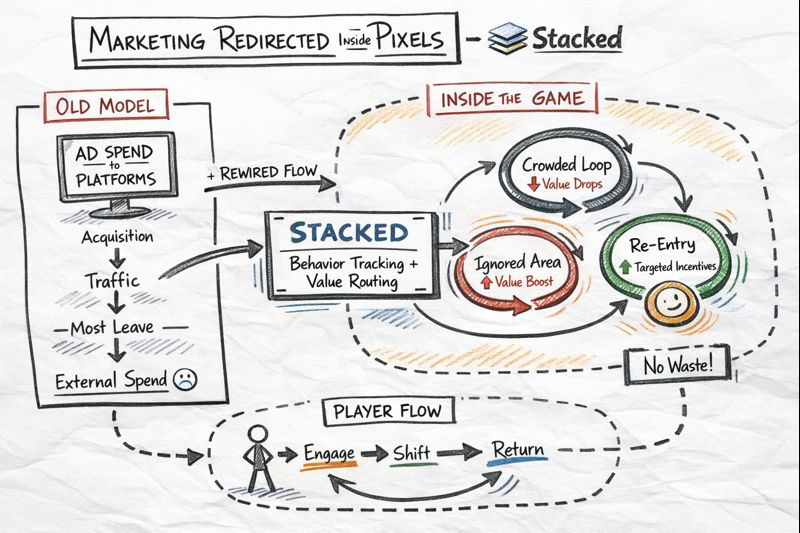
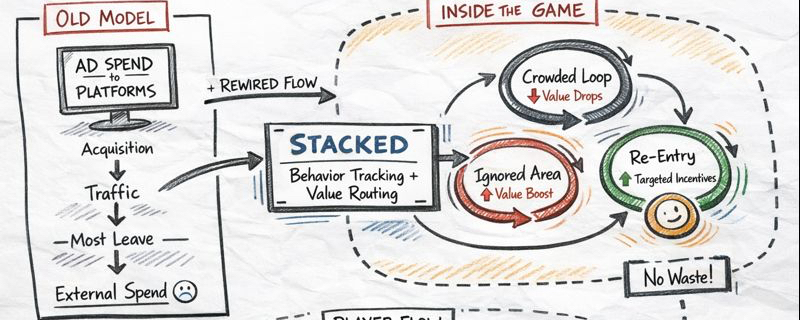
In a typical model, studios spend on platforms to acquire users. That spend happens outside the game. Users arrive, most leave, and the process repeats. The budget is consumed before stable behavior forms.
Pixels does not remove that model. It redistributes part of it.
Through Stacked, a portion of that spend is pushed inside the game and placed where it can influence behavior directly.
The difference is not in rewards. It is in placement.
Stacked reads player behavior and routes value accordingly.
If activity drops in a segment, incentives appear there.
If a loop becomes crowded, its return declines.
If an area is ignored, it becomes relatively more attractive.
This is continuous. There is no patch cycle and no fixed adjustment window.
I saw this clearly after a break.
Instead of spreading rewards across the entire game, Pixels placed value at specific re-entry points. It did not try to pull me everywhere. It pulled me back into one path.
That is targeted allocation, not generic retention.
This is where the structure changes.
In most systems:
spend → acquire → hope for retention
In Pixels:
observe → place incentives → reinforce or redirect behavior
That shift has consequences.
First, it reduces reliance on external platforms. Growth is no longer entirely dependent on continuous acquisition spend.
Second, it increases the value of active users. Players are not just participants. Their behavior determines where value is deployed.
Third, it stabilizes the system. Incentives are not fixed long enough for a single dominant loop to absorb all activity.
This is why rewards feel uneven.
They are not meant to be equal.
They are placed where they can change behavior.
This also changes how the $PIXEL token functions.
If rewards are static, the token acts as output. Its value depends on emission and selling pressure.
If rewards are routed, the token becomes part of allocation. It connects player behavior to where value is created and sustained.
There is a broader implication.
Pixels is not acquiring users. It is reallocating attention.
That is a different problem to solve, and a harder one.
If this model holds, Stacked is not just a feature inside Pixels.
It becomes a decision layer that can manage how value flows across different games. Instead of each game building its own reward logic, they could rely on a shared system that reacts to behavior in real time.
This is still early and not guaranteed to work perfectly.
The system needs to avoid overcorrecting. It needs to maintain enough stability so players can form strategies, while still preventing those strategies from becoming permanent.
What changed for me is simple.
I stopped looking at rewards as something I earn.
I started looking at where the system is placing value, and how quickly that placement shifts.
That is not visible on the surface.
But once you notice it, the game does not feel static anymore.
It feels like something that keeps adjusting while you are inside it.