

There's a number buried in a recent Pixels CEO interview that I keep coming back to. He mentioned that most Web3 games are running Return on Reward Spend somewhere between 0.1 and 0.5. Meaning for every dollar of rewards they put out, they're pulling back less than fifty cents in revenue. In-game purchases, subscriptions, marketplace fees, the works. Pixels is running 3:1.
Not 1.2. Not 1.5. Three.
The interesting question isn't whether that number is accurate. It's what mechanism produces a gap that large in the first place.
The answer Stacked offers, and it's not wrong, is precision targeting. Not mass reward distribution. The right reward, to the right player, at the right moment. The AI game economist runs cohort analysis on rolling 30-day windows, flags veteran players who haven't spent in over a month, and deploys personalized re-engagement offers at that specific segment. Pixels published internal results from one of these campaigns: 178% conversion lift, 131% return on reward spend, measured within a single campaign cycle against a defined cohort.
That sounds like an infrastructure problem that infrastructure can solve.
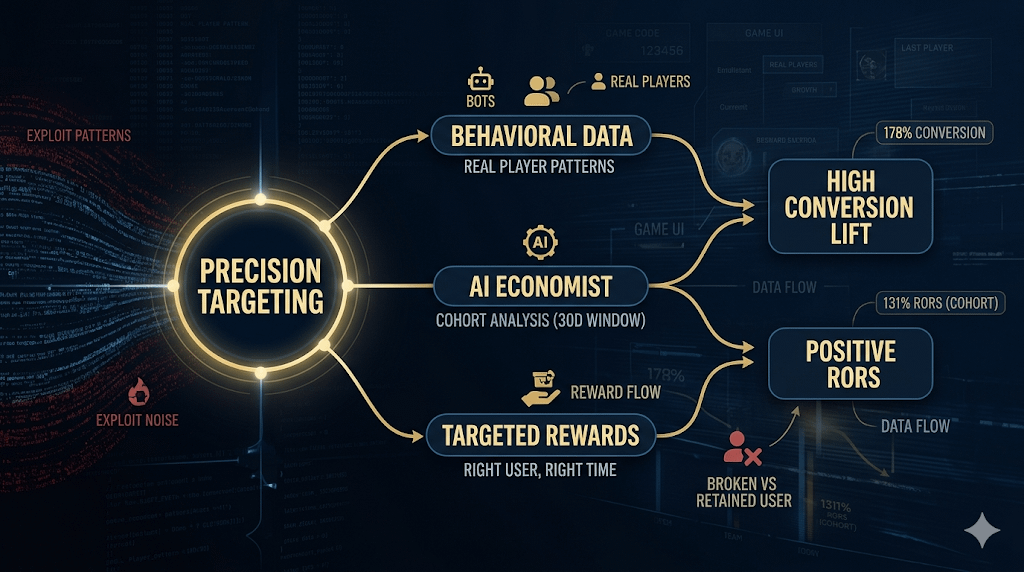
Most of it is. But precision targeting isn't just an algorithm. It's an algorithm plus the data the algorithm learns from. Specifically, behavioral data from a live environment under real adversarial pressure. Bot farming patterns. Reward abuse patterns. How player behavior shifts when token price drops. How engagement changes when an economy cracks. Each of those scenarios, playing out at sufficient scale, becomes a signal the model uses to separate retention behavior from extraction behavior.
Pixels has four years of that data. From 4,000 daily active users to one million, through two economy crises, through killing $BERRY entirely and rebuilding from scratch. Not four years of stable operation. Four years of getting attacked in new ways and adapting.
This is where the Stacked story gets more interesting than just "a good platform opening up to everyone."
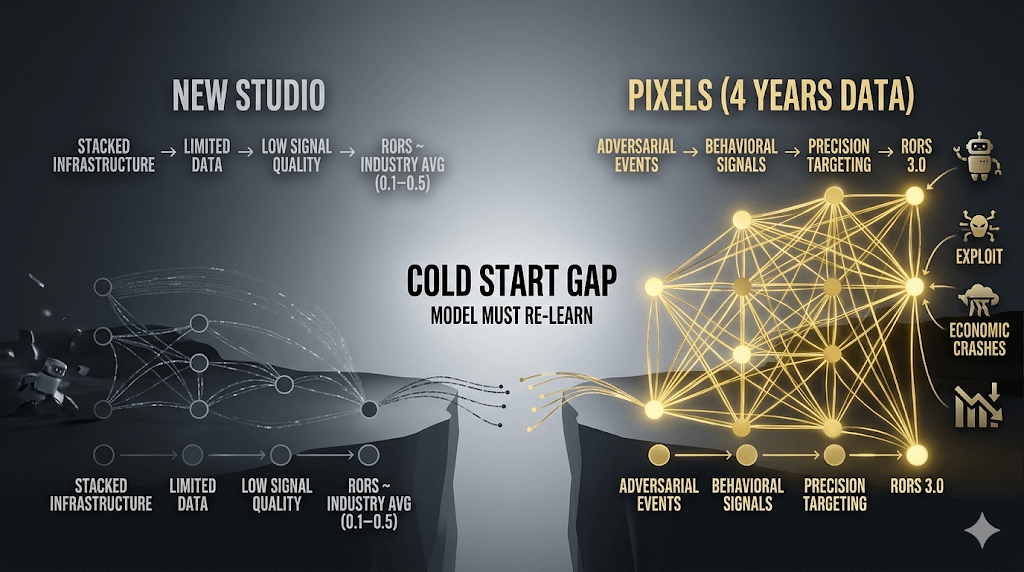
A studio that integrates Stacked next week gets real infrastructure: fraud prevention, the AI economist, targeting logic, payout systems, all of it functional from day one. What doesn't transfer is Pixels' behavioral data. The model needs to learn from scratch on a new player base, a different genre, a different community, a different incentive structure. During that period, precision is lower. And lower precision means lower RORS, closer to industry average than to 3:1.
I'd call that the cold start gap.
Not because the system doesn't work. Because behavioral signal takes time to accumulate before targeting can reach the precision Pixels has today. How long that gap lasts depends on how adversarial the player base is, how much gameplay event volume the studio generates, and how different the genre is from a farming open-world game. A battle royale and a casual idle game produce completely different behavioral signals, and the model builds its understanding of each one separately.
For anyone watching this ecosystem closely, that suggests a more specific way to read early results from studios newly integrating Stacked. The 3:1 benchmark came from a game with a very particular history, measured on cohorts the model had been learning from across multiple cycles. A new studio's RORS in the first 30 to 60 days is a different thing. If a project reports strong lift numbers in their first month on Stacked, the questions worth asking are: what was the baseline, how large was the cohort, and is the measurement window long enough to rule out one-off effects? RORS that looks good early often comes from measuring too short or cherry-picking a high-performing segment rather than the full player base.
Sustainable RORS above 1.0 needs three things working simultaneously: anti-fraud strong enough to remove noise from the signal, cohort targeting precise enough that rewards actually reach the right people, and economic sinks that prevent revenue from getting extracted immediately. If any one of those is weak, positive RORS can be temporary.
None of that makes Stacked less valuable. Outperforming industry average from day one is still a meaningful bar compared to building it yourself. But there's a real distinction between a system that works and a system that works at the precision Pixels has after four years of adversarial data.
The gap between 0.5 and 3.0 is not an infrastructure gap. Stacked closes it faster than anything else available. But a studio starting from zero and Pixels starting from four years of live data are not starting from the same place.