

Most crypto games try very hard to impress you.
They talk about digital ownership, token rewards, virtual economies, and the future of gaming. On paper, it all sounds exciting. But once you step inside many of these projects, the experience often feels cold. Too much focus on earning, not enough on enjoying. Too much economy, not enough world.
Pixels feels different.
That difference is probably why it caught so much attention.
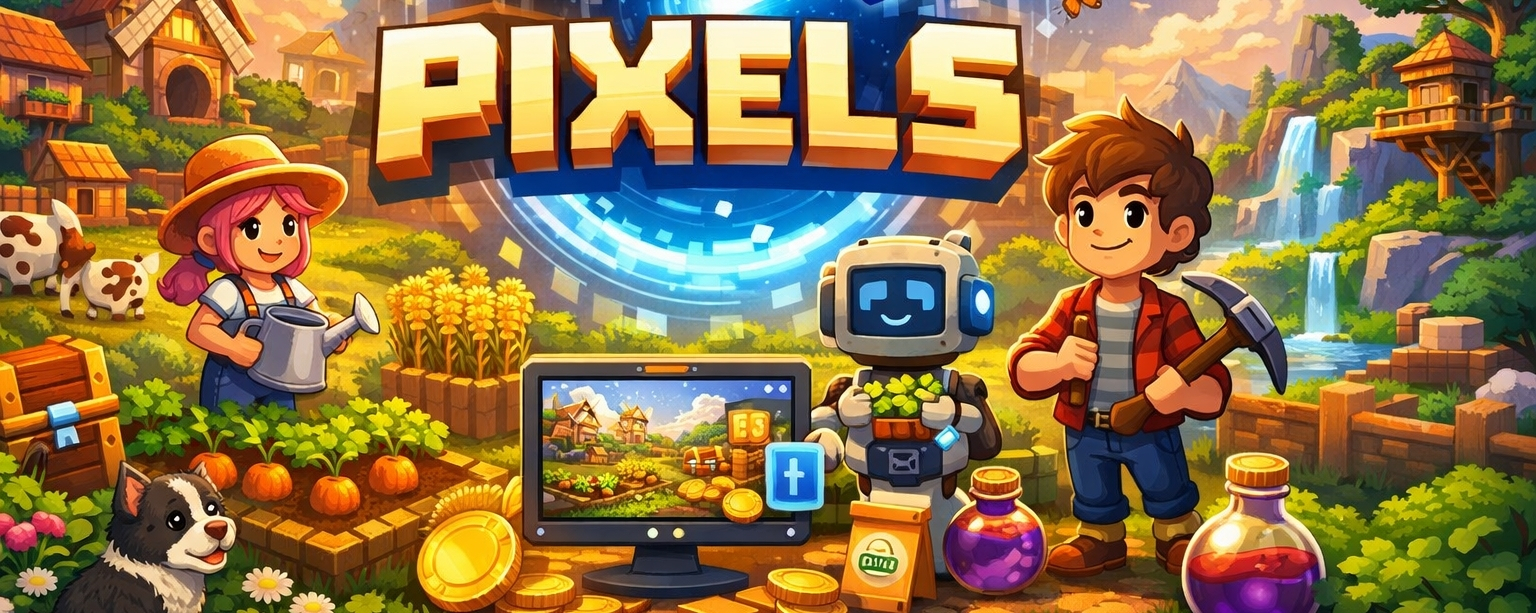
At its core, Pixels is a social farming game built on the Ronin Network. Players plant crops, gather resources, move around a shared open world, meet other players, complete quests, and slowly build their place inside the game. It is colorful, simple to understand, and easy to get into. Nothing about that formula sounds wildly new. In fact, that is exactly the point. Pixels did not become popular because it reinvented gaming. It became popular because it understood something many Web3 projects forgot: people like games that feel inviting.
That sounds obvious, but in crypto gaming it really is not.
For years, a lot of Web3 games were built around the economy first. Before players could enjoy the world, they had to understand wallets, token systems, NFTs, marketplaces, and earning mechanics. The experience often felt like work before it felt like play. Pixels came in with a softer approach. It did not demand too much too quickly. It gave players something familiar — farming, exploring, collecting, socializing — and wrapped the blockchain elements around that experience instead of putting them directly in the player’s face.
That made a huge difference.
There is something naturally comforting about farming games. They are built around routine. You log in, do a few tasks, grow a little, collect a little, improve a little. It is not intense, and it is not supposed to be. The pleasure comes from rhythm. Pixels understood that rhythm well. It created a game loop that felt relaxed without feeling empty. And because the world is shared with other players, the routine never feels completely isolated. You are not just harvesting crops alone in silence. You are walking through a space full of people doing the same thing in their own way.
That social feeling is one of the best things about Pixels.
A lot of blockchain games have users, but not all of them feel alive. There is a difference between a game having activity and a game feeling populated. Pixels managed to create that feeling of life. When you see other players around you, when the world looks busy, when movement and interaction are constant, the game stops feeling like a system and starts feeling like a place. That is much more powerful than most token incentives. People do not only come back for rewards. They come back because a place starts to feel familiar.
That is where Pixels got smarter than many of its competitors.
It did not rely only on Web3 excitement. It leaned into basic human habits — routine, community, progress, visibility. Those are strong emotional anchors. People like seeing their effort turn into something. They like shared spaces. They like games that do not make them feel stupid or late or overwhelmed. Pixels succeeded because it understood that the emotional experience matters just as much as the economic one.
Its move to Ronin helped amplify all of this.
Ronin already had a reputation in blockchain gaming, and Pixels arrived at a moment when the network was ready for something fresh. Instead of another heavily financialized game, here came a title that felt lighter, friendlier, and more socially engaging. That gave Ronin new energy, but it also gave Pixels the exact kind of audience it needed — users already familiar with crypto gaming, yet open to a more approachable style of play.
The result was explosive growth.
For a while, Pixels became one of the biggest stories in Web3 gaming. It attracted huge numbers of players and became one of the main reasons people were talking about Ronin again. That kind of rise does not happen just because of marketing. It happens when a product connects with people in the right way at the right time.
Still, the real story of Pixels is not just about growth. It is about balance.
Because as warm and approachable as the game feels, it is still part of the crypto world. And that means it still has to deal with one of Web3 gaming’s hardest problems: how do you build an economy without letting the economy take over the game?
That is where things become more complicated.
The PIXEL token gives the ecosystem another layer. It creates incentives, supports in-game systems, and adds financial meaning to player activity. In theory, that sounds useful. In practice, tokens are always tricky. They attract attention fast, but they also attract speculation. And once speculation enters the room, expectations change. Some players join because they enjoy the world. Others join because they hope the token will rise. That mix can work for a while, but it creates tension.
If players start treating the game mainly as a reward machine, the atmosphere changes. Routine becomes grind. Community becomes strategy. Play becomes extraction.
That is the danger almost every crypto game faces.
Pixels seems more aware of that danger than many projects before it. Over time, it became clear that the game could not rely only on handing out rewards and hoping excitement would sustain itself. A healthier system needs reasons for players to spend, engage, upgrade, commit, and care beyond quick short-term gain. In other words, the economy has to circulate inside the world, not just flow outward.
That lesson has been painful for the wider GameFi space, and Pixels is one of the clearest examples of a project trying to adjust in real time. It is not perfect, but it has shown signs of learning. That alone makes it more interesting than many flashy projects that burned hot and disappeared.
What also makes Pixels stand out is its tone.
It does not feel aggressive. It does not feel like it is constantly shouting at the player about opportunity. It feels more casual, more playful, more lived in. That tone matters a lot. In crypto, where everything is often marketed with urgency, a calmer and more welcoming atmosphere can actually become a competitive advantage. Pixels feels like a game you can live beside, not just a system you are supposed to optimize.
And that may be the most important reason it connected with people.
Not every player wants to feel like a trader. Not every player wants to study tokenomics before planting a crop. Many people just want to log in, move around, do a few satisfying things, and feel part of something active. Pixels offered that experience at a time when much of Web3 gaming still felt too mechanical.
Of course, that does not mean the game is above criticism.
The biggest challenge for Pixels is depth. Farming and resource loops can be charming, but charm alone does not carry a game forever. Repetition can be relaxing, but it can also become thin if the experience does not grow with the player. A cozy routine works well in the beginning. The harder question is what happens later. What keeps people emotionally invested after the novelty fades? What makes the world feel richer over time instead of just more familiar?
That is where Pixels still has something to prove.
It needs to keep building on its social strength while giving players more reasons to stay attached to the world itself. More meaningful progression, deeper systems, stronger identity, richer interactions — all of that matters if the project wants to become something lasting rather than something memorable.
Even so, Pixels has already achieved something important.
It showed that a Web3 game does not have to feel like a financial spreadsheet with avatars. It showed that accessibility matters. It showed that shared spaces matter. It showed that if a game feels friendly enough, players will forgive a lot of the blockchain complexity sitting underneath it. Most of all, it showed that the best Web3 experiences are usually the ones that do not constantly remind you that they are Web3 experiences.
That is why Pixels matters.
Not because it solved every problem. Not because its token changed the industry forever. Not because it is perfect.
It matters because it brought a little softness back into a space that often feels too hard, too technical, and too obsessed with numbers.
Pixels works when it feels like a world first and a crypto product second. When it leans into community, routine, familiarity, and simple pleasure, it becomes much more than another blockchain experiment. It becomes a place people actually want to return to.
And in Web3 gaming, that is rarer than it should be.
