
When people talk about “success” in a game like Pixels, they usually jump straight to numbers. Token price, active users, trading volume… that sort of thing. And sure, those matter. But after watching how these kinds of game economies behave over time, I’ve started to feel that most of those numbers only tell you what already happened—not what’s actually going on underneath.
A game economy doesn’t feel like a spreadsheet when you’re inside it. It feels closer to a small, shifting world where people are constantly testing what’s worth doing and what isn’t. Some days it feels busy and alive. Other days it feels like everyone is just repeating the same routine and hoping something changes.
That’s why I don’t trust a single KPI anymore. I’ve learned to look at patterns instead.
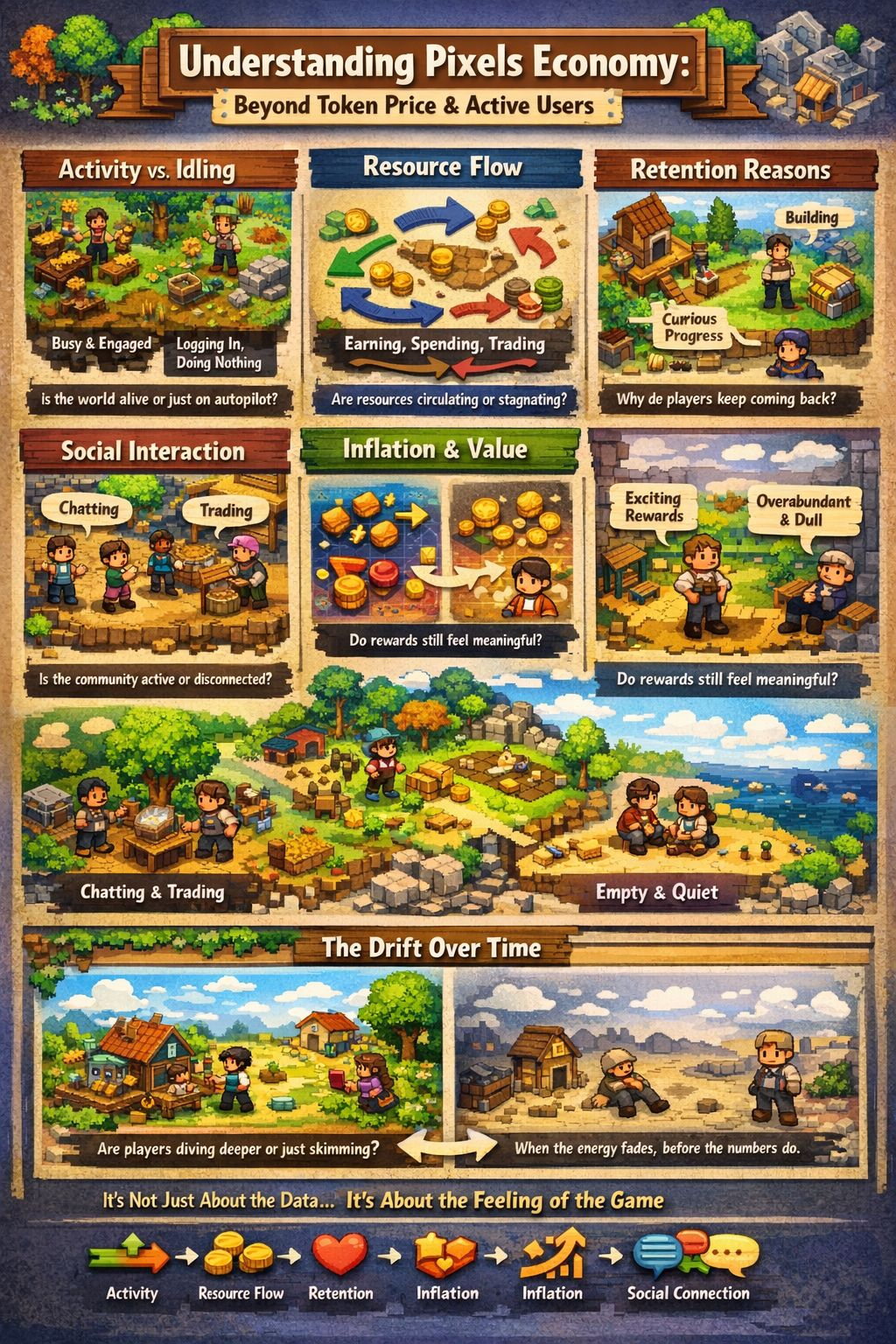
One of the first things I notice is simply whether people are doing things or just logging in.
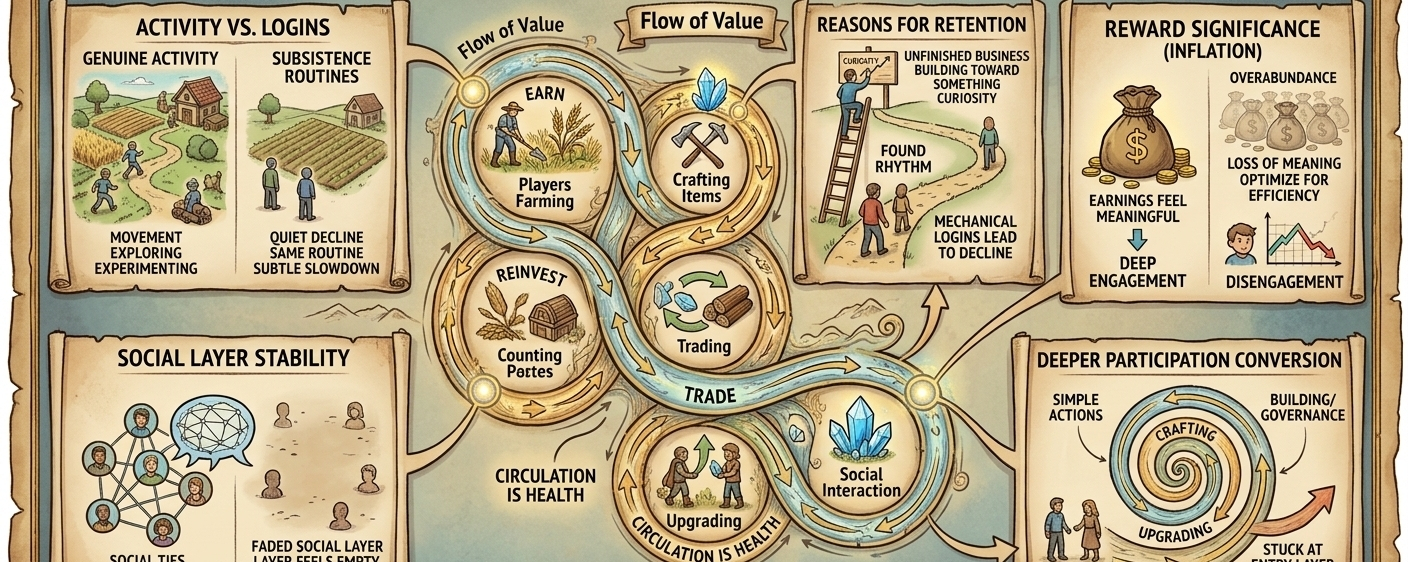
There’s a big difference between the two, even if dashboards treat them the same. In Pixels, real activity looks like movement—people farming, crafting, upgrading, talking, trading. You can almost feel when that energy is there. The world feels “in use.”
But when things start slowing down, it doesn’t always look like a crash. Sometimes it just turns quiet in a subtle way. People still show up, but they stop exploring. They stick to safe routines. They stop experimenting.
That shift tells you more than any chart line.
Then there’s the way resources move through the game.
This is something I didn’t fully appreciate at first. It’s not just about how much players earn—it’s about what happens after.
Do they spend it? Do they reinvest? Do they hold onto it because there’s nothing worth using it on?
When a game economy is healthy, resources feel like they’re constantly circulating. Nothing stays still for too long. People earn, spend, trade, lose, regain—it all keeps flowing.
But when that flow starts to freeze, you feel it in the gameplay before you see it in data. Players become more cautious. They hesitate. They start treating everything like it might be “too valuable” to use, which sounds good on paper but usually signals that the system is getting stuck.
Retention is another one that looks simple from the outside but feels very different in practice.
A lot of reports will break it down into Day 1, Day 7, Day 30 retention, like it’s a clean progression. But players don’t think in days—they think in reasons.
People come back to Pixels because something inside the game still feels unfinished for them. Maybe they’re building toward something. Maybe they’re curious what happens next. Or maybe they’ve just found a rhythm that fits into their day.
If that reason disappears, no amount of daily rewards can really replace it. They might still log in for a while, but it starts feeling mechanical.
And that’s usually the beginning of decline—not a sudden drop, but a slow loss of interest in what they’re doing while they’re there.
Inflation is something that doesn’t show itself immediately. It creeps in quietly.
At first, everything looks fine—players are earning, systems are active, numbers are growing. But over time, you start noticing something softer: what people earn doesn’t feel as meaningful anymore.
They might still be getting the same rewards, but it doesn’t change their experience the way it used to.
That’s when behavior shifts. People stop engaging deeply with systems and start optimizing for efficiency instead. Or worse, they disengage altogether because nothing feels worth the effort.
It’s not always about the token itself. Sometimes it’s just about whether progression still feels satisfying.
One thing I think gets overlooked a lot is the social side of it all.
Pixels isn’t just an economy—it’s also a space where people notice each other. Even small interactions matter more than they seem at first.
When players are active socially—trading, chatting, reacting to what others are doing—the economy feels more stable. It has more “texture.” Even if numbers fluctuate, people stay engaged because they feel connected to something larger than their own progress.
But when that social layer fades, the game can feel strangely empty, even if everything technically still works. And once it feels empty, it becomes harder to keep people invested in the systems that depend on interaction.
There’s also something about how players convert attention into deeper participation.
A lot of games get stuck at the surface level—people log in, do a few basic actions, and leave. That can look like success in analytics, but it doesn’t always mean the economy is healthy.
What really matters is whether players naturally move deeper over time. Do they start with simple actions and gradually get involved in crafting, trading, upgrading, building? Or do they stay stuck at the entry layer?
When that deeper movement slows down, growth starts to feel fragile, even if everything on the surface looks stable.
At some point, I stopped thinking of KPIs as separate boxes to check. In something like Pixels, they overlap too much for that.
Activity, flow, retention, inflation, social behavior—they all feed into each other. You can’t really understand one without watching the others shift around it.
And maybe that’s the main thing I’ve learned: a game economy doesn’t fail loudly most of the time. It doesn’t just collapse in one obvious moment. It drifts. Slowly. Quietly. Until one day you realize the system still exists, but the energy that made it interesting isn’t really there anymore.
The numbers might still be there. But the feeling changes first.