
I was sitting in a quiet café in Islamabad, watching a group of kids huddled over one phone, laughing as they passed virtual crops back and forth in some simple mobile game. No wallets, no gas fees, just pure shared fun that cost nothing beyond the data. It reminded me how games used to feel like a common space, not a marketplace.
Later that evening, I opened Binance Square and took on the campaign task: drafting thoughts for “A Comparative Study of Pixels and Traditional Gaming Economies.” I scrolled through the project details, clicked into the economy comparison sections, and paused at the land ownership and staking interfaces. That moment—staring at the farmland plots listed with real ownership claims on the Ronin side—hit me oddly. It forced me to confront how blockchain layers real financial stakes onto what was once just pixels on a screen.
The uncomfortable idea that surfaced is this: true player ownership in crypto games might quietly erode the very escapism that made gaming valuable in the first place. We’ve long believed that giving players actual economic control through tokens and NFTs liberates them from greedy publishers. But what if it binds them tighter to market logic, turning leisure into another form of labor where fun must justify itself on a balance sheet?
Traditional games often hide their economies behind polished progression systems. You grind, you unlock, you feel a sense of achievement without ever seeing the company’s revenue model intrude directly. The joy comes from the illusion of a self-contained world. In contrast, when I reviewed the Pixels farmland mechanics during that task, the ownership felt transparent yet heavy. Every plot wasn’t just a fun farming spot; it carried the weight of potential yield, staking rewards, and secondary market value. The screen element that triggered this was the visible “own your world” framing next to the land listings—it made the game feel less like a retreat and more like a small business you manage in your spare time.
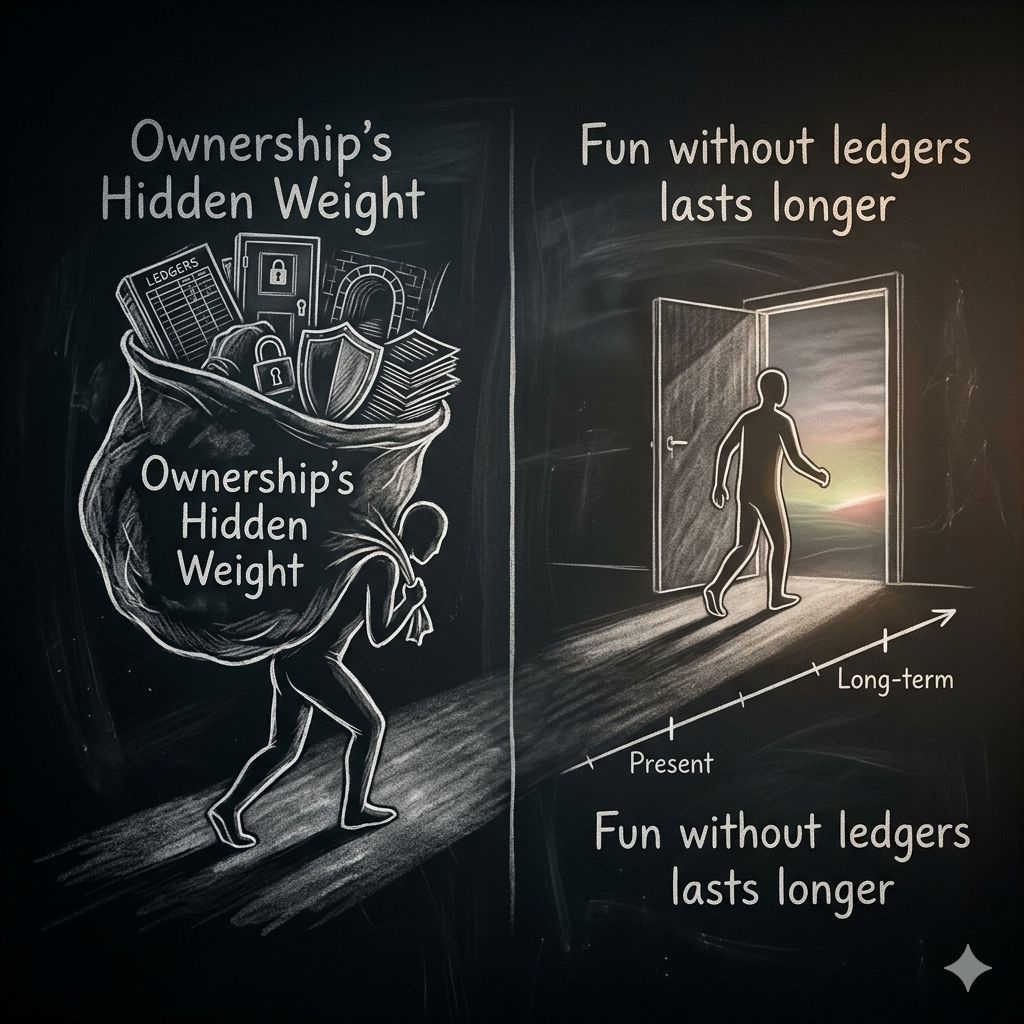
This extends beyond any single title. Many in crypto hold the belief that on-chain assets create fairer, more sustainable systems because players can exit with real value. Yet the comparison I was outlining showed how traditional economies, for all their flaws and centralized control, often sustain longer player engagement precisely because they don’t demand constant economic mindfulness. You play to forget the real world, not to replicate its incentives. When every harvest or upgrade ties back to token utility, the risk is that enjoyment becomes conditional on profitability. Players start calculating opportunity cost instead of losing themselves in the moment.
Pixels serves as a clear example here. Its farming and exploration loop draws from nostalgic pixel art roots, but the integrated economy—complete with dual-token designs and land that players truly hold—highlights the shift. During the task, comparing the lightweight joy of classic farming sims to this blockchain version revealed how ownership adds depth for some while adding pressure for others. It’s not that the game lacks fun; it’s that the fun now coexists with an undercurrent of financial transparency that traditional studios deliberately obscure.
What disturbs me most is how this reframes gaming from a universal pastime into a stratified activity. Those who treat it as investment thrive in the new model, while casual players who just want distraction might drift away, feeling the invisible ledger tracking their every click. We celebrate decentralization as empowerment, but it can also import the anxieties of capitalism into spaces once reserved for carefree play. The common belief that crypto fixes gaming’s broken publisher-driven economies starts to look incomplete when you realize it might replace one form of extraction with another—self-imposed this time.
In the end, I’m left with one unresolved but confident question: if ownership truly enriches the player experience, why does the deepest immersion still seem to happen in worlds where nothing is truly “yours” to sell? @Pixels #pixel $PIXEL @