
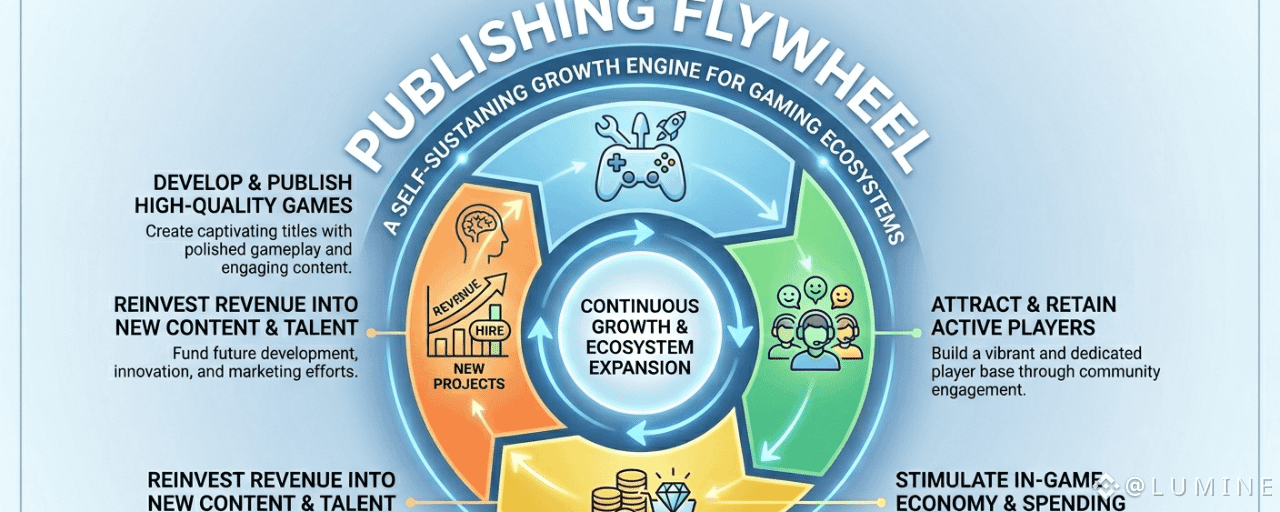

The Publishing Flywheel is designed as a self-reinforcing growth system that connects three core elements: data insights, publishing strategy, and player incentives. Instead of treating growth as a one-time effort or a linear process, it builds a continuous loop where every improvement strengthens the next stage of the ecosystem.
At its core, the idea is simple but powerful: better games attract better data, better data improves decision-making, and better decisions reduce costs and increase efficiency. Over time, this creates a system that doesn’t just grow, but becomes smarter with each cycle.
It all starts with attracting higher-quality games into the ecosystem. When strong games enter the platform, they naturally bring more engaged players. These players generate richer behavioral data because they interact more deeply, stay longer, and contribute meaningful patterns of activity. This data is far more valuable than surface-level engagement metrics—it reflects real intent, preferences, and long-term behavior.
Once this richer dataset is collected, it becomes the foundation for precision targeting. Instead of broad, inefficient marketing strategies, the system can identify exactly which players are most likely to engage with which types of games. This level of understanding dramatically improves user acquisition efficiency. Marketing spend is reduced because resources are no longer wasted on irrelevant audiences. Every dollar works harder because it is guided by real behavioral insight.
As user acquisition costs decrease, the ecosystem becomes more attractive to developers and publishers. High-quality game creators are always looking for platforms where growth is efficient and sustainable. When they see that acquiring users is cheaper and more effective, they are more likely to join the ecosystem. This leads to another wave of better games entering the system.
This is where the flywheel effect becomes visible. Better games lead to better data. Better data leads to smarter targeting. Smarter targeting lowers costs. Lower costs attract better games again. Each step strengthens the next, creating momentum that compounds over time.
What makes this approach powerful is that it removes reliance on external spikes of growth. Instead of depending on temporary marketing pushes or unpredictable trends, the system builds its own internal engine for expansion. Growth is no longer something that has to be forced—it becomes something that naturally emerges from the structure of the ecosystem itself.
Another important aspect of the Publishing Flywheel is the role of player incentives. Players are not just passive participants; they are active contributors to the system. Their behavior generates the data that powers the entire loop. When players are rewarded in meaningful ways for their actions, they engage more deeply and consistently. This improves data quality even further, making the system more accurate and effective.
In this sense, player incentives are not just about engagement—they are about fueling the entire ecosystem. When players feel that their time and actions matter, they naturally contribute to a healthier data environment. That improved data then feeds back into better targeting and better game discovery, which again improves the player experience. It becomes a closed loop where everyone benefits.
Over time, this structure leads to what can be described as self-sustaining growth. The ecosystem no longer relies heavily on external intervention to maintain momentum. Instead, each cycle reinforces the next, creating a compounding effect. The more it grows, the more efficient it becomes. The more efficient it becomes, the more attractive it is to both players and developers.
This is especially important in gaming ecosystems where user acquisition costs are often one of the biggest challenges. Traditional models rely heavily on constant spending to bring in new users, which can make scaling expensive and unsustainable. The Publishing Flywheel changes this dynamic by turning acquisition into a data-optimized process rather than a brute-force one.
As the system matures, the quality of insights improves as well. Early data might help with basic targeting, but over time, the depth of understanding becomes significantly more refined. The system begins to recognize not just what players do, but why they do it. This allows for even more precise alignment between games and audiences.
At the same time, publishers benefit from a more stable and predictable environment. Instead of competing in inefficient markets, they are part of a structured ecosystem where discovery is optimized. This reduces friction and increases the likelihood of long-term success for the games within the platform.
Ultimately, the Publishing Flywheel is about creating alignment between all parts of the ecosystem. Players get more relevant experiences. Developers gain more efficient access to their target audiences. The platform itself becomes more intelligent and self-improving over time.
What makes it powerful is not any single feature, but the way all the components work together in a continuous loop. Each cycle improves the next, and there is no fixed endpoint. Growth becomes an ongoing process of refinement and expansion.
In this model, success is not measured only by short-term metrics, but by the strength of the system itself. If the flywheel is working correctly, every new game, every new player, and every new data point contributes to making the entire ecosystem stronger.
That is the essence of the Publishing Flywheel: a self-sustaining system where data, publishing, and incentives work together to create continuous, compounding growth over time.
