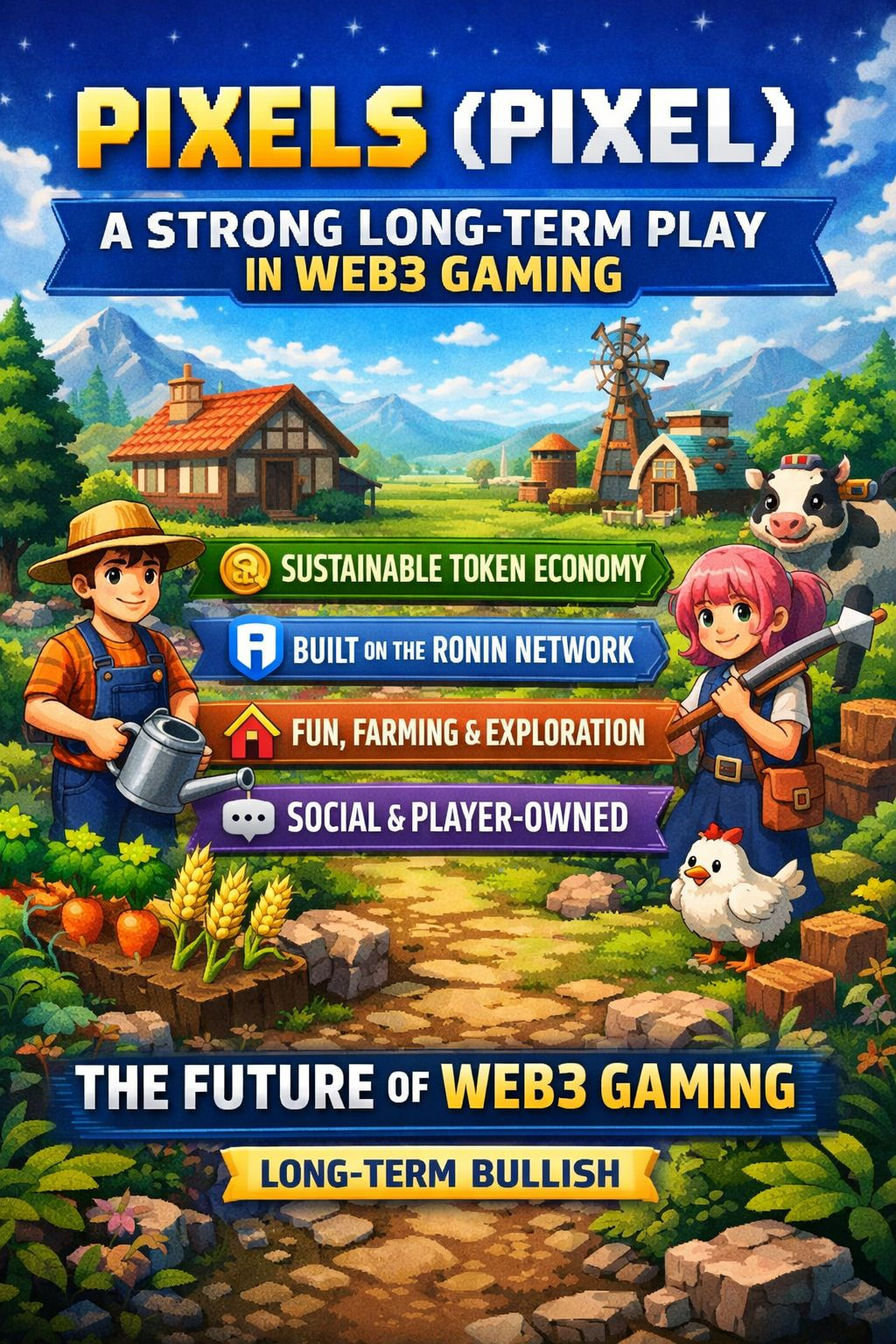
In a market where most Web3 games struggle to survive beyond hype cycles, Pixels (PIXEL) stands out as a project built on sustainability, usability, and real player engagement. Rather than relying on short-term incentives, Pixels is quietly positioning itself as a long-term leader in the GameFi sector.
At its foundation, Pixels delivers a simple yet highly effective gameplay model centered around farming, exploration, and crafting. This design choice is strategic. By keeping mechanics easy to understand, the game attracts a broader audience — including users with no prior crypto experience. This accessibility directly translates into higher user retention, which is one of the most critical metrics for any Web3 ecosystem.
What makes Pixels fundamentally strong is its balanced economic structure. Unlike many play-to-earn projects that collapse under token inflation, Pixels integrates its native token, $PIXEL, into essential gameplay functions. Players need the token for upgrades, progression, and in-game utility, creating organic demand instead of artificial reward pressure. This approach supports a healthier and more sustainable token economy over time.
The decision to build on the Ronin Network further strengthens the project’s long-term outlook. Ronin provides low transaction fees and fast execution, eliminating one of the biggest barriers in blockchain gaming. This allows players to interact with the ecosystem seamlessly, making the experience feel closer to traditional gaming while still benefiting from Web3 ownership.
From a macro perspective, Pixels is aligned with the next phase of GameFi evolution — shifting from “earn-first” models to “fun-first, economy-second” systems. This transition is crucial because only games that are genuinely enjoyable will retain users during market downturns. Pixels already demonstrates this resilience through its growing player base and active community.
Another key strength is its social layer. Pixels is not just a solo farming game; it is a shared digital environment where players trade, collaborate, and build together. This social interaction increases engagement time and strengthens the in-game economy, both of which are essential for long-term success.
However, like any developing project, there are risks. The sustainability of rewards, the balance of token supply, and competition within the Web3 gaming space remain factors to watch. That said, Pixels appears to be managing these challenges more effectively than most projects in its category.
In conclusion, Pixels (PIXEL) is not built for short-term hype — it is designed for long-term growth and adoption. With strong fundamentals, a scalable ecosystem, and a focus on real user experience, it holds the potential to become one of the defining projects in the future of Web3 gaming.