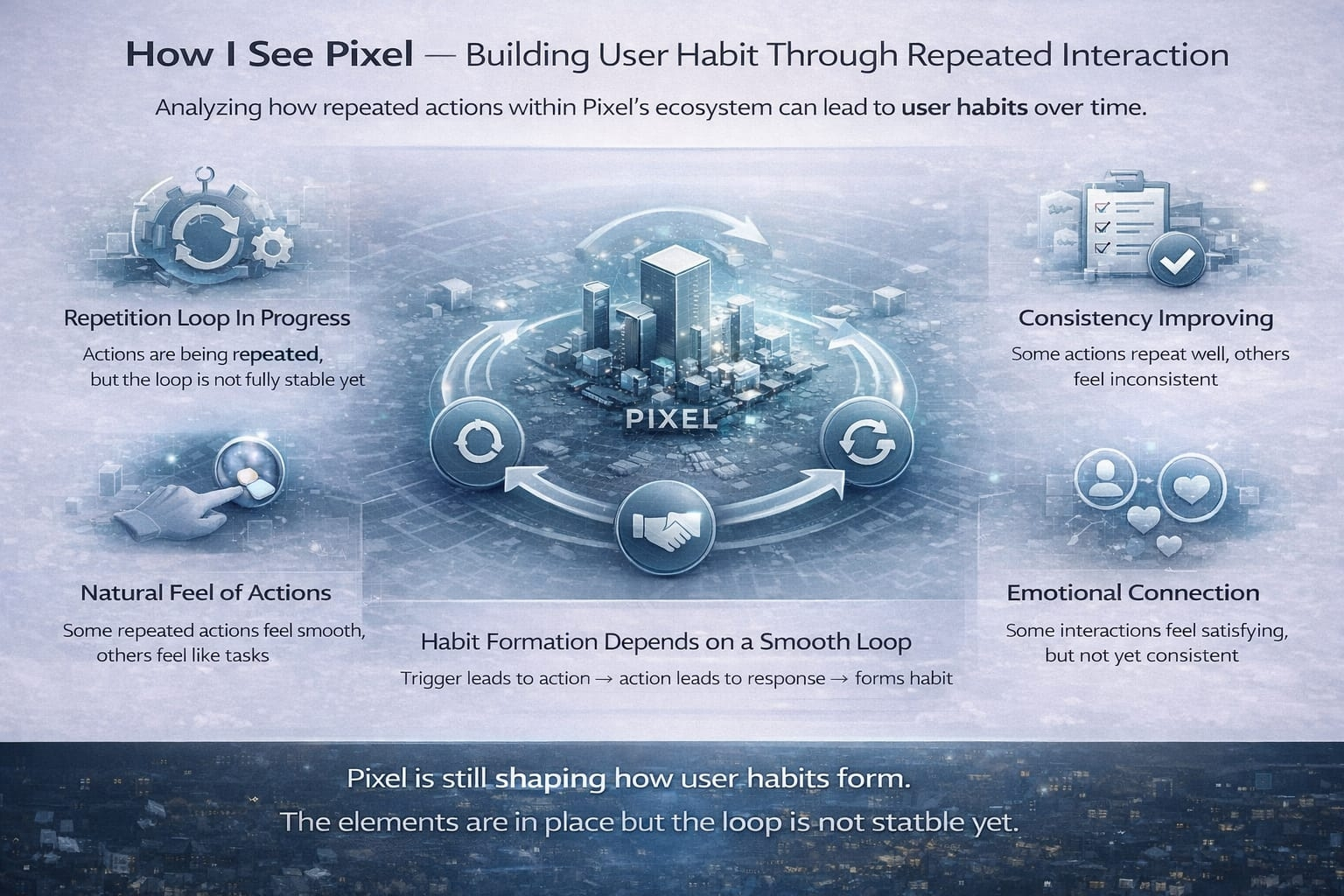
I am analyzing how Pixel builds user habit through repeated interaction patterns. I am not focusing on features individually. I am focusing on how repeated actions inside the system slowly turn into behavior over time.
In any gaming ecosystem, habit is what keeps everything alive. If users don’t form a habit, they don’t return consistently. And if they don’t return, the system loses its strength.
That is why I am paying close attention to how Pixel handles repetition.
When I think about habit, I don’t think about forced repetition. I think about natural repetition. The kind that feels smooth and unplanned. The kind where a user returns without feeling pressure.
Right now, I feel Pixel is trying to move toward that direction, but it is still early.
I notice that repeated interactions are present, but they are not fully structured into a strong loop yet. Some actions feel like they can become routine, but they are not deeply connected to user behavior right now.
That tells me the system is still shaping its internal rhythm.
Habit formation usually depends on a simple loop. A trigger leads to an action, and that action leads to a response. When this loop feels smooth and consistent, it starts repeating automatically.
In Pixel, I feel the action part is visible. Users can interact, explore, and move through the system. But the connection between trigger and response is still developing.
Sometimes the system invites interaction naturally. Other times, it feels like the user has to decide everything on their own.
That small difference matters a lot.
Because habits are not created when users think too much. They are created when actions feel automatic.
I also observe timing.
If interaction opportunities appear at the right moments, users stay in rhythm. If timing feels random, the flow breaks.
In Pixel, I feel timing is still being adjusted. It is not fully aligned yet, but it is not completely off either.
This creates a situation where habit can begin to form, but it is not strong yet.
Another thing I focus on is consistency.
For a habit to become stable, the system must behave in a predictable way. If the same action gives different types of responses, users don’t build trust.
Right now, I feel Pixel is still improving this consistency.
Some interactions feel stable and repeatable. Others feel slightly different each time.
That inconsistency does not break the system, but it slows down habit formation.
I also think about how repetition feels.
Repetition should not feel like a task. It should feel like part of the experience.
If users feel they are repeating something just to continue, they lose interest.
But if repetition feels natural, they continue without resistance.
In Pixel, I feel this balance is still being developed.
Some repeated actions feel smooth and easy. Others still feel like they need better integration into the overall flow.
This shows the system is still refining how repetition fits into user experience.
I also think about emotional response.
Habit is not only behavior. It is also emotional connection.
If a user feels a small sense of satisfaction after repeating an action, they are more likely to return again.
Right now, I feel Pixel is still developing this emotional layer.
There are moments where interaction feels satisfying, but it is not consistent across the system yet.
That means habit formation is possible, but not fully established.
Another important part is re-engagement.
A strong habit system allows users to return easily without confusion.
If coming back feels simple, habit strengthens.
If it feels disconnected, users hesitate.
In Pixel, I feel re-engagement is still being shaped.
It is not difficult, but it is not fully optimized either.
This again shows that the system is still evolving.
When I step back and look at everything, my understanding becomes clear.
I see Pixel as a system that is trying to build user habit through repeated interaction patterns, but it is still in the process of strengthening that loop.
The foundation is present.
The direction is visible.
But the structure is not fully complete yet.
And that is normal for a developing gaming ecosystem.
I am not expecting a perfect habit system at this stage.
I am only observing how repetition slowly turns into behavior over time.
Because once a habit becomes stable, users don’t need motivation anymore.
They return naturally.
Right now, Pixel is moving toward that stage, but it has not fully reached it yet.
And that is what I am watching closely.