I did not start seeing Pixels differently because of a new feature.
I started seeing it differently when I stopped reading its reward system like a gift and started reading it like a confession.
That was the real shift for me.
For a long time, a lot of Web3 games felt like they were built on one lazy belief: if rewards are big enough, the game will take care of itself. Players will come. Activity will rise. The world will look alive. On the surface, that idea always feels convincing. A busy economy looks healthy from a distance. A crowded game feels successful from a distance. But distance hides a lot. The more I think about Pixels, the more I feel the real danger in these systems is not small rewards. It is careless rewards.
That is what changed the way I read the project.
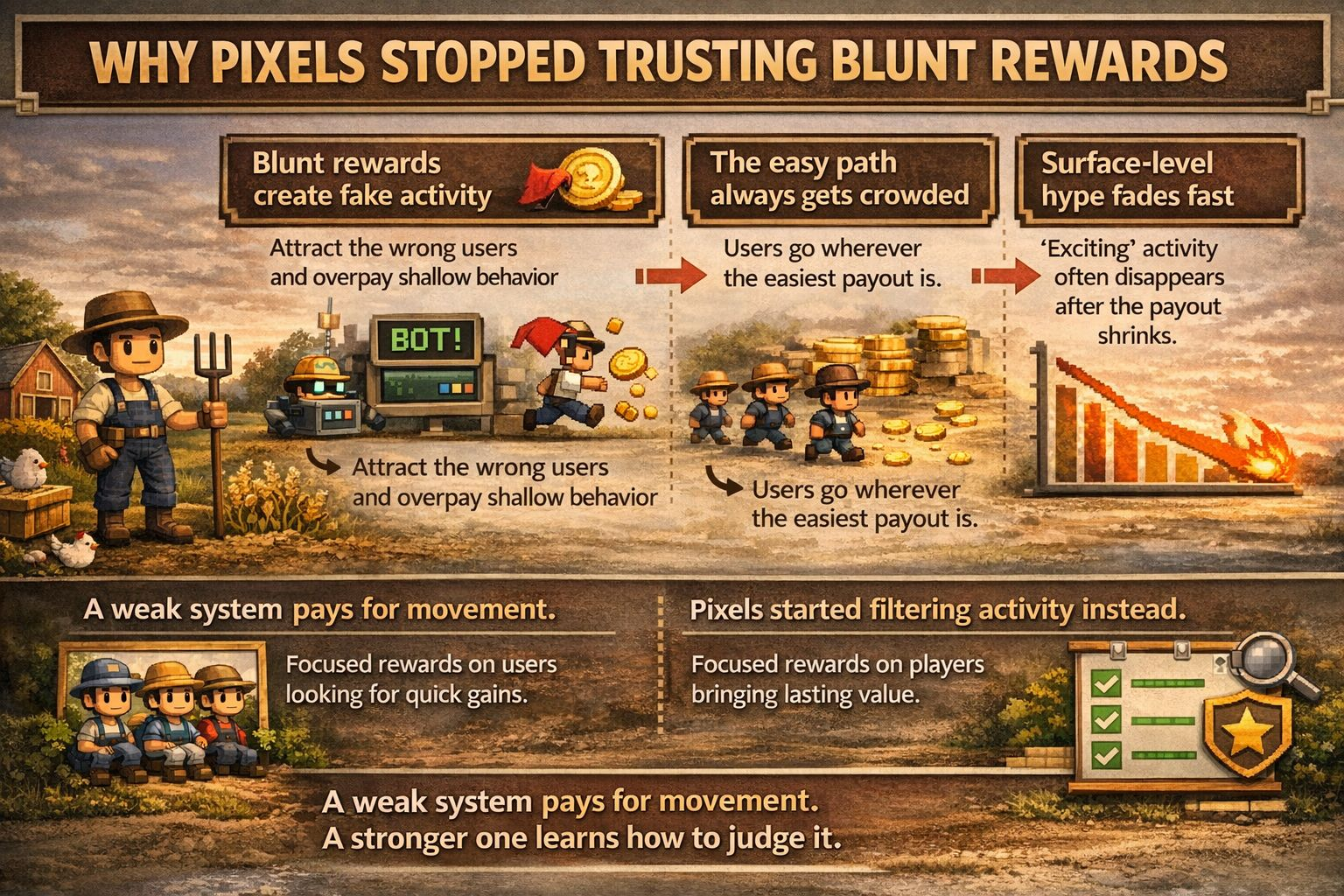
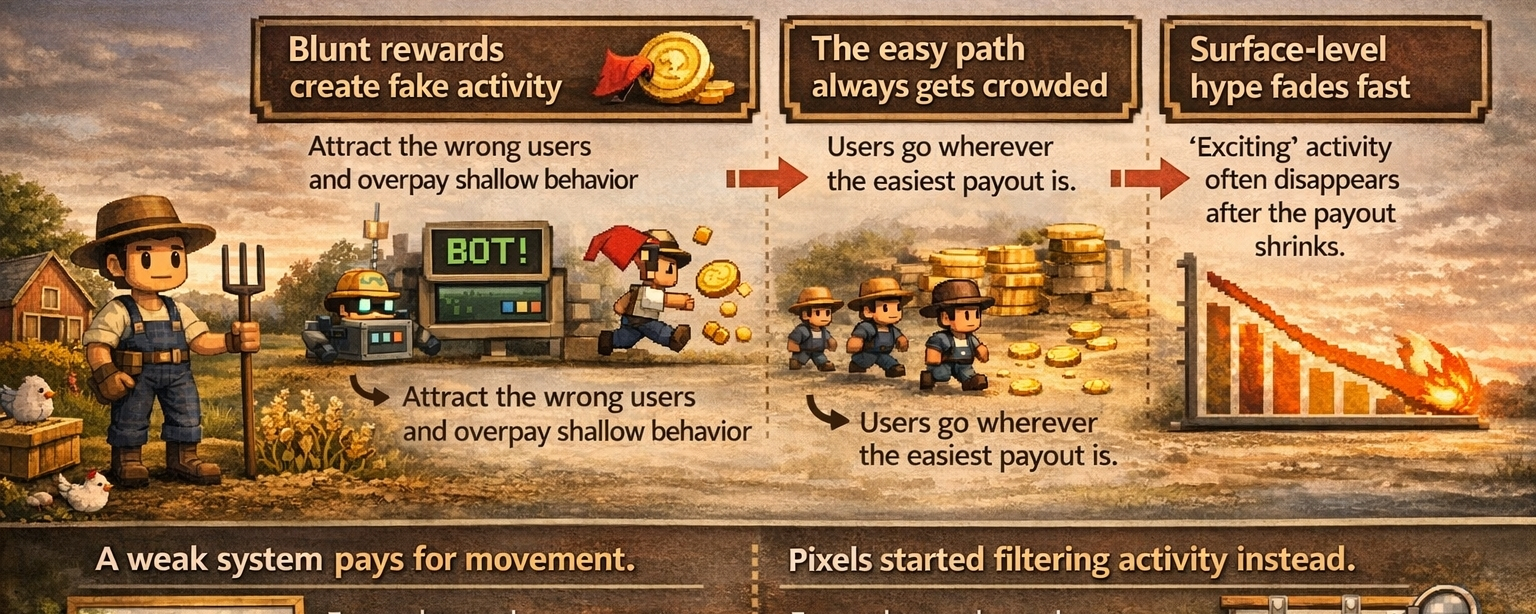
Because blunt rewards do something very seductive at first. They make everything look like growth. More movement. More farming. More repetition. More people chasing the same routes. For a while, that can create the illusion that the system is working. But the truth is harsher than that. If rewards are too loose, they do not just attract players. They attract shortcuts. They attract shallow behavior. They attract people who are not trying to understand the world, only trying to extract from it before the edge disappears.
And once that happens, the reward system stops supporting the game.
It starts hollowing it out.
That is why this topic feels more important to me than most of the usual discussion around Pixels. The farming loop is visible. The token is visible. The quests are visible. But reward design is where a project quietly reveals what it actually understands about human behavior. That is where I think Pixels became more interesting. Not because it stopped believing in rewards, but because it started looking like a team that no longer trusted easy rewards.
That difference matters.
A project that worships broad rewards is usually saying one thing without admitting it: “We still need to buy attention.” A project that starts tightening reward logic is saying something else: “Attention is not enough anymore. Now we need to decide what is worth rewarding.”
That is a much more serious conversation.
And honestly, I think it is the conversation most Web3 games avoid for too long.
Because once you ask that question properly, the entire tone changes. You stop treating all activity as equally valuable. You stop assuming every player should be paid the same way. You stop pretending every spike in participation means the world is getting stronger. Instead, you start separating useful behavior from disposable behavior. You start seeing that some users build the system and some users simply drain it. You start realizing that rewards are not just fuel. They are judgment.
That is the word I keep coming back to.
Judgment.
A game economy becomes more mature the moment it stops asking, “How do we reward more?” and starts asking, “Who actually deserves more, and why?”
To me, that is where Pixels feels more grown-up than a lot of people give it credit for. The project feels less interested in rewarding motion for its own sake and more interested in filtering for better motion. Better participation. Better alignment. Better reasons to stay. That does not sound exciting in the shallow marketing sense. It is not the kind of thing that creates cheap hype. But it is the kind of shift that makes a world feel less fragile.
And fragile is the right word here.
A lot of reward-driven games look strong right until the moment you realize the economy is being carried by habits that are not durable. People are there because the route is easy. Because the payout is soft. Because the system has not learned how to say no yet. That kind of growth is always living on borrowed time. Sooner or later, the math gets tighter, the easy path gets crowded, and the illusion breaks.
That is why I think blunt rewards are so dangerous.
They do not fail immediately.
They fail after they have already trained the wrong behavior.
And once a game teaches users to treat the world like a vending machine, it becomes very hard to persuade them to care about anything deeper than output.
That is why Pixels feels more interesting to me now. Not because it has solved everything. Not because every part of the system is perfect. But because it seems to understand that reward design is not just an economic tool. It is a cultural tool. It teaches players what kind of world they are standing inside. A careless reward model teaches people to farm the system. A sharper one teaches people that access, value, and participation are not all the same thing.
That difference matters more than most people think.
Because in the end, the strongest game economies are not the ones that reward the most activity.
They are the ones that get better at deciding which activity should still matter after the easy excitement is gone.
That is why I do not think the real story in Pixels is simply that it still uses rewards.
I think the more important story is that it seems to have stopped trusting rewards that are too easy, too broad, and too blind.
And to me, that is a much stronger sign of life than another wave of incentives ever could be.
A weak system pays for movement.
A stronger one learns how to judge it.