
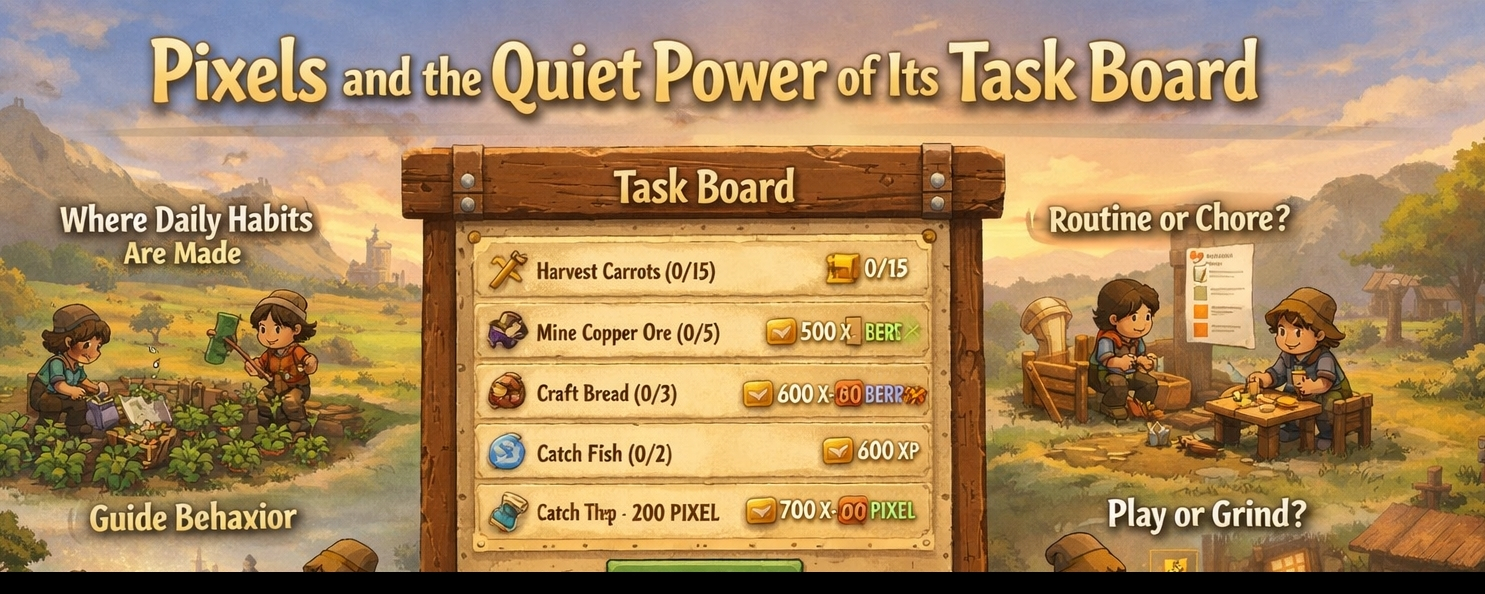

Pixels closely right now, and the part I keep coming back to is the task board. The more I look at the project, the more it feels like this is where the real story is. Not in the louder parts, not in the surface activity, but in the small daily system that quietly shapes how people play, why they return, and how long that return actually lasts. For me, that says more about Pixels than almost anything else.
At first glance, the task board can seem simple. It gives players direction. It gives them something to do when they log in. It helps create movement inside the game. But I don’t think it’s just a support feature. In a project like Pixels, systems like this end up doing much more than they appear to. They guide behavior. They create routine. They tell players what kind of effort matters and what the project is really asking from them every single day.
That’s why I keep paying attention to it.
I’ve seen enough projects to know that the daily loop is usually where the truth comes out. A project can have attention, strong branding, and a lot of conversation around it, but none of that means much if the day-to-day experience starts feeling thin. Once the early curiosity fades, people stop giving time so easily. At that point, the question becomes very simple: does the project still feel worth returning to when the novelty is gone?
That’s the real test for Pixels too.
What I find interesting is that the task board sits right at the center of that test. It is the system that turns attention into habit. It gives the project its daily rhythm. It creates a pattern that players either settle into naturally or slowly begin to resist. And that difference matters more than people sometimes admit. Because the health of a project is not just about whether people show up. It’s about how they show up, what mindset they bring with them, and whether the routine feels alive or just functional.
That’s where I think Pixels has something important to prove.
A good system gives structure without making people feel managed. It gives players enough direction to stay involved, but still leaves room for the experience to feel like play instead of obligation. That balance is hard. Most projects miss it. They either become too loose, where people lose purpose, or too mechanical, where everything starts to feel like a checklist. When that happens, users may still remain active for a while, but the quality of that participation starts to change.
And that change is usually quiet at first.
People don’t always leave the moment a system gets repetitive. More often, they stay, but their relationship with the project becomes thinner. They stop leaning into the world and start moving through it more efficiently. They do what is needed, collect what they can, and leave. The routine still exists, but it no longer feels meaningful in the same way. That’s the kind of shift I always watch for, because once a project becomes too transactional, it becomes much harder for real attachment to grow.
That’s why I think the task board matters so much in Pixels. It’s not only there to keep players busy. It plays a big role in deciding whether the project feels sustainable or draining over time. It shapes the pace of the game. It shapes the type of effort players repeat. It even shapes whether participation feels personal or just assigned. In that sense, it does much more than distribute rewards. It quietly defines the kind of relationship players are building with the project itself.
To be fair, I don’t think structure is a weakness. In fact, one of the most common problems in projects like this is lack of structure. A lot of teams assume people will create their own meaning if they are given enough freedom, but most players do not come back every day for vague possibilities. They come back for rhythm, purpose, and a feeling that their time inside the project still leads somewhere. Pixels does understand that. The task board gives players a clear reason to return, and that clarity is valuable.
But clarity only helps if the routine continues to feel justified.
That’s the part I keep thinking about. Not whether the board works in a basic sense, but whether it keeps working after repetition sets in. Does it continue to support engagement, or does it slowly become a chore system with rewards attached to it? Does it help Pixels feel more alive, or does it make the project feel narrower over time? That line is thin, and once a project crosses it, players usually notice before the numbers fully show it.
For me, this is why the task board feels so central to Pixels. It’s where the project reveals what kind of behavior it wants to build. It’s where retention either becomes something natural or something forced. It’s where daily participation either deepens into habit or flattens into routine labor. And in projects like this, that difference ends up meaning almost everything.
So when I look at Pixels, I don’t just see the task board as one feature among many. I see it as one of the clearest reflections of the project’s long-term strength. It shows whether Pixels can hold people through lived routine, not just through initial attention. It shows whether the project is building a world people want to stay inside, or simply a system they pass through for rewards.
I’m still watching that closely. Because with Pixels, I think the answer will show up there first, in the ordinary daily pattern, long before it becomes obvious anywhere else.