
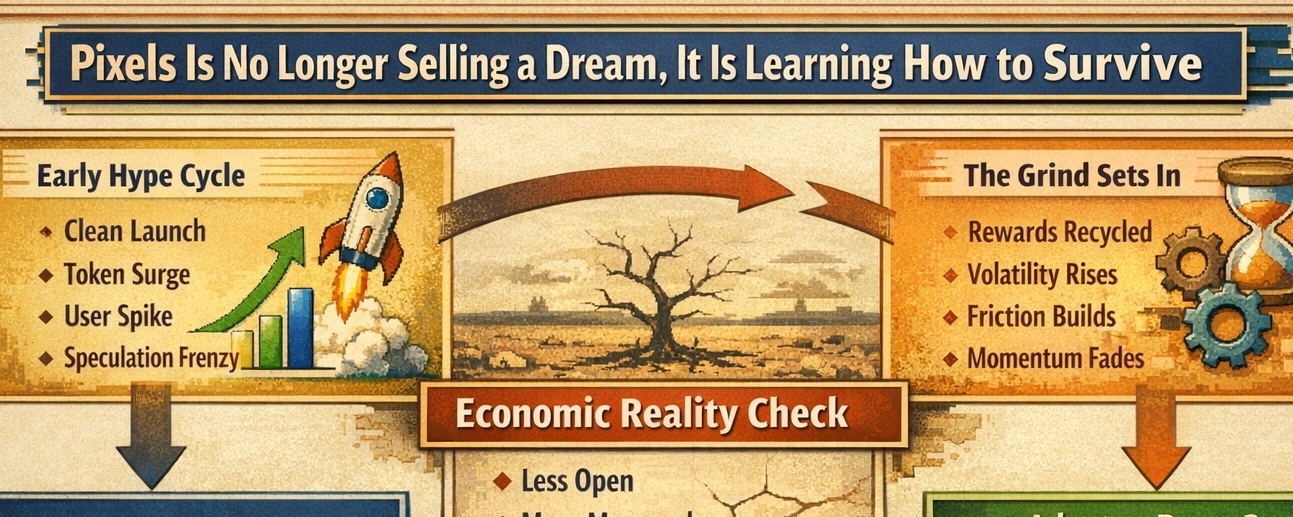
Pixels has been around long enough now that I’m no longer interested in the easy version of its story.
I’ve seen too many crypto projects follow the same familiar arc. A clean launch. A token. A burst of users. A wave of certainty. Then the slow grind begins. Rewards get recycled into noise. Speculation starts doing the emotional work the product itself can’t sustain. For a while, the community calls that momentum. Then friction shows up. Then people start pretending friction is actually proof of engagement. I’ve seen that cycle too many times to romanticize it.
That’s why Pixels has my attention now, but not for the reasons most people lean on.
At a glance, it still looks simple. Farming. Land. Resources. Social loops. A token economy humming underneath. Fine. That version is easy to explain. Too easy, honestly. On the surface, it still sells calm, routine, and accessibility. But underneath, the project feels heavier now. More managed. More intentional. Less like a game that happens to contain an economy, and more like an economy that learned it needed a softer face.
I don’t mean that as an insult.
A lot of projects never even reach this stage because they spend too much time worshipping simplicity. They convince themselves one token can do everything. Reward users. Retain users. Attract speculators. Signal value. Finance growth. Hold the whole system together while being traded like a mood ring. That story almost always breaks. Sometimes it breaks suddenly. Sometimes it just decays slowly. The chart weakens. Users thin out. Activity remains, but meaning disappears. The whole thing turns into an incentive recycling machine dressed up as a living world.
Pixels doesn’t feel blind to that anymore. Or at least it behaves like a team that has already been forced to learn that lesson.
That matters to me.
What I see now is a project trying to move pressure away from one obvious fault line. Not remove the token. Not pretend markets don’t matter. But reduce the load. Spread the risk. Build more rails. Separate different kinds of activity so the whole world doesn’t rise and fall on the same narrow financial loop. That kind of work is never glamorous. Nobody gets excited about controlled pressure distribution. But in crypto, that is often the difference between a system that survives its token and one that gets consumed by it.
Still, I keep coming back to one question.
Does that make Pixels stronger in the way that actually matters, or just denser?
Because those are not the same thing.
A stronger economy has structure. But sometimes a tired economy has structure too. Layers get added. Thresholds appear. Value starts moving through narrower channels. Participation becomes more conditional. Suddenly people start calling that maturity. Sometimes it is maturity. Sometimes it is just what happens when a project can no longer afford openness and starts replacing it with administration.
That is the real tension.
I don’t think Pixels is naive anymore. That helps. But I also don’t think it is free.
The project feels like it has learned what most crypto teams learn too late: if every user can hit the economy in the same direct way, the most extractive behavior wins. Every time. If rewards are too direct, they get farmed and dumped. If access is too loose, the system fills with people who are there for output, not presence. If the token has to carry too much utility, too much symbolism, too much hope, it eventually starts cracking under stories it was never built to hold.
So Pixels adjusts.
It adds layers. It separates functions. It builds more controlled routes for value. On paper, that makes sense. In practice, it also means the world starts to feel less loose, less accidental, less alive in the old way.
That is what I keep watching.
Crypto projects talk about sustainability as if it is automatically a virtue. I’m not convinced. Sometimes sustainability just means the system has become better at protecting itself. Better at filtering behavior. Better at deciding who gets what, when, and under which conditions. Maybe that is necessary. Most of the time, it probably is. But there is always a trade-off. The tighter the structure becomes, the easier it is for participation to start feeling like compliance.
Pixels is close to that line.
I can feel the design getting heavier. Not broken. Heavier. More aware of leaks. More suspicious of open loops. More careful about where value lands and who is allowed to touch it. That kind of thinking usually comes after a project has already taken enough damage to stop romanticizing its own economy. To be fair, that is healthier than the alternative. I would rather watch a team respond to real market fatigue than keep repeating the same dead playbook.
But I still watch projects like this with old skepticism.
The kind that only shows up after enough cycles.
Because sometimes what looks like discipline is just fear wearing better clothes. Sometimes “better structure” really means the easy phase is over, and now the project has to rely on gates, grind, and managed scarcity to keep the machine standing. That can work. Sometimes for longer than people expect. But I am always looking for the point where maintenance starts outweighing meaning.
And I don’t fully know where Pixels sits yet.
There are moments when it looks like one of the more self-aware crypto projects in its lane. It seems to understand that you cannot build a lasting digital world by forcing one asset to absorb every shock. That matters. It also seems to understand that user activity and real economic health are not the same thing, which already puts it ahead of a depressing number of projects.
But awareness is not escape.
The real test is whether Pixels can keep adding economic discipline without draining the life out of the world itself. That is where projects usually get strange. They solve one problem and quietly create another. They reduce chaos, but they also reduce spontaneity. They tighten the economy, but flatten the emotional texture. The world becomes legible. Predictable. Efficient. And then one day you realize nobody is truly inhabiting it anymore. They are just moving through it correctly.
I’ve seen that happen too.
So when I look at Pixels now, I don’t see a clean success story. I don’t see a clear failure either. I see a project in that uncomfortable middle stretch, where the noise has faded, the fantasy has thinned out, and the design choices start revealing the truth. That is usually when I start paying real attention. Not at launch. Not at peak hype. Here, in the grind, when a project has to decide whether it wants to become a world or just a better-managed system.
Maybe Pixels is figuring that out in real time.
Maybe survival in crypto was always less about promise and more about where the friction gets placed.
I’m just not sure yet whether that friction is holding the world together, or slowly turning it into something people only know how to operate.
