
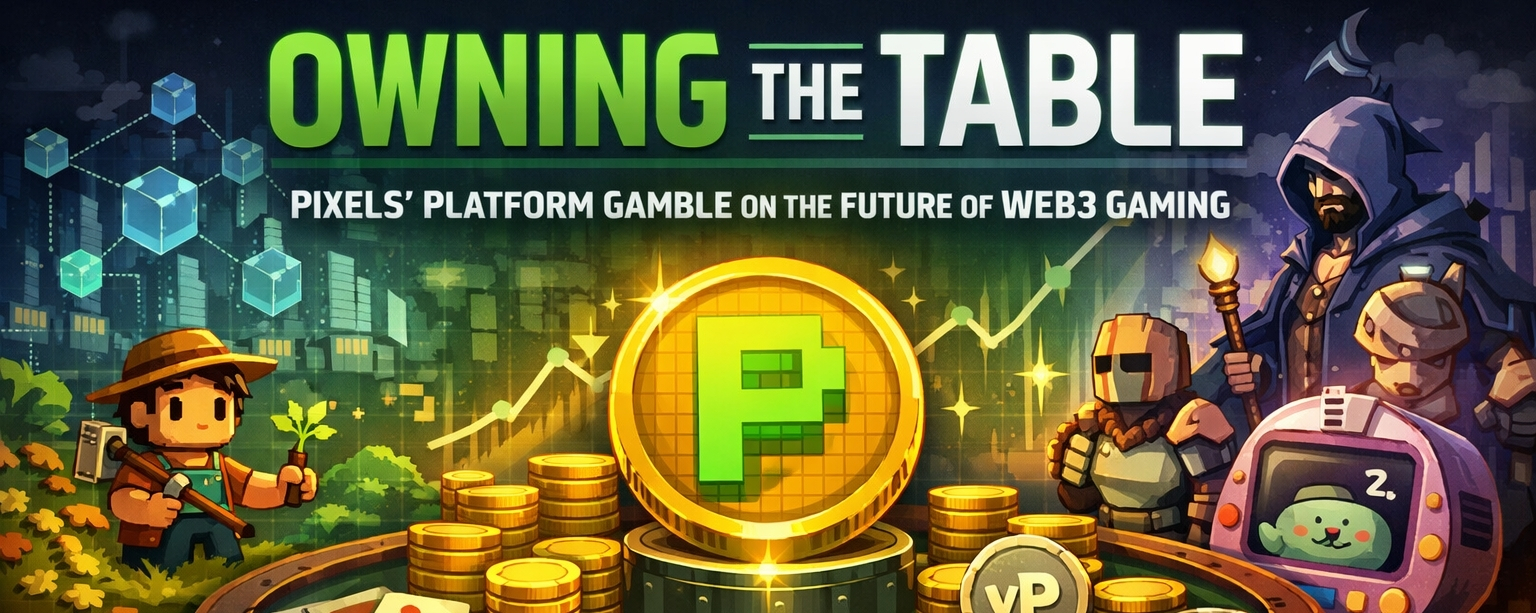

I keep coming back to something Luke Barwikowski said, and I can't quite shake it.
In a Web3 space where every founder is busy chasing the AI narrative, busy pivoting toward whatever vocabulary is generating the most venture interest right now, the founder of Pixels stood up in February and said crypto gaming still matters. That everyday participants can find real upside here in a way that AI's closed investment rounds will never allow. It was a contrarian thing to say. It was also a convenient thing to say, because it doubled as a defense of his own project at a moment when PIXEL was trading at fractions of its all-time high.
But here is what I noticed. He wasn't wrong. And the more I look at what Pixels has been quietly building, the harder it becomes to dismiss this as just a founder protecting his narrative.
Because Pixels is no longer really making a case for itself as a game. It is making a case for itself as infrastructure.
That shift is subtle. It doesn't announce itself loudly. It doesn't show up in a single headline. But when you watch what they have been doing since mid-2025, the direction is unmistakable. The multi-game staking launch. The vPIXEL token architecture. The expansion into Forgotten Runiverse, Pixel Dungeons, Sleepagotchi. The structured four-phase rollout that begins with curated game pools and ends, if it works, with any title meeting a minimum activity threshold becoming eligible to plug into the $PIXEL ecosystem. That is not a game roadmap. That is a publishing platform with a token at its center.
The described model is something like an index PIXEL staked across multiple games, rewarding holders while supporting ecosystem growth. I understand why that framing excites people. An index doesn't depend on any single title succeeding. It spreads risk. It creates a surface area for demand that no single game could generate alone. On paper, it's a smarter bet than trying to build one perfect world and hoping it holds everyone's attention forever.
In practice, though, I have questions.
In the first month after the staking launch, over 88 million PIXEL tokens were staked by more than 4,900 players, with deposits outpacing withdrawals. Those numbers look healthy on first glance. But 4,900 players is a small cohort for a project that once pulled over a million daily users at its peak. So the question isn't whether early stakers believe. Early believers always show up. The question is whether this model can reach the people who came for a game and stayed for a world. Whether it can convert passive participants into economic stakeholders without making the whole thing feel like a job application.
That tension lives inside vPIXEL more than anywhere else.
The CEO was direct about the problem vPIXEL is solving: players were earning tokens, withdrawing them, selling them, and that behavior was hurting the people who genuinely loved the game and the ecosystem. So vPIXEL is the fix. It is backed one-to-one with PIXEL but cannot be traded. It can only be spent or staked inside the ecosystem. If you want actual liquid PIXEL, you pay a farmer fee somewhere between 20 and 50 percent which gets redistributed to stakers. The logic is clean. Reward commitment. Penalize extraction. Build a moat around the people who actually intend to stay.
I think the logic is right. I also think it fundamentally changes what kind of game Pixels is.
Because there is a version of a Web3 game where you play, earn, and occasionally sell some of what you earned. That version has a certain honesty to it. It doesn't hide the economic reality behind clever token engineering. But vPIXEL creates a two-speed system. Players who believe in the long-term value of the ecosystem accept the spend-only token and stay inside. Players who want to extract pay a significant premium for the privilege. The staking rewards pool is currently capped at 28 million PIXEL per month as of March 2026, with Farm Land NFT holders receiving a 10% staking power boost of up to 100,000 PIXEL per land. That means land ownership matters again. NFT holders get structural advantages baked into the economy. Which is either a reward for early believers or a barrier for anyone arriving late, depending on which side of the land market you're standing on.
And standing back from all of this, I notice something that feels important.
Pixels is now building for a version of itself that doesn't exist yet. Five to six games are reportedly in development within the Pixels ecosystem. The staking system is designed for a world where multiple titles are competing for player attention and capital allocation. The vPIXEL architecture makes most sense when there are ten games to spend it across, not three. The whole publishing flywheel model only spins properly once there is enough activity across enough titles to create genuine competition for staked PIXEL.
Right now, that world is partially imagined. The infrastructure is real. The vision is real. The execution gap between here and there is also real.
The Chapter 2.5 update managed to cut daily token inflation by nearly 84%, and monthly revenue from PIXEL tokens climbed from 8.1 million to 9.08 million. That is genuine progress. It means the economics are moving in the right direction, at least directionally. The milestone of deposits outpacing withdrawals, first hit in May 2025, is the kind of signal that matters more to me than price action. Price moves fast and fades fast. Net ecosystem spend moving positive and staying positive is a different kind of statement. It means players are choosing to put more into the world than they are taking out.
But I keep coming back to the unlock schedule.
With a total supply of 5 billion PIXEL and roughly 2.6 billion currently unlocked, the remaining 2.3 billion tokens still sit locked, with scheduled unlocks continuing including a 91 million PIXEL release coming in the near term, representing about 1.8% of total supply. That is not a trivial number. And in a market where GameFi sentiment is still fragile, where player attention is thin and speculative capital moves faster than any community can retain it, a recurring stream of unlock pressure is a problem that no amount of vPIXEL engineering fully solves.
So here is where I land, and I am not going to pretend it's somewhere comfortable.
Pixels is attempting something genuinely interesting. Not because the farming game finally added a new mechanic, but because the farming game is quietly becoming something else a token-denominated publishing ecosystem with staking as its governance layer and vPIXEL as its retention mechanism. Whether that is the future of Web3 gaming or just a more sophisticated way to obscure the same old extraction loop underneath better vocabulary, I genuinely do not know yet.
What I know is that the bet requires patience, requires multiple games shipping and succeeding, requires the unlock schedule not undermining every green signal the economy sends, and requires players who came for a cozy farming experience to care about token architecture and staking pools and the subtle difference between PIXEL and vPIXEL.
That is a lot to ask of a community built on crops and color.
Maybe they're ready for it. Maybe the survival instinct that carried Pixels through its worst drawdown has created exactly the kind of hardened, long-horizon player base this model needs. Or maybe the platform bet arrives just slightly ahead of the audience that would make it work.
That gap is the only thing worth watching right now.