
I’ve noticed something over the past year. People in crypto keep saying they care about utility, but most of the time they only stay where they feel familiar. Not impressed, not entertained for five minutes. Familiar.
That’s probably why so many loud projects fade so fast. They get attention, they get volume, they get everyone talking for a week, and then the crowd moves on. What usually gets ignored is habit.
I keep coming back to that when I look at Pixels. Not because it feels perfect, and not because I think every Web3 game deserves serious attention. Most of them don’t. But this one seems to understand something a lot of projects miss.
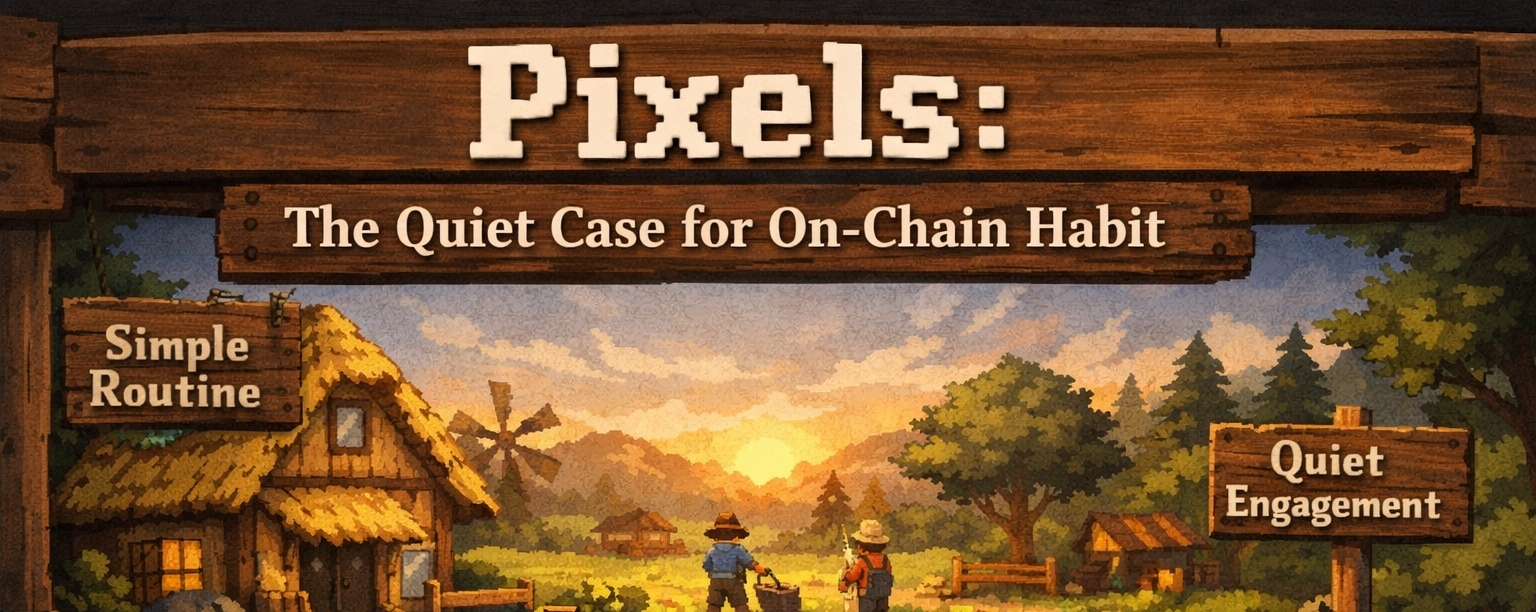
At its core, Pixels is a social casual farming game on Ronin where people explore, gather resources, build, and interact in a shared world. Simple idea on paper. Maybe even too simple if you only look at it from the outside.
But simple is sometimes where the signal hides. People are tired of products that ask them to think like traders all day. A game like this is doing something quieter. It gives people a reason to return without making every interaction feel like a financial decision.
That part matters more than people admit. In crypto, a lot of users don’t really build connection. They rotate. They speculate. They leave. Pixels looks like it’s trying to build routine before narrative, and that’s a different thing entirely.
Main abhi bhi is bare mein unsure hoon, but I think that may be the real angle here. Not the token, not the hype cycle, not the usual talk about adoption. Just the fact that repeated, low-pressure activity can create a kind of trust.
And trust in this market is weird. People talk about it like it comes from audits or big names, but a lot of the time it comes from memory. Seeing the same place again. Seeing the same players again. Feeling like something is still there when you come back.
That’s where Pixels starts to make more sense structurally. It may not be solving some dramatic problem. It may just be offering a quiet environment for on-chain memory to form. In this space, that’s rarer than it should be.
Ronin also gives it a context that feels more natural. Gaming on Ronin doesn’t feel forced in the same way it does on chains that suddenly want to become gaming ecosystems overnight. There’s already some cultural fit there, and that matters.
Maybe I’m overthinking this, but I’m not fully convinced the market knows how to read projects like this yet. People still price things like events, while something like Pixels might be more about behavior that compounds slowly in the background.
That’s also why I’m careful not to overpraise it. Games can lose attention quickly. Communities can look strong until incentives dry up. And crypto users are still very good at pretending they care about long-term culture when they’re really just chasing the next exit.
Still, when I look at Pixels, I don’t just see a game. I see an experiment around retention, trust, and shared digital routine. And if that works, it may end up mattering more than louder projects with better marketing.
Sometimes the market notices the biggest thing in the room. Other times, it misses the quieter shift completely until it has already changed user behavior. I think Pixels sits somewhere in that second category, and that’s exactly why I keep watching it.
