
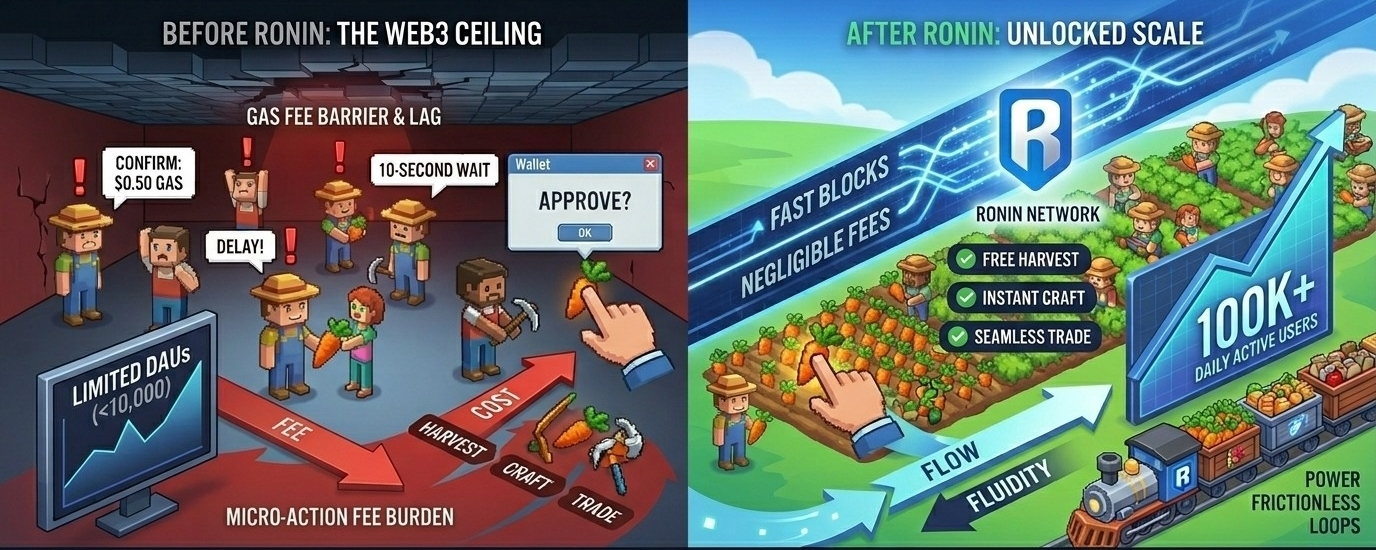

Every Web3 game has the same constraint: its chain becomes its ceiling. For PIXEL, that ceiling was clear before Ronin.
PIXEL Before the Migration :
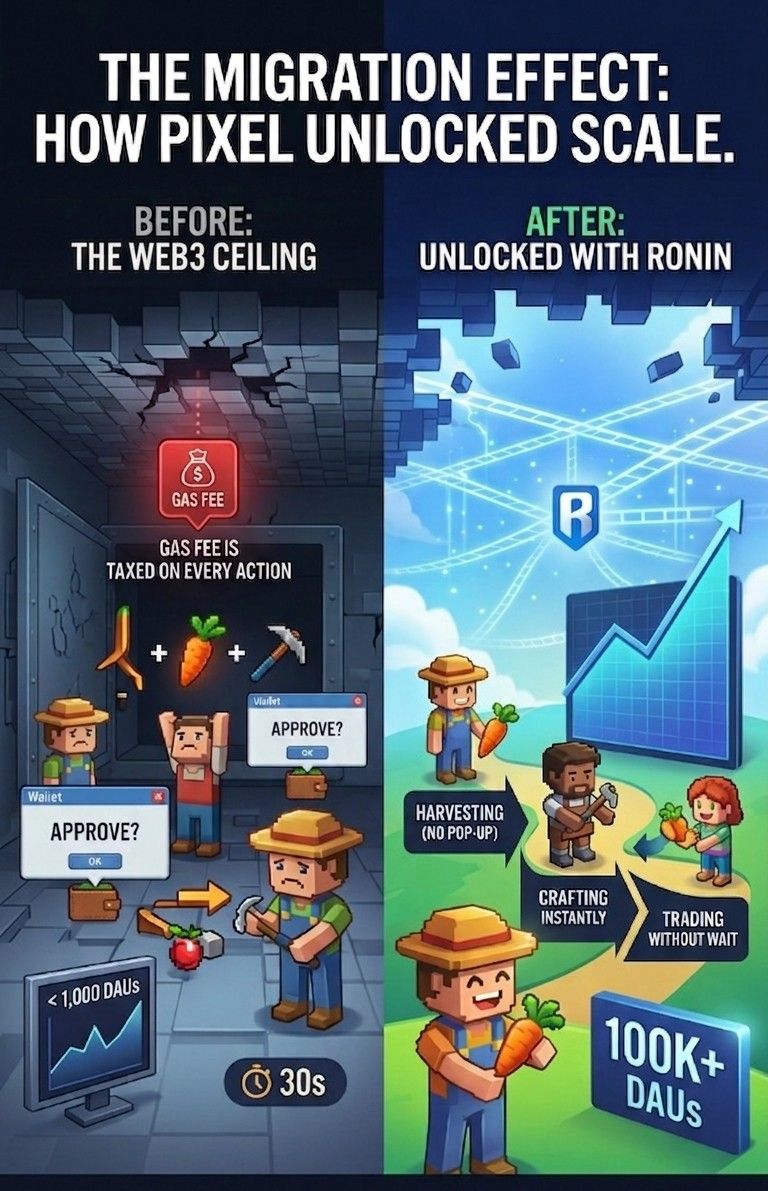
PIXEL gameplay is built on thousands of micro-actions. Planting, watering, crafting, trading. On traditional EVM chains, each PIXEL action triggered gas costs and delays. A player won’t pay $0.50 in fees to harvest a PIXEL crop worth $0.01. Lag also broke PIXEL’s timing loops, farming relies on rhythm.
The result: PIXEL could not support a mass-market player base. The game design was social and persistent, but the chain made PIXEL feel expensive and slow. Infrastructure became a gameplay problem.
Why Infrastructure Dictates PIXEL Experience :
In Web2, players don’t think about servers. In Web3, the chain is the server. For PIXEL, slow confirmations mean slow farming. High fees mean gated progression. Infrastructure stops being backend and starts defining how PIXEL feels.
PIXEL needed two things to scale: negligible cost per onchain action, and consistent speed. Without both, 100K+ daily PIXEL users wasn’t realistic.
PIXEL After the Migration :
Moving to Ronin removed both constraints for PIXEL. Ronin gave PIXEL high-frequency throughput with minimal fees and fast finality. The impact on PIXEL was direct:
1. Frictionless PIXEL loops: Harvesting, watering, and crafting in PIXEL happen without wallet pop-ups. Players interact with PIXEL, not the chain.
2. Real-time PIXEL economy: PIXEL trading and marketplace activity run instantly. A 20-step craft doesn’t collect 20 fees.
3. PIXEL at scale: With 100K+ daily PIXEL users, gameplay stays consistent. The PIXEL loop works whether 1,000 or 100,000 players are online.
PIXEL itself didn’t change overnight. The infrastructure supporting PIXEL did. Good infra is invisible, players log in and PIXEL just works.
The Bigger Point for PIXEL :
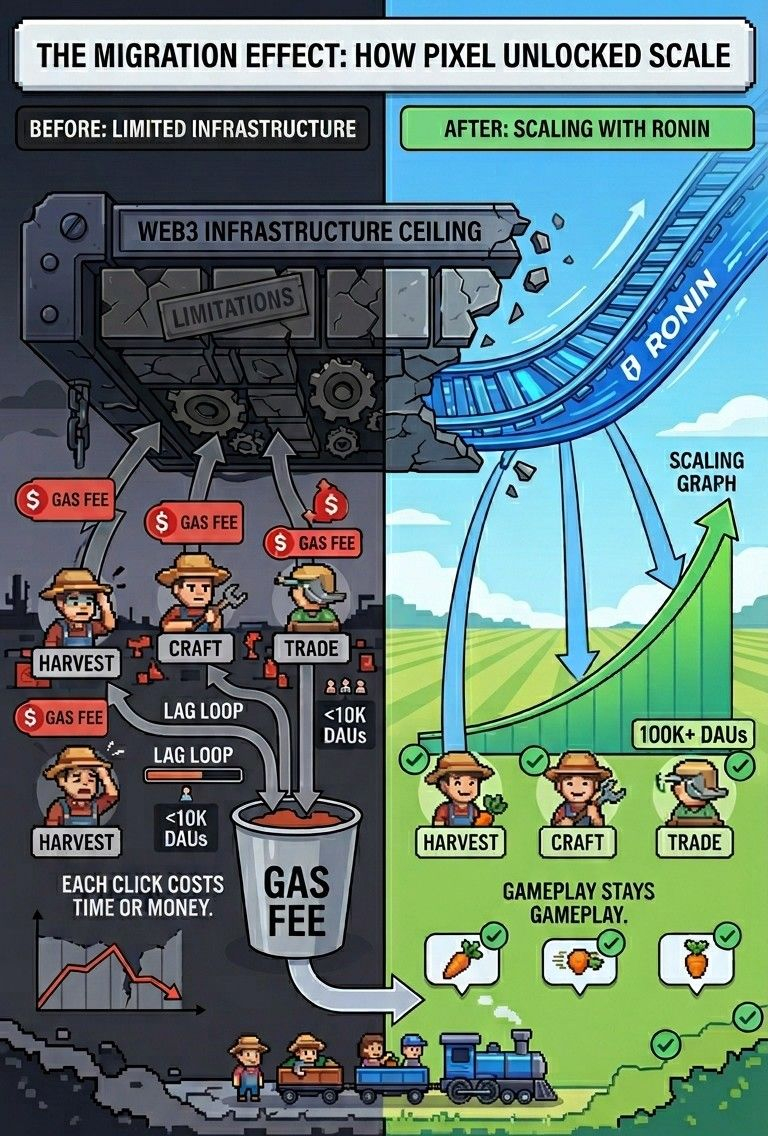
The migration proves that PIXEL cannot scale its economy if the chain can’t scale with users. Token sinks and utility don’t matter if players quit PIXEL because every click costs time or money.
Ronin solved the throughput problem for PIXEL first. That gave PIXEL the foundation to retain a real player base. Once PIXEL gameplay works at scale, then supply design and sinks become relevant.
Infra was step one for PIXEL. Tomorrow we shift to step two: why most gaming reward tokens inflate to zero, and how PIXEL’s supply design addresses it.
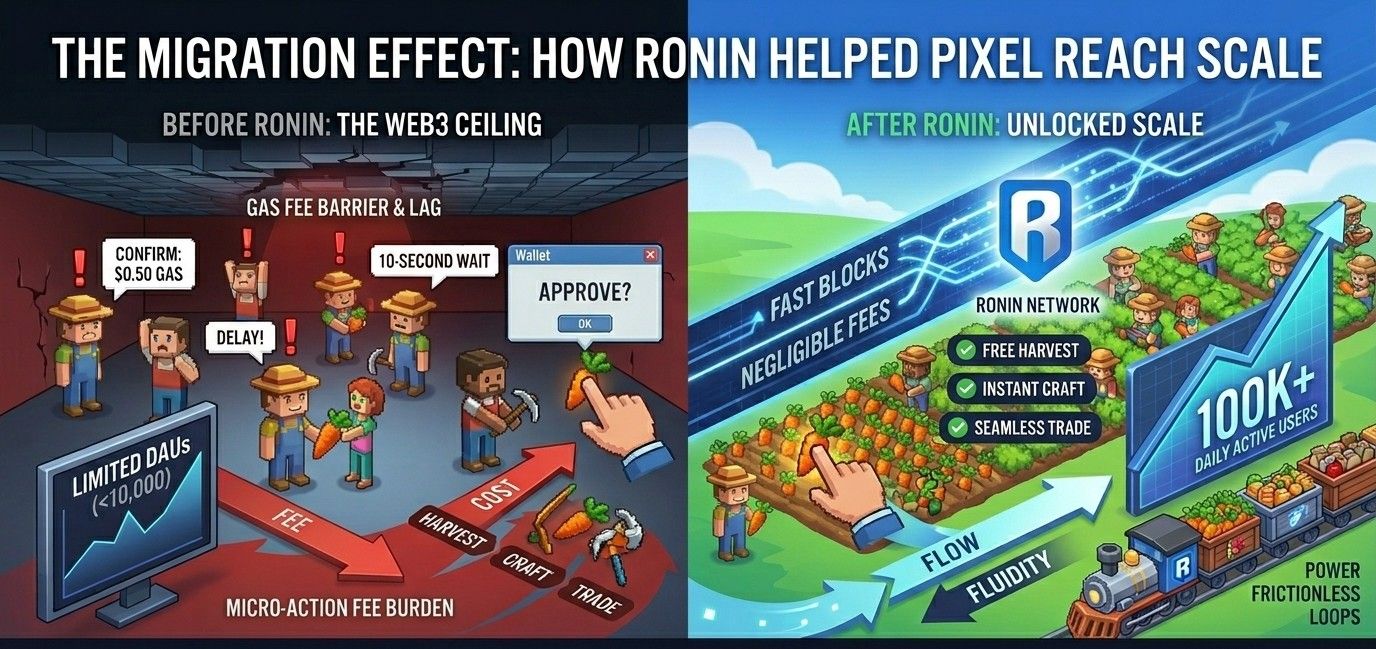
Which PIXEL onchain action - harvesting, crafting, or trading, would break first without Ronin’s low-friction design?