
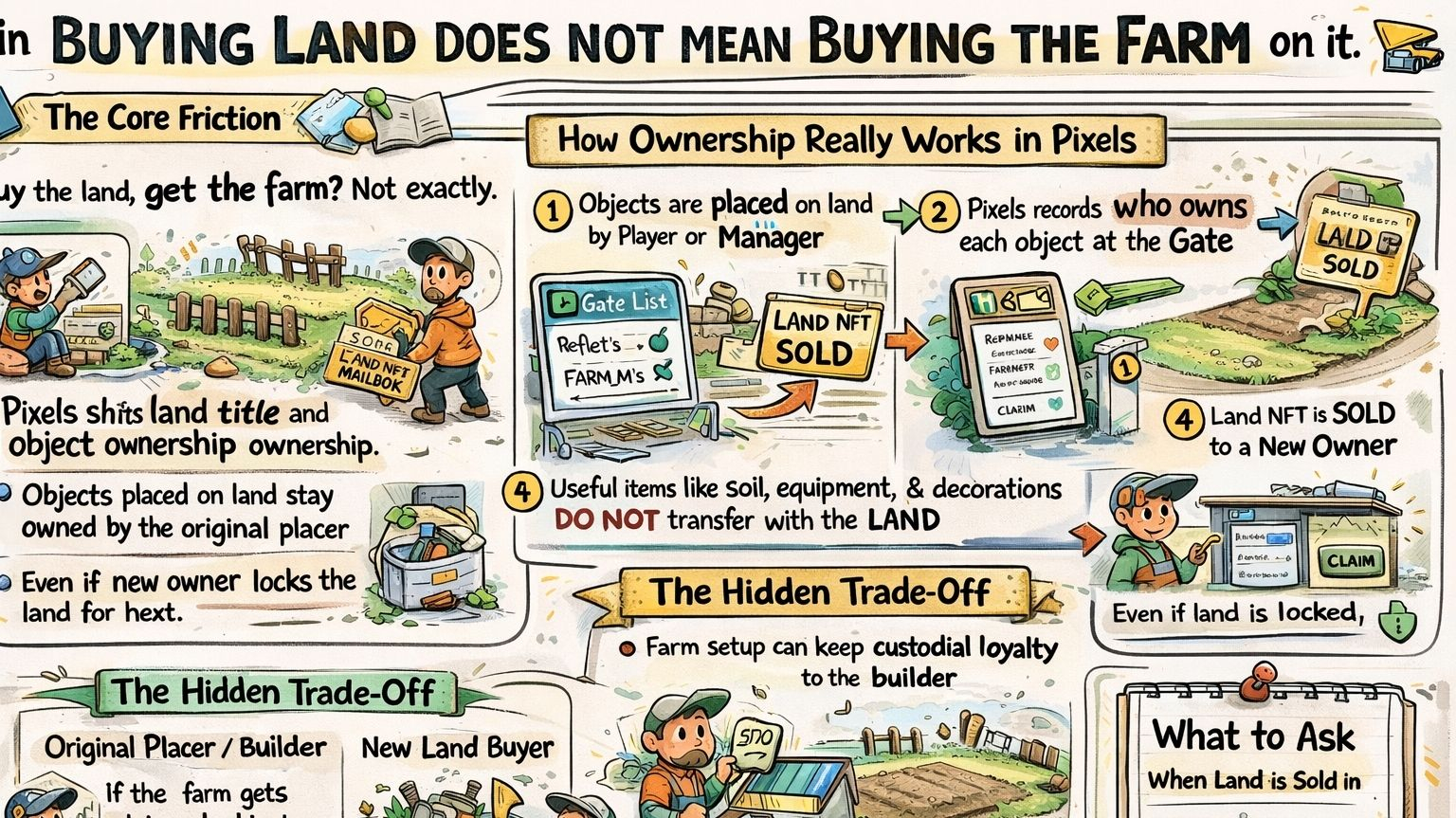
I had to read the land rules in Pixels twice because the first reading felt wrong. The simple version most people carry in their head is this: buy the land, get the farm. Pixels does not actually work that cleanly. If useful objects were placed on that land by someone else, those objects can still belong to the original placer even after the land NFT changes hands. If the new owner removes them, they go back to the original owner’s mailbox. Even locking the land does not fully erase that claim, because listed owners can still reclaim through the gate panel.
That is a much bigger design choice than it looks.
It means Pixels does not treat land as one clean bundle of rights. It splits the title to the location from the title to the objects on that location. In plain terms, a player can own the map tile and still not own the things that make the farm useful. Soil, decorations, placed equipment, and other setup objects can stay economically tied to the person who originally put them there. So when land is sold, the farm does not necessarily sell with it. Not the working version of it.
I think that changes how land in Pixels should be read.
A lot of people see land NFTs and assume the main value sits in the land itself. But in a game like this, the real working value often sits in the setup, the layout, the placed tools, and the accumulated operating convenience that makes a farm actually usable. Pixels protects that layer very aggressively. The person who built or managed the place does not automatically lose their objects just because ownership of the land changes. From one angle, that is a strong protection. It stops builders and managers from getting wiped out when control of the location moves elsewhere. It says labor and setup are not instantly swallowed by title.
That is the good side.
The harder side is that a land sale becomes less clean than buyers may expect. If I buy a land NFT in Pixels, I may be buying the location without buying the operational memory already sitting on it. I may get the land, but not the useful arrangement that made the land worth wanting in the first place. If I strip that arrangement out, the items do not become mine. They go back to whoever owned them before. So the buyer’s control is real, but incomplete. It is closer to site ownership than full productive ownership.
That creates a real bottleneck in any handoff.
The problem is not just legal in a game sense. It is operational. A manager can build a strong setup on someone else’s land, and that setup can keep part of its economic identity even after the NFT is sold. A new land owner can end up with an empty shell once the useful objects are reclaimed. That means continuity after a sale depends on coordination between title holder and builder, not just on the blockchain transfer of the land itself. The transfer of ownership is instant. The transfer of usable reality is not.
That gap matters.
It changes who has leverage. The builder or manager who placed the important objects does not just have sentimental attachment. They have custody. The new land buyer may have the stronger headline right, but the older object owner can still pull real value back out of the site. That makes Pixels land feel less like a house sale where the fixtures stay, and more like buying a shop where the shelves, tools, and working inventory can still walk out with someone else.
I do not think that makes the system bad. It makes it honest about a different problem. Pixels is trying to protect people who actually put value into a farm. If every placed object automatically transferred with the land, managers and builders would be much easier to exploit. Someone else could benefit from their setup the moment title changed. So Pixels chose the opposite risk. It protects the builder better, but it also makes the asset less simple for the buyer. That is the trade-off.
And it has a market consequence.
The scarce thing in Pixels may not just be land. It may be clean control over the useful setup on that land. Those are not the same asset anymore. A buyer who understands that can price land differently. A buyer who does not understand it may overpay for a location and only discover later that the farm they thought they bought was partly rented from the past.
That is the part I keep coming back to. In Pixels, land title and object title are not the same thing. The farm can keep some loyalty to the person who built it, even after the NFT is sold. That protects labor. It also means ownership is messier than the market headline suggests. So when I look at land in Pixels now, I do not just ask who owns the plot. I ask who can still take the farm apart and carry it home.
