
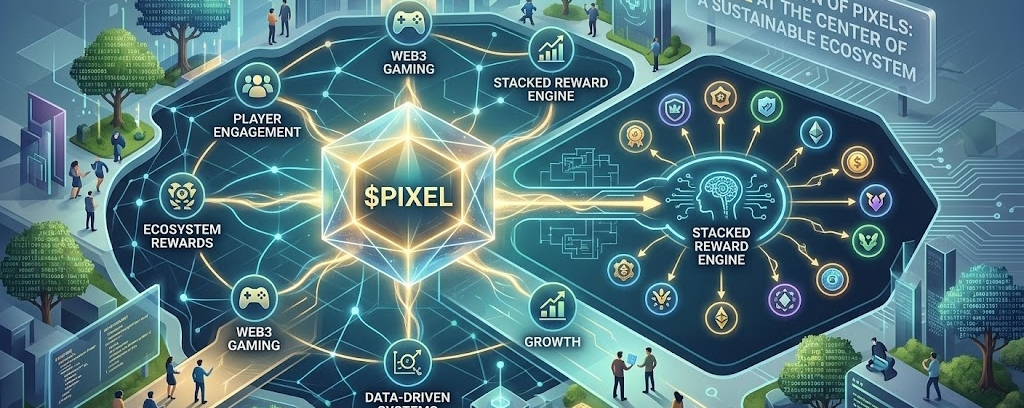
In Web3 gaming, sustainability is not achieved through hype it is built through systems that can evolve with their users. Pixels is demonstrating this principle by redefining how value is created and distributed within its ecosystem, with PIXEL at the center of that transformation.
From the beginning, PIXEL has served as the core economic layer of Pixels, enabling rewards, participation, and progression. It established a foundation that aligned player activity with tangible value. However, as the ecosystem matures, its role is not diminishing it is becoming more strategic.
With the introduction of Stacked, Pixels is transitioning from a single-layer reward structure into a more adaptive and intelligent system. At launch, players will continue to experience PIXEL rewards across the Pixels and Stacked ecosystem, ensuring stability and continuity. This consistency is critical in maintaining trust while new infrastructure is introduced.
What sets this evolution apart is Stacked’s capability to support multiple reward types over time. This is not a replacement of $PIXEL, but an expansion of the ecosystem’s capacity. By enabling diverse reward mechanisms, Pixels can better respond to player behavior, optimize engagement, and design more sustainable economic loops.
This shift has significant implications. A multi-reward framework allows for greater precision in how incentives are distributed. Developers can create tailored experiences, reward meaningful participation, and avoid the limitations of a one-dimensional reward system. The result is a more resilient ecosystem that can scale without compromising its economic balance.
In this model PIXEL remains the backbone the consistent unit of value while Stacked acts as the intelligence layer that refines how and when that value is delivered. Together, they form a system that is both stable and adaptable.
Pixels is not simply expanding its features; it is strengthening its foundation for long-term growth. By combining a proven token with a flexible reward engine, it is positioning itself ahead of a market that is still searching for sustainable models.
The real shift is not just in technology, but in approach: moving from static rewards to dynamic, data-driven engagement.
And in a space defined by short-term cycles, Pixels is building something far more enduring a system designed not just to reward participation, but to sustain it.