
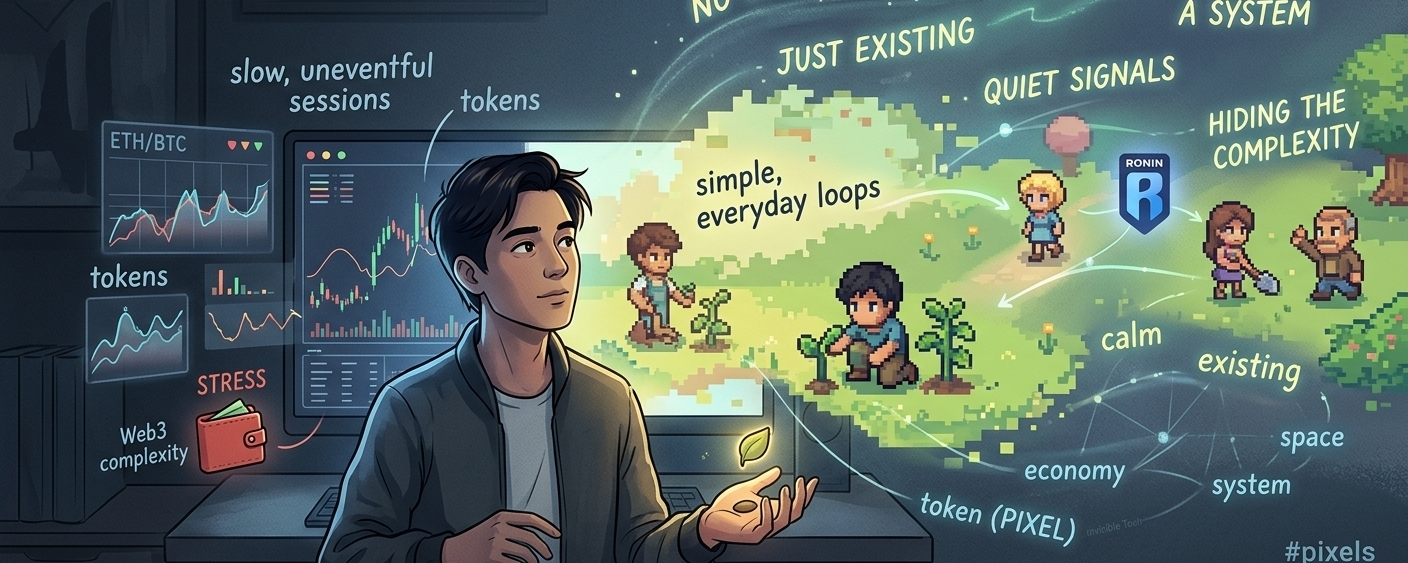
I wasn’t even looking for a game that day.
It was one of those slow, uneventful sessions—charts open, nothing really moving, just scrolling out of habit. Not searching for opportunities, just passing time between candles. Somewhere in that routine, I clicked into Pixels without expecting much. I figured I’d check it for a minute and move on.
At first, it felt almost meaningless. Plant something, walk around, leave, come back later. No urgency, no pressure, no sense that I should be optimizing anything. And in crypto, that’s unusual—most things are constantly demanding attention, pushing you to act, earn, or not miss out.
Pixels doesn’t do that. It just exists—and lets you exist in it.
Strangely, that’s what made me stay longer than I expected.
At some point, without realizing it, I stopped thinking about tokens altogether. I wasn’t checking value or doing any calculations. I was just playing—casually, almost in the background of my mind. That kind of detachment is rare in Web3, where you usually feel the system immediately, always aware there’s something to optimize or extract.
Here, it doesn’t present itself that way. It almost hides it.
Then gradually, things start to connect. You notice other players, small interactions, subtle exchanges—nothing loud or forced, just quiet signals that there’s more beneath the surface. It builds slowly, not all at once.
That’s when it clicked for me.
It didn’t feel like the game was pulling me into an economy—it felt like I was drifting into one.
That’s a very different approach.
Most projects lead with value and hope you stay. Pixels starts with familiarity, and by the time you notice the economy, you’re already part of it. That subtle onboarding is what stood out the most.
Even the underlying tech feels invisible. It runs on Ronin, but you barely notice it—no constant friction, no reminders that you’re interacting with blockchain. Everything just flows naturally.
And that made me think.
For years, Web3 has focused on showcasing the tech—wallets, transactions, confirmations—almost as proof of decentralization. Pixels seems to take the opposite route, hiding that complexity instead of emphasizing it.
It sounds like a better experience. But I’m not fully convinced yet.
Because there’s always a turning point—the moment when people stop casually playing and start optimizing everything. When it shifts from “this feels nice” to “how do I maximize this?”
That’s when things usually change.
Right now, Pixels feels calm because nothing is forcing urgency. But the underlying structure is still there—the token, the economy, the incentives. They’re just not front and center yet.
So the real question becomes: what happens when everyone starts treating it like a system instead of a space?
That’s where most Web3 games struggle. They feel alive early on, but once efficiency takes over, everything becomes more mechanical, less organic.
At the moment, Pixels feels more like a space than a system—and that’s probably why it stands out.
You don’t enter with a strategy. You don’t feel behind. You just explore, do small things, and somehow that’s enough. It builds a quiet connection instead of forcing engagement.
But in crypto, that softness rarely lasts. Once value becomes the focus, optimization usually follows.
So I’m left somewhere in between.
Part of me thinks this approach is smarter—letting players settle in first, experience the world before introducing the numbers. That could solve a lot of retention issues in Web3.
But another part wonders if this calm only exists because it’s still early.
Because once efficiency takes over, the feeling might change completely.
Still, that first experience stuck with me.
No pressure. No urgency. No constant focus on profit.
Just a loop that asked nothing from me.
And in a space where everything is fighting for your attention… that quietness felt louder than anything else.
