

@Pixels $PIXEL #pixel Most Web3 games don’t FaiL because of bad ideas—they fail because of predictable behavior. The cycle has played out too many times: users arrive for yield, extract value as quickly as possible, and leave behind a hollow economy. So when a project like Pixels (PIXEL) shows up with farming mechanics and token rewards, the natural reaction lsn’t excitement—it’s skEpticisM.
That skepticIsm is actually the right starting point.
At first glance, PixEls looks like another iteration of the sae playbook. There’s land, resource generation, progression loops, and a token tied to in-game activity. But spend a little more time inside its design, and something begins to feel different—not dramatically, not loudly, but structurally. The game doesn’t push you toward extraction. It quietly nudges you toward participation.
That distinction matters more than it sounds.
The real problem Web3 gaming has been trying to solve isn’t onboarding—it’s retention of value. In most systems, tokens are emitted faster than they’re meaningfully used. Players earn, but they don’t need to spend. And when there’s no reason to hold or reinvest, selling becomes the default behavior. Pixels attempts to counter this not wiTh strict lockups or artificial staking pressure, but with something more organic: making the token part of the gameplay itself.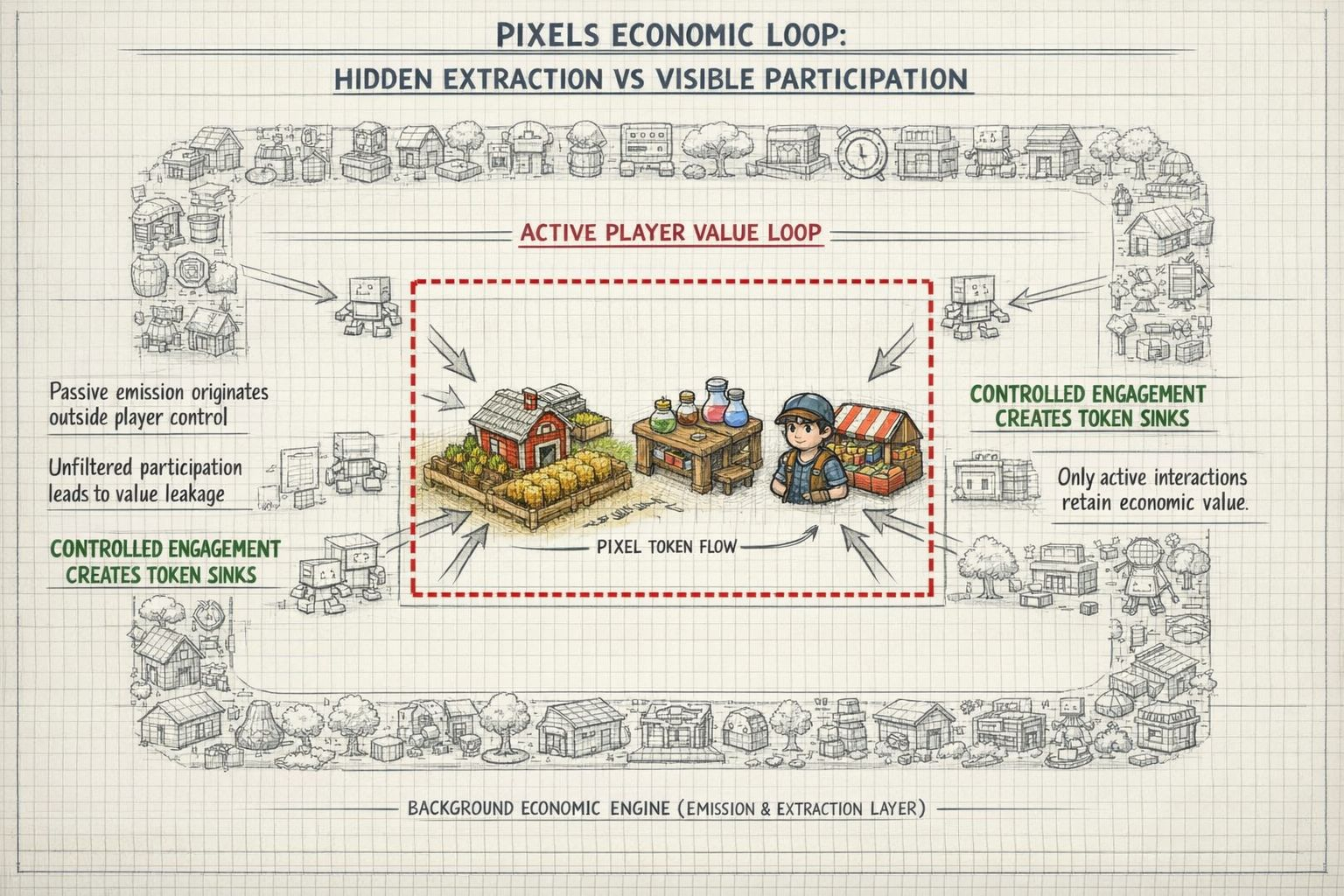
Progression isn’t isolated from the economy it depends on it. UpgraDing land, improving efficiency, accessing better loops—all of it pulls PIXEL back into the system. Not because users are forced into a lock, but because the game makes spending feel like forward motion. That subtle shift from “holding for profit” to “using for progress” is where the design starts to separate itself from earlier failures.
It’s not a perfect shield against dumping, but it changes the psychology. And in token economies, psychology is often more powerful than mechanics.
There’s also a quieter layer to this that doesn’t get enough attention: where the game actually lives. Running on Ronin Network isn’t just a branding choice—it’s a structural advantage. Most chains were built for financial transactions first and user interaction second. Ronin flips that priority. It was designed around the idea that users would be constantly clicking, farming, upgrading, and interacting in real time.
That matters because friction kills behavior. If every small action carries a cost or delay, users either slow down or stop entirely. In Pixels, the low-cost, high-frequency environment allows the economy to breathe. Small transactions remain viable, loops stay intact, and the system doesn’t choke under its own mechanics.
Even more interesting is how the game deals with one of Web3’s most persistent problems: bots. Instead of relying purely on identity verification or heavy-handed restrictions, Pixels leans into time and effort as natural barriers. Yes, bots can exist—but scaling them becomes inefficient when progression requires sustained interaction. It’s not a perfect defense, but it’s a realistic one. The system doesn’t try to eliminate exploitation entirely; it tries to make it less profitable.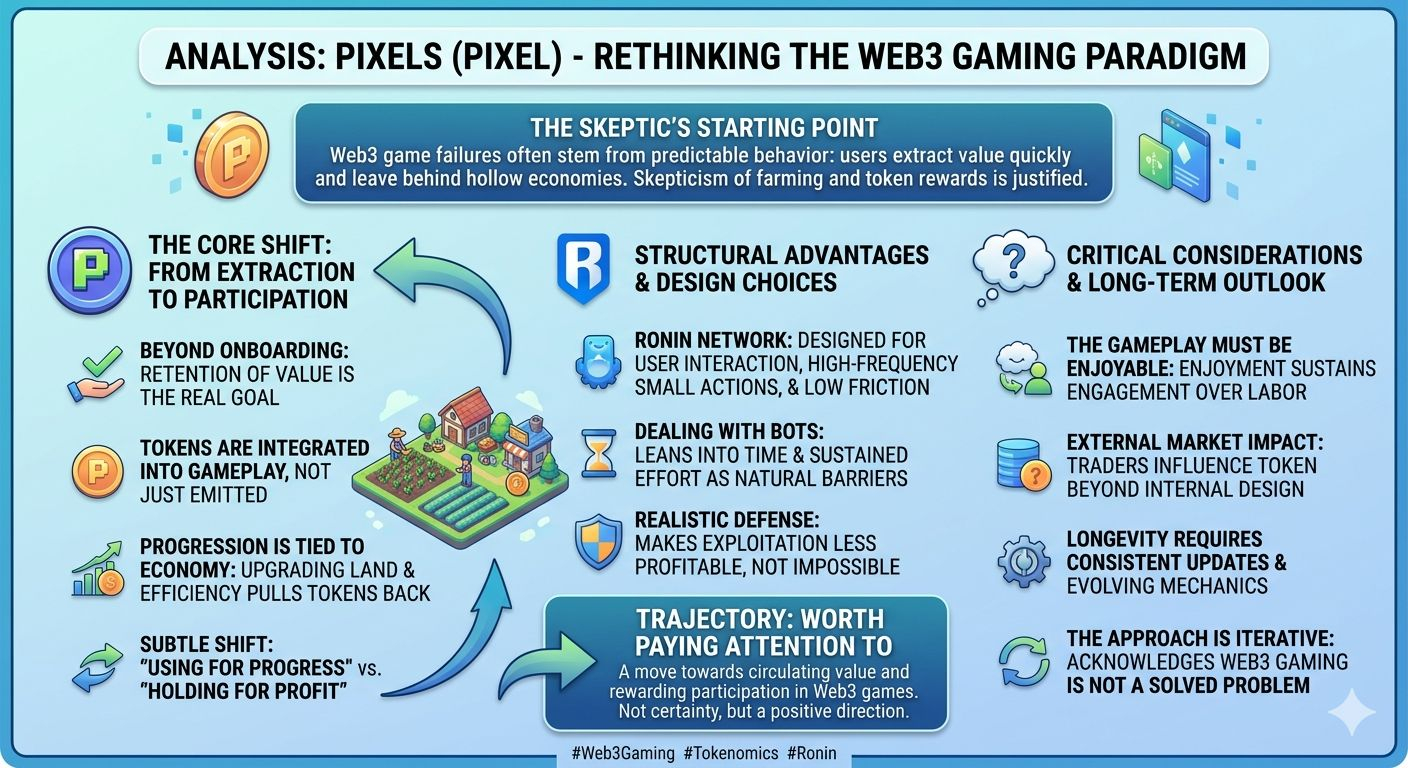
Still, none of this guarantees success.
The entire structure depends on one fragile variable: people actually enjoying the game. If the experience starts to feel like repetitive labor lnstead of meaningful engagement, the same patterns return. Users optimize for extraction, no matter how well-designed the economy is. And beyond that, there’s always the external market—traders who have no connection to the game itself but can influence the token’s trajectory in ways the internal design can’t fully control.
There’s also the question of longevity. Farming loops can sustain early engagement, but they rarely carry a game indefinitely. Without consistent updates, evolving mechanics, and new layers of interaction, even the most balanced economy begins to stall. At that point, the pressure shifts back to emissions, and the old cycle quietly re-emerges.
What makes Pixels worth watching isn’t that it claims to solve everything. It’s that it doesn’t pretend to. The approach feels more iterative than declarative, more experimental than absolute. It acknowledges, at least implicitly, that Web3 gaming isn’t a solved problem—it’s still being shaped in real time.
From a strategic perspective, that humility might be its strongest advantage.
There’s a version of the future where Web3 games don’t rely on constant hype cycles to survive, where economies are designed to circulate value instead of draining it, and where participation feels more rewarding than extraction. Pixels doesn’t fully represent that future yet, but it leans in that direction in a way that’s hard to ignore.
So no, this isn’t a story about certainty. It’s a sTory about trajectory.
And right now, Pixels is moving in a direction that’s at least worth paying attention to ...