
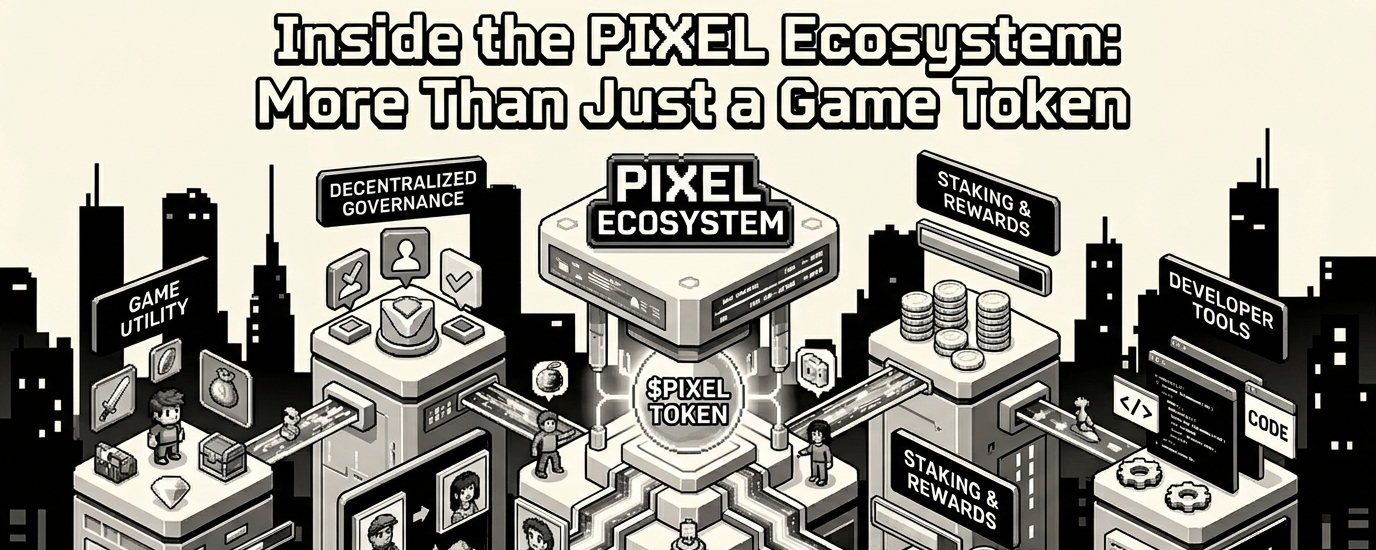
i've been looking more closely at pixel from last few days. The idea behind Pixel is simple and easy and what caught my attention isn't the gameplay. It's the architecture underneath it.
I think most people see pixel as a web3 game. log in, farm, earn, repeat. But when you start pulling back the layers, there's a more deliberate economic structure sitting behind it. The $PIXEL token isn't just a reward mechanism — it's supposed to function as the connective tissue of an entire on-chain ecosystem.
The game itself is built on ronin, which already gives it a foundation with real transaction throughput and low fees. That matters because in-game economies die fast when gas costs make small actions economically irrational. Pixel sidesteps that. Every action a player takes — crafting, trading, staking land — can settle cheaply and quickly, which keeps the loop intact.
Why I feel pixel is real and what makes the ecosystem angle interesting is land. Landowners in pixel aren't just cosmetic holders. They earn a share of the activity that happens on their plots. Players farming on your land generates yield for you. That's a passive income layer built into the core game loop, not bolted on as an afterthought. It gives the token demand a second engine — one that doesn't rely entirely on new player inflows.
There's also the guild and cooperative layer. pixel has leaned into social structures in a way most web3 games haven't. Coordinated land development, resource pooling, shared yield — these mechanics push toward a player-driven economy rather than a developer-controlled one. That distinction matters a lot when you're thinking about long-term token sustainability.
I'm not calling this a solved model. Web3 gaming has failed enough times that skepticism is earned. But pixel has more structural depth than its surface suggests, and that makes it worth watching beyond the price chart.
The first idea is that ownership should mean something. In traditional gaming, everything you earn exists at the discretion of the developer. Servers go down, games shut down, and your progress disappears with them. Pixel is built on the opposite premise — that players should hold verifiable, transferable ownership of what they build and earn. That's not a marketing angle. It's a foundational design choice that changes how the entire economy behaves. @Pixels #pixel $PIXEL