
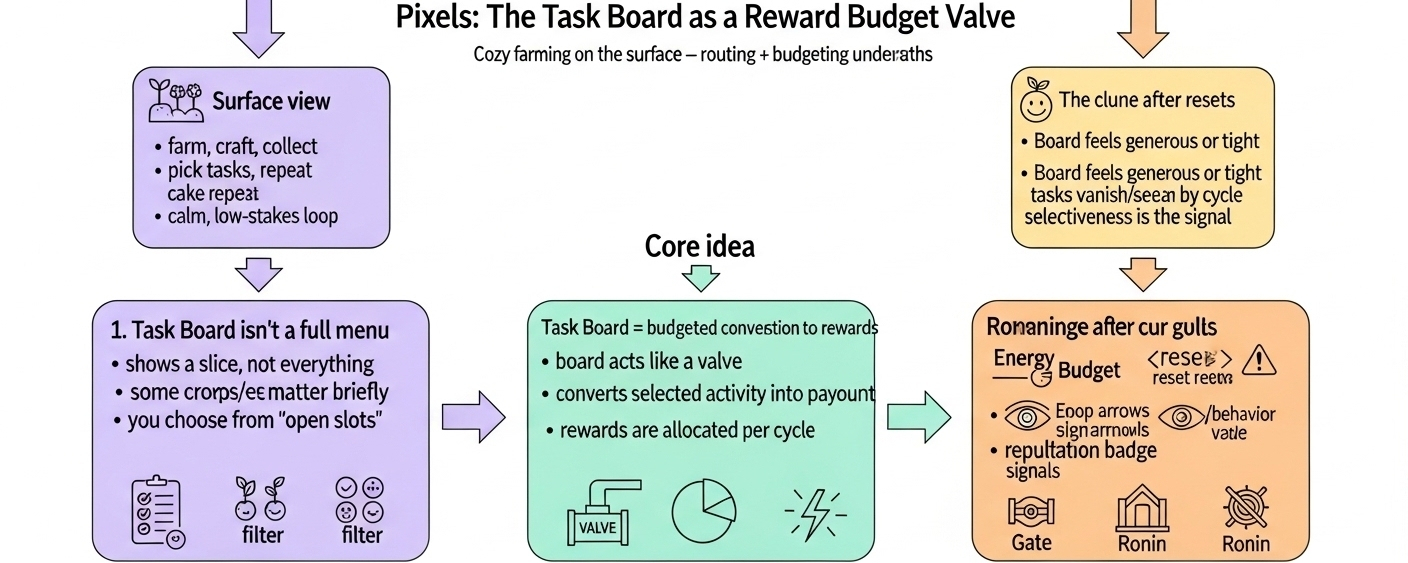


Pixels is easy to describe if you only look at the surface. you farm, you craft, you collect resources, you pick tasks, you repeat. it’s calm, low-stakes, almost soothing. the kind of game you open when you want something simple. but if you stay long enough, the “simple farming world” starts to feel like a mask over something more engineered.
the first clue is the Task Board. at the start it reads like normal quests: do X, get Y. but after a few resets you notice a pattern that doesn’t feel like luck. some days the board feels generous, other days it feels tight, even when your effort is the same. the list changes. tasks you relied on disappear. certain crops or crafting recipes matter for one cycle, then vanish. it’s not that the game is broken. it’s that the board is selective.
and once you see that selectiveness, the Task Board stops feeling like a menu and starts feeling like a valve. it’s not showing you everything you could do. it’s showing you what the system is willing to convert into rewarded outcomes right now. in other words, rewards feel budgeted, and the board is how the budget gets allocated. you think you’re choosing tasks, but you’re really choosing from whatever slots are open in that cycle.
the reward loop makes the same point in a quieter way. you earn something, and then you immediately need to spend. energy runs low. crafting needs inputs. resources never stretch quite far enough. you’re always nudged back into action. the reward isn’t a finish line, it’s a trigger for more activity. that’s basically Return on Reward Spend logic in practice: payouts are designed to create follow-on behavior, not just to exit the system.
then there’s the uncomfortable part: different players can experience different outcomes even with similar effort. people explain it away as timing or randomness, but the text suggests something else is happening. the system watches behavior patterns—when you log in, how consistently you play, what you prioritize—and those signals influence what gets surfaced and how it pays out. same grind, different permission. once that clicks, you stop treating the board like a list and start treating it like a signal. what’s open, what’s maintenance, what’s likely to convert, what’s just keeping the loop spinning.
reputation adds another gate. you can do the work and still hit a wall, because doing isn’t the same as qualifying. before anything becomes “real” on Ronin, there’s a layer that decides what can leave the off-chain environment and what stays contained. most gameplay happens off-chain because it’s fast and frictionless, but that also means the system can adjust, contain, and shape outcomes before they settle on-chain.
so Pixels starts looking less like a farming game and more like a routing system wrapped in a cozy world. tasks regulate how much value flows out. rewards push value back into spending. behavior affects what you’re allowed to see. reputation influences what becomes withdrawable. nothing about it has to be malicious for it to be true. it’s just design.
and that’s why it’s hard to unsee once you notice. you’re still planting and harvesting, sure. but you’re also learning to play the board, because the board is where the economy decides what matters.
