
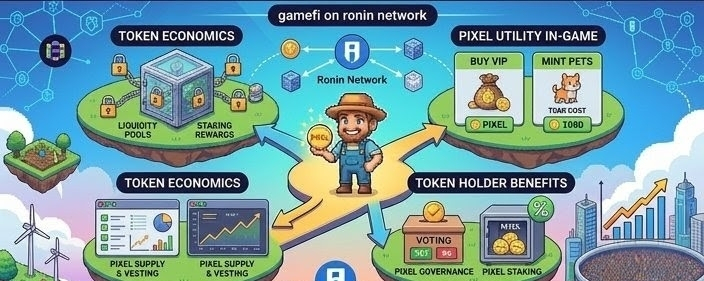

In today’s evolving digital landscape the line between gaming and real - world economy is becoming increasingly blurred. Projects like Pixels are often discussed not just as games, but as part of a growing digital economy movement. This raises an important question: Is Pixels just a game economy or is it something closer to a real digital financial system?
The answer lies some where in between.
From Simple Gameplay to Economic Activity
At first glance Pixels looks like a simple farming and exploration game. Players plant crops, collect resources craft items and progress through the world. But beneath this simple structure lies a player - driven economy where actions have value.
Unlike traditional games where in - game currency is only for internal use Pixels introduces systems where effort time and strategy influence outcomes that can carry real - world implications.
This is where things start to feel different.
Players are not just completing tasks - they are participating in an evolving digital marketplace shaped by supply demand and collective behavior.
The Idea of Real Earnings in Pixels
One of the most discussed aspects of Pixels is the possibility of earning through gameplay. Rewards tokens and in - game assets create a system where players feel their time has value.
However it is important to understand this carefully.
Earnings in Pixels are not guaranteed income. Instead they represent participation in a digital ecosystem where value can fluctuate depending on market conditions player activity and overall demand.
This makes the system more similar to a digital economy simulation rather than a fixed salary model.
Players who understand timing resource management and strategy often perform better than those who simply grind without planning.
Strategy Over Speed
One of the key features of Pixels is that it rewards thinking over rushing.
Many players initially assume that playing longer hours will automatically lead to higher rewards. But in reality efficiency matters more than raw time.
Smart decisions such as:
• When to produce or sell items
• What resources to focus on
• How to manage in-game time
…can have a bigger impact than simply playing nonstop.
This creates a mindset shift where players start thinking more like participants in an economy rather than just gamers.
A Player-Driven Digital Economy
The most important innovation in Pixels is its player - driven system.
Prices and demand are influenced by how players interact with the game. If too many players focus on the same activity value can decrease. If certain items become rare, their importance increases.
This creates a constantly changing environment that resembles real - world market behavior on a smaller scale.
Because of this Pixels feels less like a fixed game and more like a living digital ecosystem.
Is It a Real Currency System?
While Pixels introduces economic mechanics it is not a traditional financial system or guaranteed income source. Instead it exists in the Web3 space where digital assets and tokens can have fluctuating value.
This means:
• Value is dynamic, not fixed
• Rewards depend on ecosystem activity
• Market conditions play a major role
So while it can feel like real money gaming it is more accurate to describe it as a digital economy experience with potential value interaction rather than a stable currency system.
Why Players Are Drawn to It
Despite the complexity players are attracted to Pixels for a simple reason: it feels engaging and meaningful.
You are not just clicking buttons - you are:
• Making decisions
• Managing resources
• Observing market changes
• Adapting strategies over time
This creates a sense of involvement that many traditional games lack.
The community aspect also strengthens this experience as players share strategies and learn from each other.
Opportunity and Risk Together
Like any system involving digital assets Pixels also carries risk.
Market fluctuations changing strategies and evolving gameplay conditions mean that outcomes are never guaranteed. This is why understanding the system is more important than blindly participating.
Players who approach it with awareness tend to have a more balanced and realistic experience.
Final Thoughts
Pixels sits in an interesting position between gaming and digital economy simulation.
It is not a traditional financial system, but it introduces mechanics that make players think about value strategy and efficiency in new ways. This blend of fun gameplay and economic interaction is what makes it stand out.
Ultimately Pixels shows that modern gaming is evolving. It is no longer just about entertainment it is also about participation decision making and understanding digital systems that reflect real world economic behavior.
And that is exactly why people are paying attention to it today.