
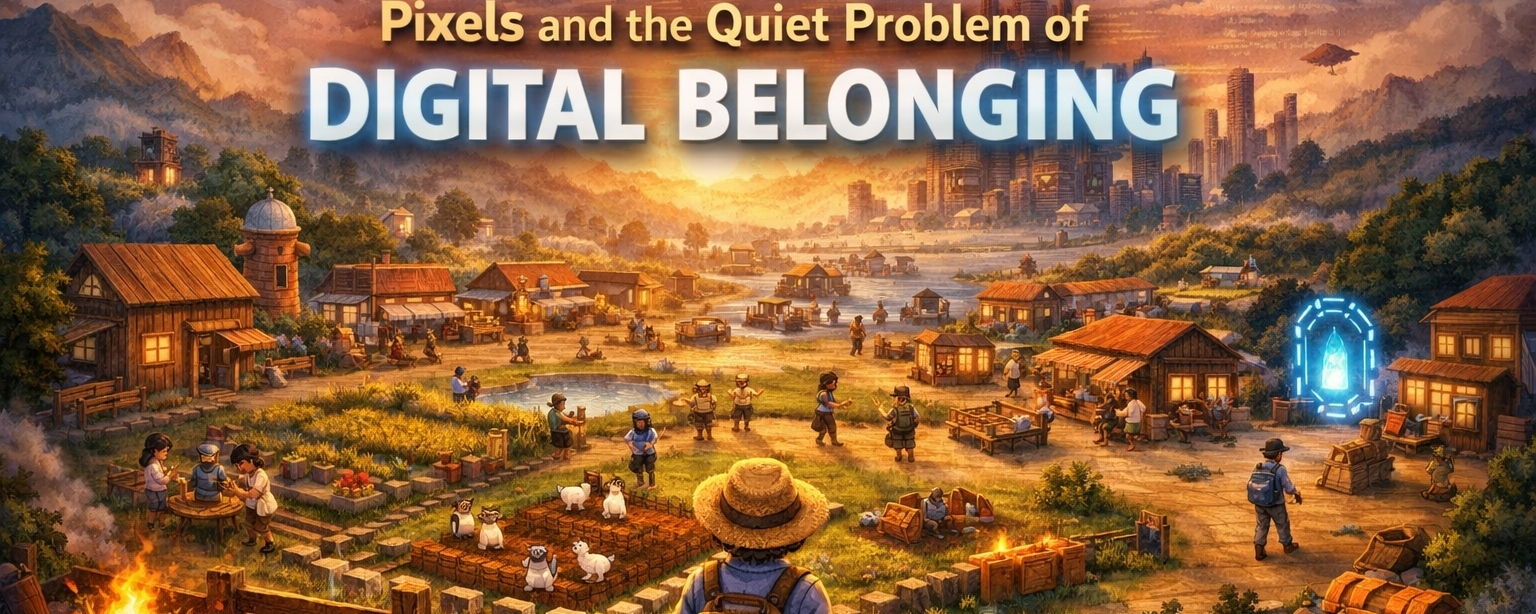
At first, Pixels did not feel like something worth stopping for. Maybe that was the first reason it stayed with me. In crypto, you get used to seeing the same shapes over and over again. A new game, a new token, a new social layer, a new reason people are told to pay attention. After a while, the reaction becomes automatic. You do not lean in. You pull back. Not because everything is bad, but because too much of it arrives sounding finished before it has really proved anything.
That was my first reaction here. A farming game, a social world, a Web3 project on Ronin. It was easy to place it in the same mental folder as a lot of other projects that came with familiar language and familiar expectations. I did not look at it and think there was something deep hiding underneath. I looked at it, understood the shape of it quickly, and moved on.
But some things do not fully leave once you move on from them. They come back quietly. You see the name again. You notice people still talking about it without sounding forced. You realize it has remained in view longer than a lot of louder things that were supposed to matter more. That kind of return gets my attention more now than strong first impressions do. Strong first impressions in this market are often manufactured. What matters more is what keeps finding its way back into view after the first wave has passed.
That is where Pixels started feeling different to me. Not because it looked exceptional on the surface, but because it kept pushing me to look beneath the surface. And once I did, it stopped feeling like just another game project and started feeling like it was circling something older, something that has been sitting underneath the internet for a long time and underneath crypto even more clearly. How do you make people care about a digital place in a way that is real. Not briefly. Not only because there is something to earn. Not only because the timing is good. Actually care.
That is a harder problem than crypto usually admits. The industry likes to talk as if participation can be designed cleanly, as if a good enough system of incentives can turn activity into attachment. But that is not how people work. People return to places for reasons that are rarely neat. Habit, curiosity, comfort, routine, social gravity, boredom, identity, reward. Sometimes all of it at once. Sometimes none of it in a stable form. A person can keep showing up somewhere without fully knowing why. A project can look active without actually becoming meaningful. That gap matters more than most dashboards can show.
That is why Pixels stayed in my mind. Not because farming is new or because open digital worlds are new. None of that is new. In fact, the familiarity of it is part of what makes it interesting. It is trying to move through a category that has already been worn down by repetition. Crypto has seen games before. It has seen digital land before. It has seen social mechanics, economies, ecosystems, and all the language that usually comes with them. Most of those attempts ended up trapped between entertainment and extraction, never fully becoming either one in a satisfying way. So when something in that same area keeps holding attention, even quietly, I think it is worth asking what exactly it is touching.
For me, the answer is less about what Pixels does and more about the kind of tension it sits inside. The old tension between action and meaning. Between visible participation and real attachment. Between a system that records behavior and a human reason for being there that cannot be recorded so easily. The blockchain can tell you that something happened. It can tell you who moved, who traded, who held, who returned. But it cannot tell you what those actions meant to the person doing them. It cannot tell you whether the return came from interest, from routine, from social pull, or from the simple fact that people will stay in almost anything a little longer when value is attached to the exit.
That is where a lot of crypto still gets lost. It sees action and calls it proof. It sees participation and calls it belief. It sees retention and calls it community. But those words collapse too much. They make everything sound more settled than it is. And I think Pixels, whether intentionally or not, sits inside that uncertainty in a way that feels more honest than most projects do. It does not remove the doubt. It makes the doubt harder to ignore.
I keep coming back to that because I have been around long enough to know how often this market mistakes movement for depth. We are surrounded by systems that can generate activity. That part is not hard anymore. The harder part is whether any of that activity becomes weight. Whether repetition turns into familiarity. Whether familiarity turns into care. Whether a digital place starts to feel inhabited rather than simply used. Those are not technical questions, even when technology shapes the environment. They are human questions. Old ones. The surface changes, the tools change, the ownership model changes, but the core difficulty stays the same.
Pixels seems to be circling that difficulty. That is what kept drawing me back to it. Not because I think it has solved it, and not because I want to overstate what it is. I do not. If anything, I think one of the strengths of looking at projects like this is refusing to flatten them into certainty. There is still too much we do not know. A lot of what looks durable in crypto is still conditional. A lot of what looks social can still be rented. A lot of what feels alive can still thin out once the incentive structure changes. I do not think Pixels is above those pressures. I think it lives inside them like everything else.
But I also think there is something worth noticing in the fact that it does not immediately disappear into the usual blur. In a market where so many things arrive overbuilt and overexplained, something that keeps attention without constantly trying to force a grand narrative around itself starts to stand out. Quietly. Not dramatically. Just enough to make you look again.
And when I looked again, what stood out to me was not the promise of a game economy or the usual Web3 framing around ownership and participation. What stood out was that it felt like another attempt, maybe a more grounded one, to answer a question crypto keeps failing to answer cleanly. How do you build digital environments where people return for reasons that are not fully reducible to extraction. How do you create a place where routine does not feel empty. How do you let value exist without letting value become the only explanation for why anyone is there.
That is where the project feels larger than itself to me. Not larger in scale. Larger in the problem it brushes against. Because this is not only about games. It is not only about tokens either. It is about whether online spaces can become meaningful without being flattened into metrics, and whether systems that make every action legible also make it harder to know what any action truly means. Trust versus record. Presence versus activity. Signal versus noise. These tensions keep resurfacing in different forms because the underlying issue never really goes away.
I think that is why Pixels stayed with me longer than I expected. It did not arrive looking important. It looked familiar, maybe even easy to underestimate. But there are projects that fade the moment the first impression passes, and there are projects that keep returning because they are sitting closer to a real question than they first appear to be. Pixels feels like the second kind.
I am not trying to turn that into a larger claim than it deserves. I do not think it needs that. I do not think every interesting project has to be framed as a breakthrough to matter. Sometimes it is enough that something keeps exposing a tension the market still has not worked through. Sometimes it is enough that it makes you slow down and ask whether what you are seeing is just activity or something a little heavier starting to form underneath it.
I still do not think the answer is clean. Maybe it never will be. Maybe that is part of what makes this category so difficult. The same systems that create participation also distort it. The same incentives that help bootstrap behavior can make the behavior harder to interpret. The same records that give transparency can also create a false sense of certainty. Crypto is very good at showing what happened. It is still not very good at showing what mattered.
And that, for me, is where Pixels becomes worth paying attention to. Not because it has escaped all the old problems. It has not. Not because it suddenly makes the case for Web3 gaming in some final way. I do not think any project can carry that burden honestly. But because it seems to be moving around a real and persistent problem without pretending the problem is already solved.
That alone is rare enough.
I looked at Pixels once and did not think much of it. Then I kept seeing it, kept noticing it, kept feeling that there was something in it that did not fully blend into the usual market noise. Not a perfect answer. Not a dramatic shift. Just a project sitting near a question that feels older than crypto and more difficult than most people want to admit. How digital places become worth returning to, and how hard it is to tell the difference between people using a system and people actually beginning to believe in it.
That is what kept my attention. And honestly, in this market, anything that can do that without shouting is already worth more thought than it first seems.