Most Web3 games ask for your attention before they earn your trust.
That is usually where the problem begins. They arrive with noise, token talk, reward promises, and the kind of excitement that feels big for a few days but fades the moment people stop getting paid to care.
Pixels feels different because it does not rush at you in that way.
It does not try to prove its worth through pressure. It lets the experience speak first.
And in a space where so many projects confuse hype with value, that difference matters more than people realize.
When I look at Pixels, I do not just see another blockchain game trying to stay relevant.
I see a project that understands something many others missed: value in Web3 gaming cannot come from rewards alone.
Rewards can bring people in, yes. But they cannot make people stay.
They cannot create attachment, rhythm, or habit on their own.
People return to something when it begins to feel familiar, useful, enjoyable, and worth being part of even when nobody is forcing the moment.
That is where Pixels has shown real strength.
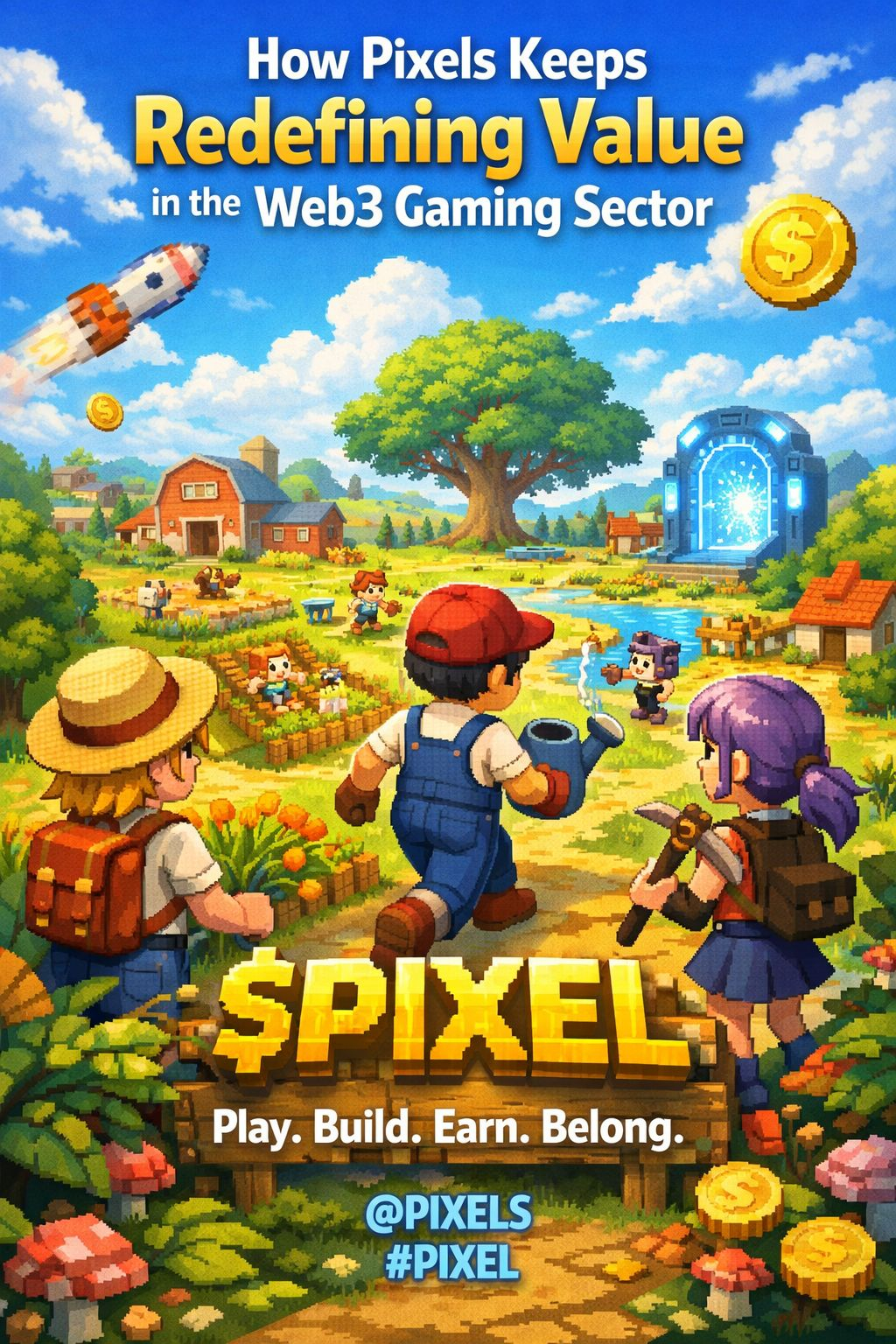
At first glance, Pixels may look simple. The style feels approachable.
The world feels light. The gameplay does not overwhelm you.
But that simplicity is not weakness. It is part of the design intelligence behind it.
A lot of Web3 projects build too much friction into the user experience.
They expect people to learn systems, manage wallets, understand token mechanics, and commit effort before they have even found a reason to care.
Pixels lowers that barrier. It creates an entry point that feels natural.
And when something feels natural, people stay longer. That staying power is where deeper value starts to form.
This is also where $PIXEL becomes more interesting.
In many GameFi projects, the token feels like the main product and the game feels like the excuse.
You can feel that imbalance almost immediately.
The economy is built first, and the player experience gets added later.
That usually leads to the same cycle: early attention, reward chasing, inflation, fatigue, and then decline.
Pixels does not feel built around that same desperation.
The token exists inside a world that already gives people a reason to participate. That changes the meaning of the asset.
$PIXEL matters because it is tied to an environment people actually use, not just a market narrative people briefly trade.
That may sound like a small distinction, but it is a very important one.
A token becomes stronger when it is connected to behavior, not just speculation.
If people are returning, building, playing, interacting, and staying active inside the ecosystem, then the token begins to reflect something more durable than temporary hype.
It starts to represent movement inside a living network rather than excitement around an empty shell.
What makes Pixels even more valuable in the bigger Web3 gaming conversation is that it points toward a healthier model.
For a long time, the sector acted as if financial incentive was enough to create loyalty. It is not.
Loyalty comes from experience.
It comes from enjoyment, belonging, consistency, and a feeling that your time inside a world actually means something.
Pixels seems to understand that value is not just something extracted from a game.
It is something created between the game and the people who keep returning to it.
That is why Pixels keeps redefining value. It is not doing it by making the loudest promises.
It is doing it by proving that softness can be strength, that simplicity can be strategic, and that a game can build economic meaning without making the economy feel like the only reason to show up.
In a market where many projects still chase attention like it is the final goal, Pixels feels more focused on building retention, culture, and a real place within the daily habits of its users.
And that is the part people should pay close attention to.
The future value of Pixels will not depend only on price action or short-term excitement.
It will depend on whether it continues doing what made it stand out in the first place: creating a world people want to return to.
If it keeps protecting that balance between gameplay, community, and token utility, then $PIXELhas a stronger foundation than many projects that looked bigger on the surface.
In the end, Pixels is not just redefining value in Web3 gaming because it has a token or a game people recognize.
It is redefining value because it understands where real value comes from.
Not from noise. Not from pressure. Not from empty speed.
But from creating something people genuinely want to keep being part of.
And in this sector, that may be one of the rarest strengths of all.