

For years,Charles Schwab stood just close enough to crypto to benefit from its rise—but far enough to avoid fully committing.
Clients could get exposure to digital assets through ETFs, futures, or crypto-related stocks. But if they wanted to actually own Bitcoin or Ethereum, they had to leave the platform.
That gap is finally closing.
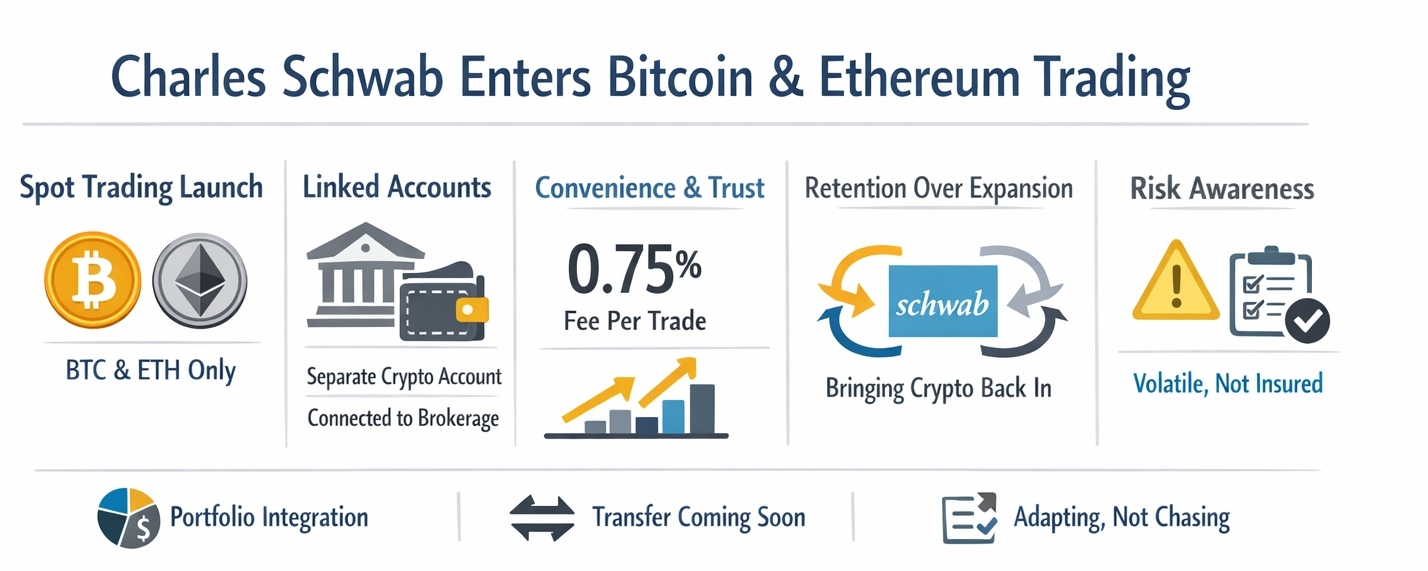
Schwab is now rolling out direct spot trading for Bitcoin and Ethereum, bringing crypto ownership into the same ecosystem where millions already manage their investments.
But this isn’t a loud, aggressive entry.
It’s measured, controlled, and very intentional.
A Move That Was Always Coming
Schwab didn’t ignore crypto. It just approached it differently.
While other platforms rushed to list new tokens and capture trading volume, Schwab focused on what it does best—structure, trust, and long-term relationships.
The result is a launch that feels less like a reaction and more like a delayed extension of its existing system.
Crypto wasn’t missing by accident.
It just wasn’t ready to fit—until now.
What Schwab Is Actually Offering
On the surface, the product looks simple.
Clients can buy and sell Bitcoin and Ethereum directly, view their holdings alongside stocks and other assets, and manage everything from familiar Schwab platforms.
But behind that simplicity is a layered setup.
Users will have a separate crypto account, linked to their brokerage account, with custody handled through Schwab’s banking structure and execution supported by partners like .
It’s not a full merge between traditional finance and crypto.
It’s more like a carefully built bridge between the two.
Why Only Bitcoin and Ethereum?
Limiting the launch to two assets might seem conservative.
But it reflects how Schwab sees its audience.
Bitcoin and Ethereum aren’t just the largest cryptocurrencies—they’re the most familiar, the most liquid, and the easiest to explain within a traditional portfolio.
Schwab isn’t trying to attract speculative traders chasing the next breakout token.
It’s serving investors who want exposure without complexity.
And for that, two assets are enough.
Pricing That Matches the Philosophy
Schwab’s fee—around 0.75% per trade—sits in the middle of the market.
It’s not designed to undercut competitors.
It’s designed to justify convenience.
Because this product isn’t about finding the cheapest place to trade crypto.
It’s about removing the need to go somewhere else.
For many users, that trade-off will make sense.
This Is About Retention, Not Expansion
Schwab isn’t creating new demand for crypto.
That demand already exists within its client base.
People were already buying crypto—just not through Schwab.
Some used ETFs. Others used external platforms.
This launch is about bringing that activity back.
It’s less about growth at the edges and more about strengthening the center.
The Real Advantage: Everything in One Place
The biggest shift isn’t the ability to trade crypto.
It’s where that crypto now sits.
Next to retirement accounts.
Next to stock portfolios.
Next to cash balances.
That kind of integration changes how people interact with their investments.
Crypto stops feeling separate.
It becomes part of the same financial picture.
And that changes behavior over time.
What’s Still Missing
For now, the system isn’t fully complete.
The ability to transfer existing crypto holdings into Schwab—or move assets out freely—is still developing.
That matters.
Because buying crypto is one thing.
Consolidating it is another.
When transfers become seamless, Schwab’s offering becomes much more powerful.
A Careful Approach to Risk
Schwab is clear about the risks.
Crypto assets are volatile. They aren’t protected like traditional deposits. They require a different level of awareness.
This isn’t hidden in fine print.
It’s part of the messaging.
Schwab isn’t trying to make crypto feel safer than it is.
It’s trying to present it in a way that fits within a broader investment strategy.
A Bigger Shift, Happening Quietly
This launch doesn’t change crypto overnight.
But it does signal something important.
Crypto no longer needs to exist outside traditional finance.
It can now live inside one of the most established investment platforms without friction.
That’s not a dramatic shift.
It’s a structural one.
Final Thoughts
Schwab didn’t rush into crypto.
It waited until the space matured enough to align with its own approach.
Now, Bitcoin and Ethereum aren’t being introduced as something new or disruptive.
They’re being positioned as just another part of the investment landscape.
And that’s what makes this moment different.
Not the launch itself—but the way it fits so naturally into everything that was already there.