
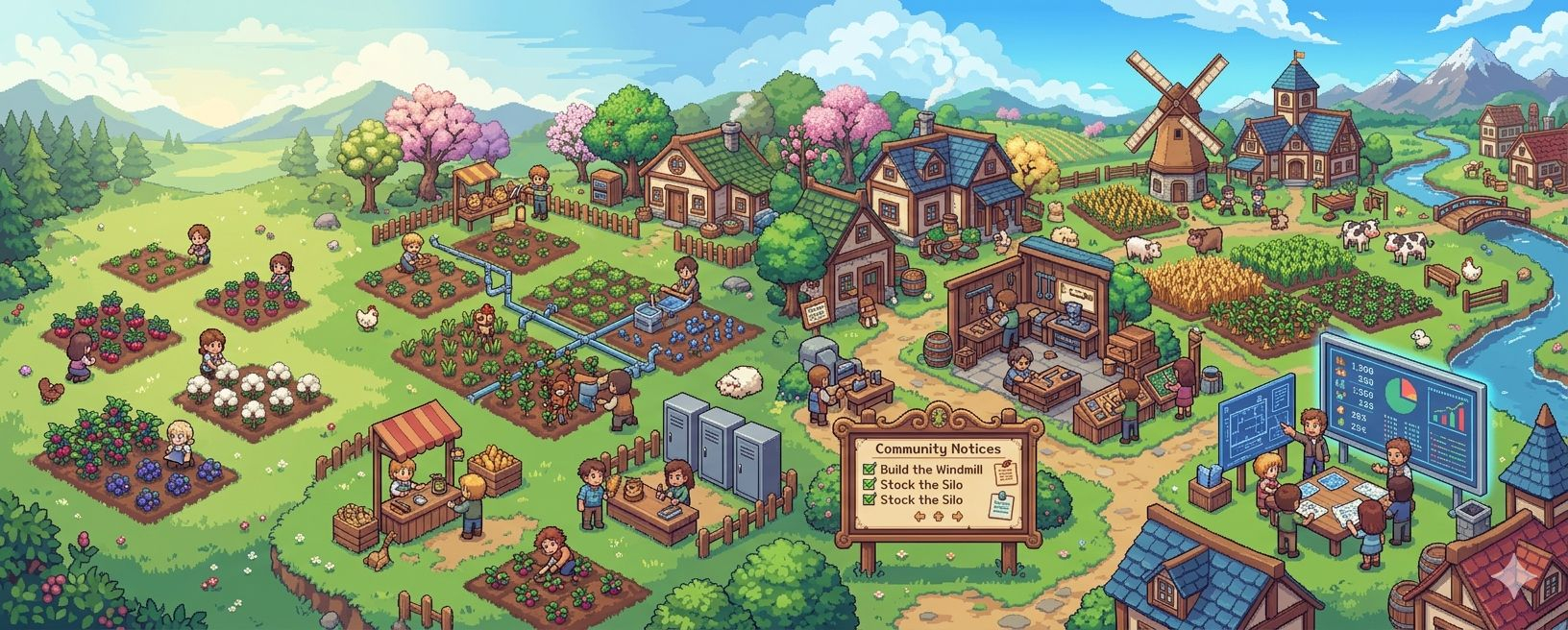
There was a time when logging into a game meant nothing more than passing time. You played, you enjoyed a few moments, and then you left, carrying nothing with you except a memory. No weight, no consequence, no continuation. But something has shifted in the way digital worlds are being built, and Pixels stands right in the middle of that transformation.
At first, it doesn’t feel different. You enter a soft, pixelated world filled with color and calmness. You plant seeds, walk across land, gather simple resources. It feels slow, almost peaceful. I’m just playing, you tell yourself. And in that moment, it’s true. There’s no urgency, no pressure, no sense that anything deeper is happening.
But the longer you stay, the more something begins to unfold beneath that simplicity.
You start noticing patterns. The way your actions connect. The way time turns into output, and output turns into progress. They’re small realizations, almost invisible at first. If I do this now, it helps me later. If I save this instead of spending it, it might matter more tomorrow. These thoughts don’t arrive all at once. They build gradually, shaping how you interact with the world.
And without realizing it, you begin to change.
Your time starts to feel different. It’s no longer just something you’re spending. It becomes something you’re using. Every action has direction. Every decision carries weight. What once felt like a casual experience starts to feel structured, almost intentional. You’re no longer just moving through the game. You’re moving within a system.
That’s where Pixels begins to separate itself.
Because it doesn’t force this realization on you. It lets you discover it. It lets you slowly step into a space where play and purpose begin to overlap. And once you feel that overlap, it’s hard to ignore.
There comes a moment, subtle but powerful, where your mindset shifts. You log in, and instead of asking what you feel like doing, you start asking what makes the most sense to do. They’re not just playing anymore. They’re thinking, planning, optimizing. The experience hasn’t changed on the surface, but internally, everything feels different.
Ownership plays a quiet but important role in this transformation. When something belongs to you, even in a digital space, your connection to it deepens. Land is no longer just a place to stand. It becomes a source of possibility. Resources are no longer just items. They represent effort, time, and potential outcomes. Progress is no longer just movement forward. It becomes positioning within a larger system.
And that connection pulls you in further.
You begin to think ahead. You consider outcomes. You start seeing the game not just as it is, but as what it could become depending on your choices. This is where Pixels stops being just an experience and starts becoming something more immersive, something that feels closer to a living environment than a static game.
Then come the people.
At first, they’re just other players moving through the same world. But over time, interactions begin to matter. You trade, you collaborate, you observe how others approach the same systems differently. Communities begin to form, not because they’re required, but because they naturally emerge from shared goals and shared understanding.
We’re seeing something deeper take shape here.
Not just gameplay, but coordination. Not just interaction, but structure. Players aren’t just existing side by side. They’re influencing each other, building around each other, shaping the environment collectively.
And yet, with all this growth, something else quietly appears.
Weight.
As systems expand, complexity increases. More mechanics, more decisions, more layers to consider. Each addition makes sense individually, but together they begin to create pressure. You notice it when playing starts to feel like managing. When logging in feels less like curiosity and more like responsibility. When missing a day feels like losing ground.
This is where the balance becomes fragile.
Because the same systems that create meaning can also create tension. If it becomes too structured, it risks losing the freedom that made it enjoyable in the first place. If it becomes too focused on outcomes, it risks overshadowing the simple act of play.
Pixels exists right in that space.
Balancing between something light and something meaningful. Between a game you enjoy and a system you engage with seriously. It hasn’t tipped fully in either direction, and maybe that’s why it feels so compelling.
There’s also a quiet uncertainty that sits beneath everything.
What happens if it becomes too much?
Not in a dramatic way, but gradually. If systems continue to grow, if expectations continue to rise, if the sense of play slowly fades into routine. People won’t necessarily leave all at once. They’ll just stop returning, one by one, without noise.
That’s how digital worlds lose their life.
But there’s another possibility.
A more hopeful one.
What if Pixels manages to hold onto its core feeling while continuing to evolve? What if it keeps that sense of ease, that feeling of simply being inside a world, even as it builds deeper systems underneath?
Then it becomes something rare.
A place where effort matters, but doesn’t overwhelm. Where progress feels meaningful, but not exhausting. Where people return not because they have to, but because they want to.
Right now, Pixels feels like it’s still deciding what it wants to be. It’s growing, adapting, experimenting with how far it can go without losing what made it special in the first place.
And maybe that’s what makes it worth paying attention to.
Because you’re not just watching a finished product.
You’re watching something evolve in real time.
Something that’s trying to answer a difficult question without saying it out loud.
Can a digital world give your time meaning… without taking away the joy of simply being there?
If it finds that answer, even partially, then Pixels won’t just be another game that came and went.
It will be remembered as a place where something quietly changed.
Where play turned into purpose.
And where people didn’t just log in to pass time
but to feel like their time meant something.