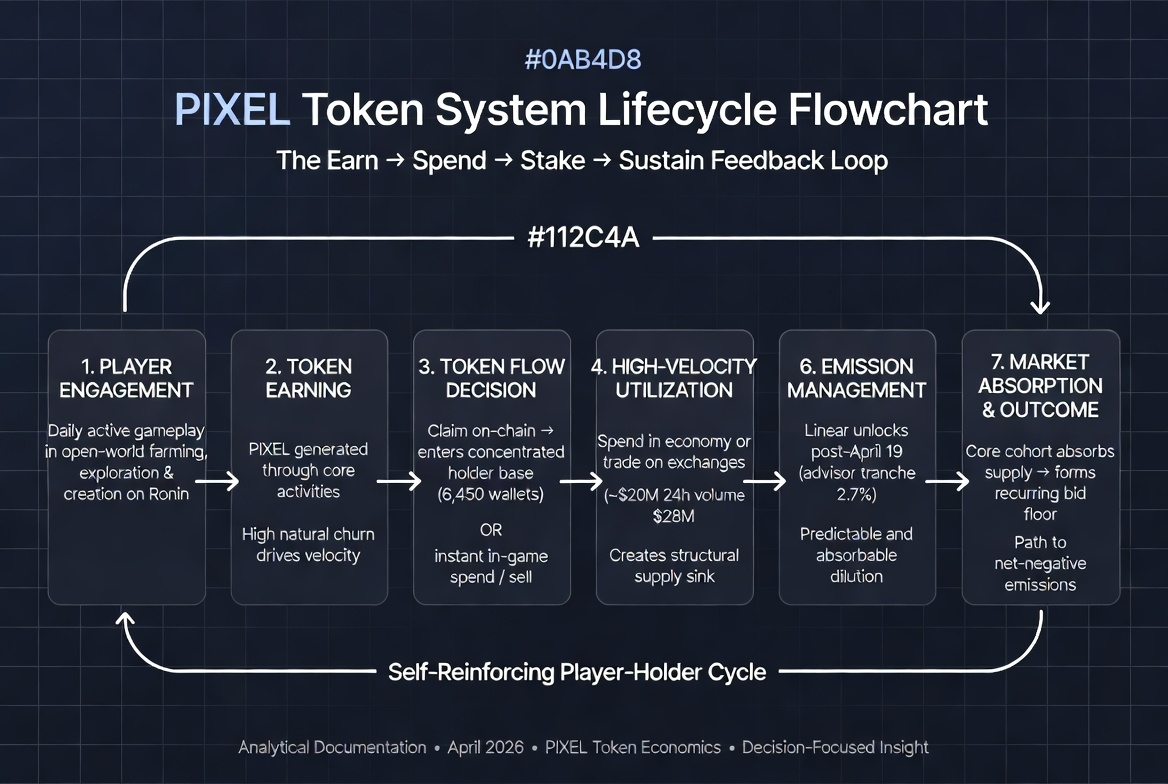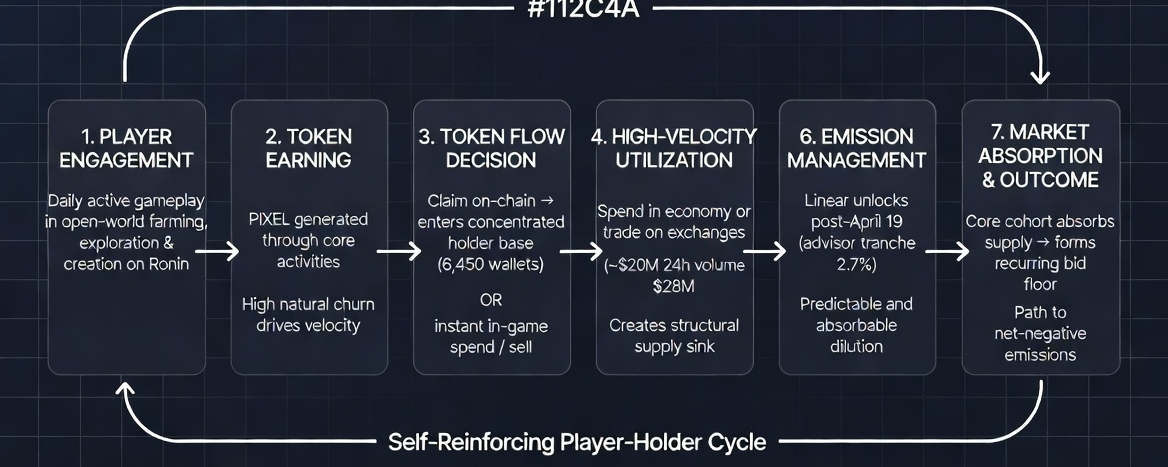

I’ve been playing Pixels on and off since the early days on Ronin, mostly for the simple joy of tending a pixel farm while chatting with random strangers in the same world. But a couple of weeks ago I did something different: I stopped looking at the pretty screenshots and started digging into the actual token data like it was a puzzle I couldn’t let go of. What I found feels rare in this space something that doesn’t scream “hype cycle” but instead feels like a slow-burning structural edge most people are missing while they chase the next big GameFi narrative.
The token isn’t trading like a typical speculative gaming play. It’s behaving like a high velocity in game currency that just happens to have a public price tag. Right now PIXEL sits at roughly $0.0082 with a market cap around $28 million. That’s on 3.38 billion circulating tokens out of a 5 billion max supply about 67.6% already out there. The fully diluted value is only $41 million, which means the market is pricing in the remaining supply at a noticeable discount. Yet the price has been remarkably steady through recent volatility, and that stability started making sense once I looked closer.
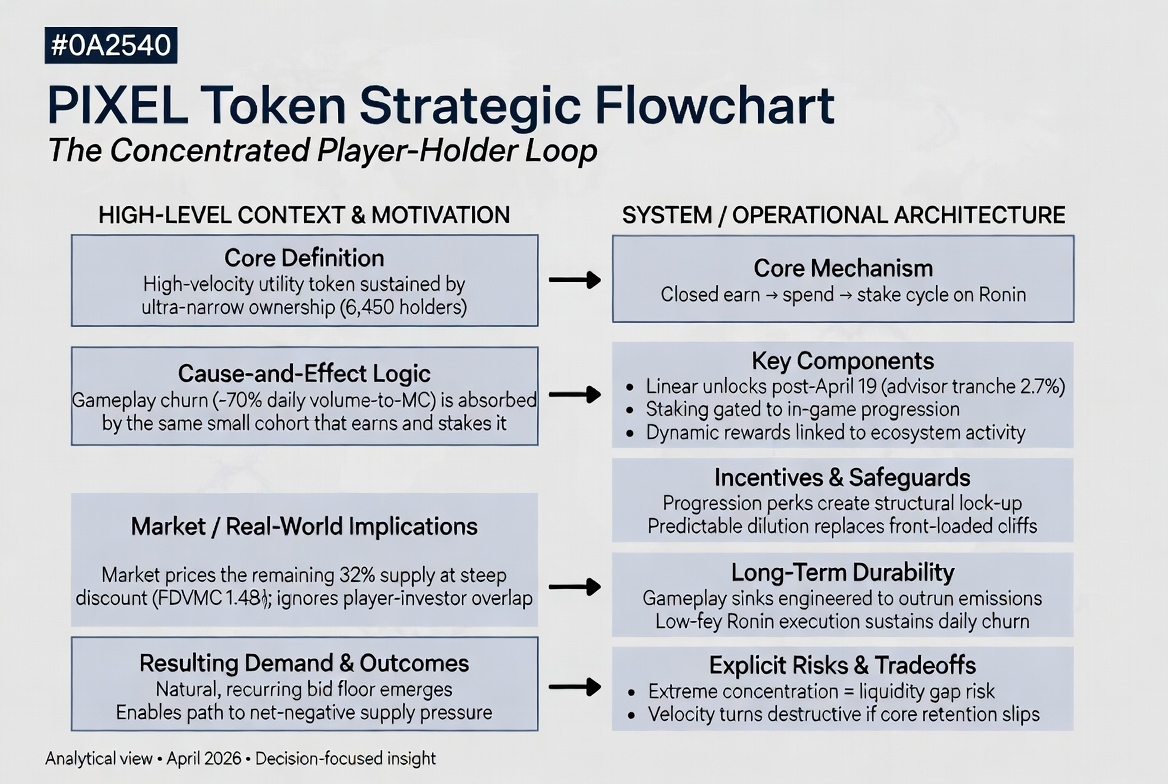
What really struck me was the 24-hour trading volume hovering near $20 million. That’s almost three-quarters of the entire market cap turning over every single day. In most tokens that kind of velocity would be a red flag constant selling pressure, people cashing out as fast as they earn. But here it feels different. The turnover isn’t coming from flippers dumping unlocks; it’s the natural churn of players earning, spending, and re-earning inside the actual game. Every crop harvested, every pet raised, every guild quest completed moves PIXEL around. And somehow the price isn’t collapsing under that pressure.
Then there’s the holder count. CoinMarketCap shows just 6,450 wallets holding the token in any meaningful way. For a game that’s pulled in millions of players and still boasts serious daily activity, that number feels almost comically small. It tells me the vast majority of people enjoying the farm life either never bother claiming their PIXEL, sell it instantly for gas or other in game needs, or simply treat the on-chain version as a secondary tool rather than an investment. The real ownership is concentrated in a core group likely the same dedicated players who are also staking, building, and sticking around long-term. That overlap between player and holder is the part I haven’t seen discussed much anywhere else.
And the timing of the next unlock only sharpens the picture. On April 19 just two days from now about 91 million advisor tokens (roughly 2.7% of the current circulating supply) are scheduled to enter the market. In isolation that sounds like it should create a decent overhang. But when you realize the heaviest unlock waves are already behind us and the remaining schedule stretches out linearly into 2029, the dilution risk suddenly looks far more manageable than it did a year ago. The market has already absorbed the big cliffs. What’s left is predictable and, crucially, small enough that the concentrated demand from active players can actually absorb it without drama.
The real quiet engine here is the staking mechanic. It isn’t some generic yield farm slapped on top; it’s tied directly to in-game progression. You need a minimum balance to participate, and the rewards are designed to flow back into gameplay rather than pure financial speculation. I’ve watched a few of my own farm friends lock up their earnings because it gives them tangible advantages inside the world better seeds, faster growth, guild perks. Every token that gets staked is one that isn’t hitting the open market. Over time that creates a natural supply sink that’s been quietly tightening even as the game keeps growing.
None of this is guaranteed to send the price to the moon. That’s not the point. The counter-risk is obvious and fair to acknowledge: with ownership so concentrated, liquidity can feel brittle if even a handful of those core wallets decide to rotate out at once. If game retention ever slips or if the in game economy stops feeling rewarding, the velocity could flip from supportive to destructive overnight. I’ve seen it happen in other projects where the “active users” numbers looked great on paper until the token stopped being worth the effort to claim.
Still, the setup feels unique in a good way. If over the next few months we see the price hold this $0.0075–$0.0085 range through the April unlock and the next couple of smaller ones, while on-chain activity stays healthy and staked supply creeps higher, that would be strong confirmation that the player holder loop is real and self-reinforcing. Conversely, a clean break lower on decent volume with no rebound would tell me the concentration was a weakness, not a strength.
I didn’t write this because I’m shilling or because I need the price to go up for my own bags. I wrote it because after months of casually playing and then finally sitting down with the numbers, I realized PIXEL might be one of those rare cases where the boring on-chain reality is actually more interesting than the flashy game trailers. The token has built a small but sticky core of owners who treat it as both fuel and long-term stake in the world they’re helping build. In a sea of GameFi tokens that feel like they’re constantly fighting their own economics, this one seems to have accidentally engineered a feedback loop that works in its favor.
Whether that loop scales beyond its current niche is the open question. But right now, the data suggests the market is still under appreciating how tight and self-sustaining that loop already is. And for someone who just likes farming pixels while the rest of crypto does its usual dance, that feels like a pretty compelling story worth watching.