
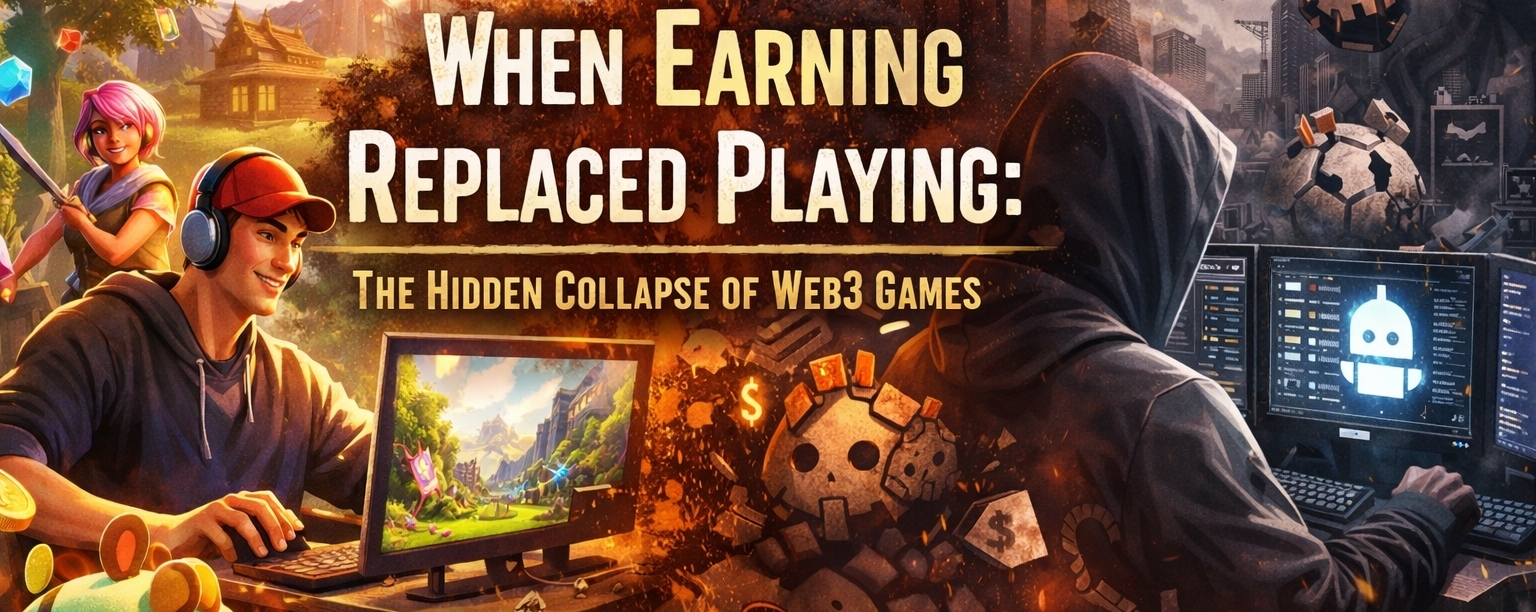
It wasn’t a big crash or shocking news. It was quieter. People were still playing, but not really enjoying the game. They were just trying to earn as much as possible and leave. They were not playing for fun anymore. They were extracting value.
This small change explains why many Web3 games failed.
Some people blame the bear market, and yes, timing matters. But the real problem was deeper. The reward systems were broken from the start.
In early play-to-earn games, rewards were given to everyone equally. It looked fair, but it wasn’t smart. The system could not tell the difference between real players and bots. So both were rewarded the same.
Because of this, many fake users joined. Bots and farmers started dominating the system. They were not there to play, only to earn. Data showed that real players were not staying long. That means the rewards were attracting the wrong behavior.
Once this starts, it gets worse over time.
Bots became more powerful. One person could control many accounts. This is called a Sybil attack. When one person acts like many players, the system breaks. Rewards go to fake activity instead of real engagement.
On the surface, it looked like growth. More wallets, more transactions. But in reality, the system was empty inside.
Even big games were not safe. Take Axie Infinity as an example. It was once the biggest Web3 game. But later, its trading volume dropped by 98%. This happened because too many tokens were created. The system gave out more value than it could handle.
Another big issue was lack of tracking.
Game developers were giving rewards, but they didn’t know if those rewards were actually working. They couldn’t measure if rewards improved player retention or revenue. In traditional games, everything is tested and improved. But in Web3, rewards were often just given without analysis.
Because of this, games lost their identity.
Rewards became more important than gameplay. Players focused on repeating simple tasks just to earn tokens. The fun, creativity, and strategy disappeared.
When rewards slowed down, players left. There was not enough real game left to keep them.
By 2025, hundreds of Web3 games had shut down. This was not random. It followed a pattern. These games depended on new players joining constantly. When growth stopped, the system collapsed.
Now, some new ideas are trying to fix these problems.
Instead of giving rewards to everyone, the focus is on giving rewards to the right players. Players who actually play, return, and contribute to the game.
This makes rewards more like an investment, not just a cost.
There is also better bot detection. If fake users are removed quickly, real players get a fair chance.
Another idea is using AI to manage the game economy. The system can adjust rewards in real time. If too many tokens are being created, rewards can be reduced. If player activity drops, rewards can be improved.
This makes the system more flexible.
But this also has risks. AI can make wrong decisions if the data is not good. So it is not a perfect solution yet.
One important idea is “return on rewards.” This means asking a simple question:
For every reward given, what do we get back?
Do players stay longer?
Do they spend more?
Do they enjoy the game more?
If developers can answer this, they can build better systems.
Personalization also helps. Different players like different things. Some enjoy fighting, others enjoy building or exploring. Rewards should match how people actually play.
This makes the experience feel more natural.
But there is one important truth.
Even the best reward system cannot fix a bad game.
If the game is not fun, people will not stay. Rewards alone are not enough.
The Web3 gaming space is now changing. It is moving away from fast growth and easy rewards. It is focusing more on long-term sustainability.
In the future, successful games will not be the ones that pay the most.
They will be the ones that are actually fun to play, where rewards support the game instead of replacing it.
In the end, the real problem was simple:
It was not just too many rewards.
It was rewards given without understanding.