
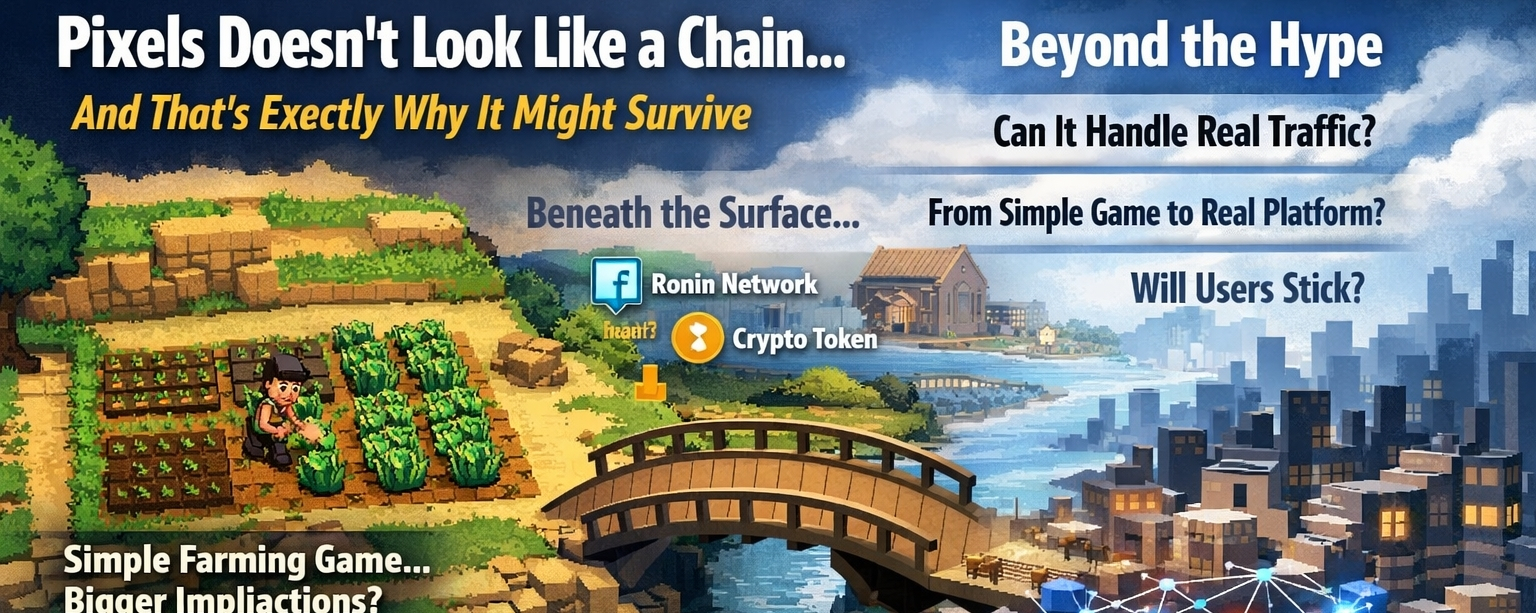
The first time I opened Pixels, it didn’t register as infrastructure. It barely even registered as “crypto,” honestly. It felt like a game that wasn’t in a rush to prove anything. You walk around, plant things, do small repetitive actions that don’t scream innovation. And that’s exactly what made me pause a bit. Because in a space where everything is trying to look like the future, this thing is comfortable looking small.
After a while, though, you start noticing the framing around it. The Ronin connection. The token. The quiet suggestion that this isn’t just a game, it’s part of something bigger. And that’s where the familiar feeling creeps in. Not excitement exactly. More like recognition. We’ve seen this pattern before—something simple on the surface, with a much larger claim sitting underneath. Another attempt, maybe, at building a foundation people actually use instead of just talking about.
It’s hard not to think about how many “new chains” have come and gone. Every cycle has its batch. Faster, cheaper, more scalable, more “AI-integrated” now, whatever that means this month. And for a while, they all sound convincing. Clean dashboards, confident roadmaps, a lot of words about throughput and modularity. Then real usage shows up—if it ever does—and things start to wobble. Not because the design was bad on paper, but because reality has a way of exposing what wasn’t fully thought through.
That’s the part people don’t like to admit. Blockchains don’t really fail in theory. They fail when people actually use them at scale. Traffic is the only honest test. You can simulate it, model it, write long threads about it, but none of that feels the same as thousands of real users doing unpredictable things at the same time.
You can see glimpses of that in chains that are already out there. Solana, for example, feels incredibly smooth when it’s working well. Fast, cheap, almost invisible in the way good infrastructure should be. But it’s also had moments where that smoothness cracks under pressure. Not constantly, not catastrophically every time, but enough to remind you that performance claims and sustained reality are two different things. And to be fair, that’s not a failure unique to one chain. It’s just the nature of pushing systems to their limits.
Which is why Pixels is interesting in a slightly sideways way. It’s not presenting itself as a better Layer 1 in the traditional sense. It’s not leading with architecture diagrams or trying to win debates about consensus models. It’s doing something quieter. It’s putting actual user activity first, even if that activity looks trivial. Farming, clicking, waiting, returning. Not exactly groundbreaking gameplay, but consistent. Predictable. Real.
And maybe that’s the point it’s circling around without saying it too loudly. Instead of designing a chain and hoping users come later, it leans into an environment where users are already doing something, however simple, and lets the infrastructure sit underneath that. Almost like it’s testing the system without announcing that it’s a test.
There’s a trade-off in that approach, obviously. To make something accessible, you simplify. You don’t overload the experience with complexity. You avoid sharp edges. But in doing that, you also limit how much depth there is, at least initially. The question becomes whether that simplicity is a stepping stone or just a ceiling. A lot of projects start simple and never quite evolve past that first layer.
Then there’s the bigger question that hangs over all of this. Even if it works, even if the system holds up under real usage, what happens next? Do users stay? Do they care about the underlying chain at all? Or is it just another case where the infrastructure becomes invisible, and the value doesn’t really flow back the way people expect?
And beyond that, will anything actually move? Liquidity, users, attention—it all tends to cluster and stay where it already is. People talk a lot about multi-chain futures, about ecosystems sharing load and coexisting, but in practice, movement is slow. Friction is real. Habits are hard to break. It’s easy to imagine a world where everything connects smoothly. It’s harder to point to where that’s actually happening in a meaningful way.
Still, there’s something here that doesn’t feel entirely forced. Pixels isn’t trying to convince you it’s the next big chain. It doesn’t seem interested in that label, at least not on the surface. It’s just… running. Letting people interact, letting the system carry that weight quietly in the background. And if you’ve been around long enough, that kind of restraint stands out more than another ambitious promise.
I’m not sure it solves anything in a definitive way. It might just be approaching the problem from a different angle. Fewer declarations, more observation. Let the usage come first, see what breaks, adjust from there.
There’s a version of this where it grows into something meaningful without ever needing to shout about it. And there’s another version where it stays exactly what it looks like right now—a small, contained loop that never really escapes its own boundaries.
It might work. Or nobody shows up.
