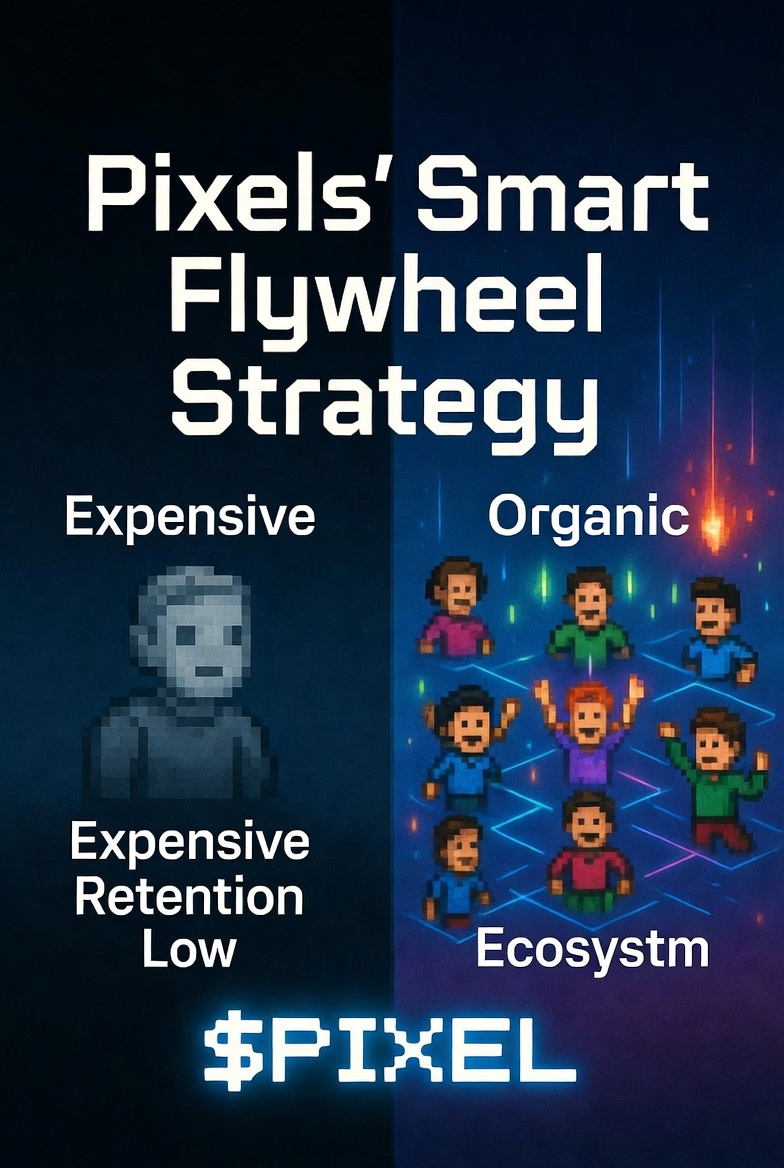
User Acquisition (UA) cost is one of the biggest challenges for any game, especially in Web3. Most projects spend heavily on marketing, influencer campaigns, airdrops, and paid ads just to bring in new players, only to see many of them leave shortly after. This makes growth extremely expensive and unsustainable in the long run.
@Pixels has taken a very smart and forward-thinking approach to solve this problem. In their whitepaper, they have outlined a complete strategy centered around the “Publishing Flywheel” that aims to dramatically reduce user acquisition costs over time.
Here’s how they plan to do it:
Instead of constantly spending money to attract users from outside, $PIXEL wants to create a self-sustaining system. The idea is simple but powerful: When high-quality games join the Pixels ecosystem, they bring their own players. These new players generate rich behavioral data. With better data, Pixels can optimize its reward system and targeting, which improves player retention and engagement. Higher retention and engagement make the platform more attractive to even better game developers. This creates a positive loop where the ecosystem grows organically with less and less need for expensive external marketing.
This flywheel effect is the core of their long-term plan. As the ecosystem becomes stronger and more games are added, the cost of acquiring each new user should decrease significantly. They are essentially shifting from “paying to get users” to “building an ecosystem that naturally attracts users”.
Another important part of their strategy is using data science and AI to understand what truly drives player interest and retention. By precisely targeting the right rewards to the right players, they can achieve higher conversion rates and better lifetime value from each user. This efficiency directly helps in lowering overall acquisition costs.
Pixels is moving away from the traditional “spend big on marketing” model that most Web3 games follow. Instead, they are investing in building a strong foundation better games, smarter rewards, and a healthy economy that can grow by itself.
If this strategy works as planned, #Pixels could achieve something very rare in Web3 gaming: sustainable growth with significantly lower user acquisition costs compared to their competitors.
This approach shows that Pixels is thinking several steps ahead. They are not just building a game, they are building an entire ecosystem designed for long-term efficiency and scalability.
The big question now is execution. If they can successfully turn this flywheel and continuously improve their data-driven system, Pixels might set a new standard for how Web3 gaming projects grow in the future.