
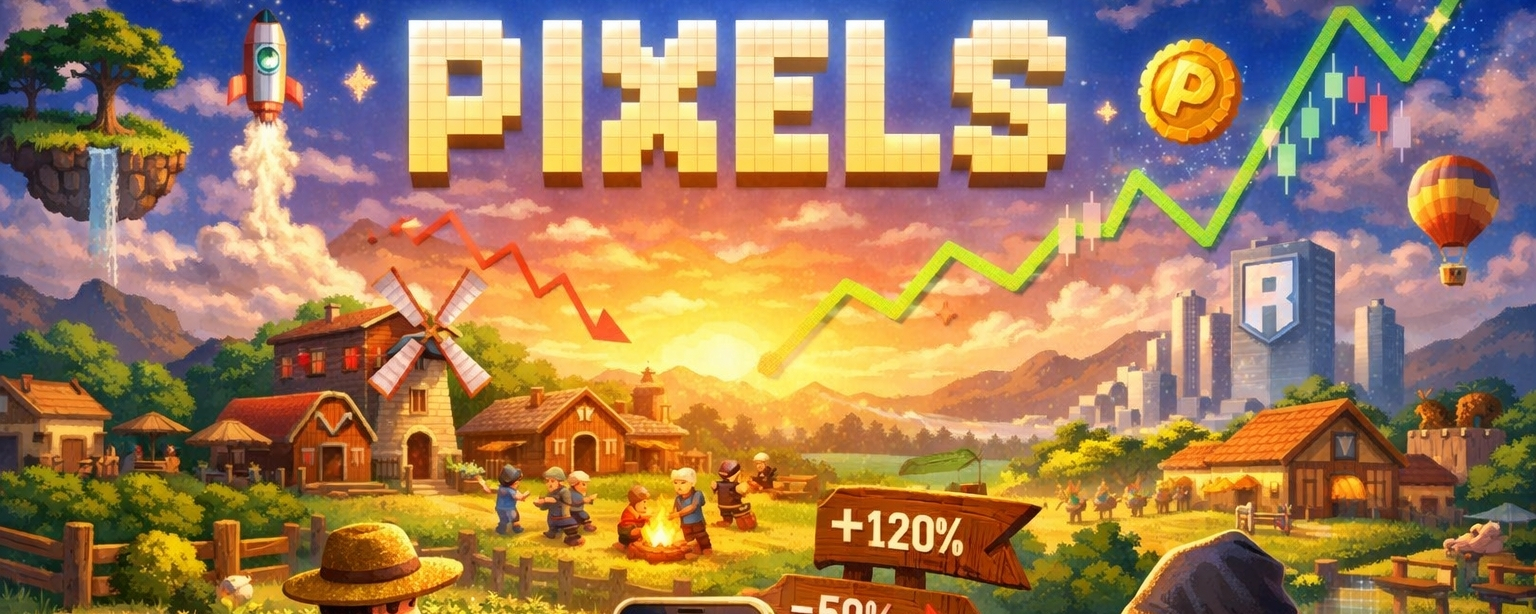
I keep coming back to this simple moment: logging into Pixels, planting crops, walking around, chatting with random players… and then checking the token price right after. That small habit says more about the system than any whitepaper ever could.
At first glance, Pixels feels like a cozy escape. You farm, you explore, you build your little world. It reminds you of classic casual games but with a twist: everything you do means something financially, at least in theory. That’s the story most people tell. Play, own, earn. Simple.
But after spending real time inside it, I don’t think it’s that simple at all.
The usual narrative says Pixels is a player-owned economy powered by blockchain. And yes, that part is real. You own your land, your items, your progress. It’s all recorded, verifiable, transparent. No one can take it away from you. That’s powerful.
But here’s where things get a bit messy.
Owning something doesn’t automatically make it valuable in practice.
I’ve seen players grind for hours planting, harvesting, crafting—believing they’re building something meaningful. And sometimes they are. But other times, the value of what they earn depends less on the game itself and more on what’s happening outside the game. If the PIXEL token is pumping, everything feels rewarding. If it drops, suddenly the same effort feels… different.
It’s like running a small farm where crop prices change every hour based on global speculation. You’re doing the same work, but the outcome keeps shifting.
That’s the tension Pixels lives in.
On one side, it wants to be a real gamea place you come back to because it’s relaxing, social, even a bit addictive in a good way. On the other side, it’s deeply tied to a crypto economy that’s anything but stable. And those two forces don’t always get along.
I remember a moment where a lot of new players rushed in. The world felt alive busy farms, active chats, constant movement. But if you looked closer, many of them weren’t really playing the game. They were optimizing it. Calculating returns. Treating gameplay like a strategy sheet.
And when the hype cooled down, many of them disappeared just as quickly.
That’s when it clicked for me: Pixels doesn’t just have players it has different types of participants. Some are there to enjoy the world. Others are there to extract value. And the system has to somehow serve both.
That’s not easy.
Because a good game rewards consistency. Show up, put in time, get better, feel progress. But a token-driven system rewards timing. Be early, be fast, exit at the right moment. Those are completely different behaviors.
Pixels is trying to merge them into one experience.
To its credit, you can see it evolving. The move to the Ronin Network made the game smoother transactions are faster, cheaper, more seamless. It feels more like an actual game now, less like a clunky experiment.
And the addition of social systems guilds, shared spaces, collaborative play shows a deeper understanding. The team seems to realize that people don’t stay for tokens alone. They stay for connection, routine, identity.
But even with these improvements, the core question remains:
What actually makes this system reliable over time?
Because reliability isn’t just about tech working. It’s about expectations holding up.
If a player spends weeks building something, they need to feel like it matters not just today, but tomorrow too. Not just when the market is good, but when it’s quiet. That’s where many Web3 games struggle. They can prove ownership, but they can’t always sustain meaning.
Pixels is right in the middle of figuring this out.
And honestly, that’s what makes it interesting to watch.
It’s not a finished product pretending to be perfect. It’s a system under pressure balancing fun and finance, community and speculation, permanence and volatility. Sometimes it holds together beautifully. Other times, you can see the cracks.
But those cracks are revealing.
They show that building a “player-owned world” isn’t just about putting assets on-chain. It’s about aligning human behavior with system design. It’s about making sure the reason people stay is stronger than the reason they came.
And that’s still an open question.
When I log out of Pixels now, I don’t just think about what I earned or built. I think about whether I’d come back if the token didn’t exist at all.
That question lingers longer than anything else.
Because whatever the answer becomes that’s where the real foundation of Pixels will be.
