
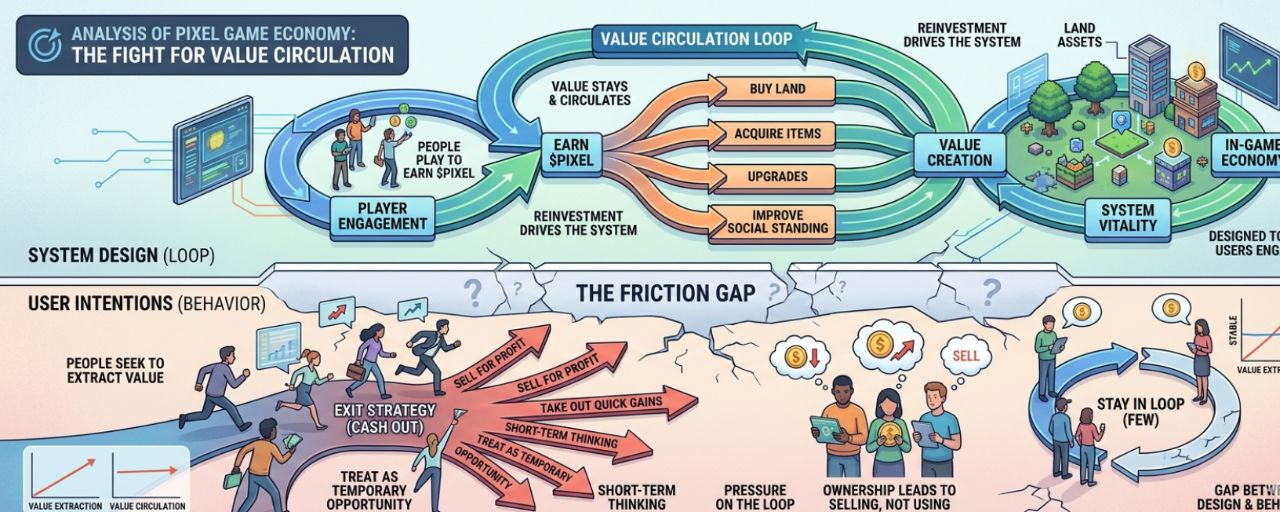
I keep looking at PIXEL. The first thing that catches my attention is not how you play the game. It is how value moves around inside the system. Where does it start? Where does it go?. Does it come back or just disappear slowly?
Most systems like this fail at that point. Value leaves the system faster than it comes in. Players take out more than they put in.. Over time the system relies on new users to fill the gap. That is usually when things fall apart.
PIXEL seems to be trying to fight this problem.. I am not entirely sure if it is succeeding yet. There is an effort to keep value circulating inside the system. You earn money inside the game. Then you are encouraged to spend it inside the same environment. You can buy land, items, upgrades. Even improve your social standing. This creates a loop where earning money's not the only goal. Spending becomes a part of staying relevant in the game.
That is really interesting because it changes how people behave. If users only play the game to earn money and then leave the system will die.. If users earn money and then reinvest it the system starts to look like a small economy instead of just a machine that gives out rewards.
However there is still a gap in the system. The system assumes that users will choose to stay inside the loop.. In reality many users come in with the mindset of taking out as much value as they can. They are not thinking about their long-term position in the game. They are thinking about short-term gains. This creates pressure on the loop.
So the real question is not how the system is designed. How users actually behave inside it. Now it feels like there are two layers at the same time. One layer is the designed loop where value circulates and assets are connected. The other layer is the users intentions, where people try to take out value quickly as possible.
These two layers do not always match. This creates friction. For example some actions in the game are meant to be meaningful. If they do not give you real value users will skip them. This breaks the loop.. When many users skip the same thing, that part of the system becomes useless.
So the system has to adapt.. By adding incentives to make people use certain features or by removing features that nobody uses. That is where it gets tricky. If you keep adding incentives just to force people to use features you risk creating fake activity. It may look healthy on the surface. Underneath it is just people chasing rewards again.
The balance is very thin. Another thing that stands out is how much PIXEL depends on participation. Not just new users,. Active users who keep interacting with assets. Land needs users items need to be used and systems need to be circulated. If activity slows down the whole structure feels it.
This is different from systems where assets can just sit there and hold value. In PIXEL inactivity actually hurts the system. Which means keeping users engaged is more important than getting users.
Keeping users engaged is hard. Because once a user understands the loop they. Commit deeper or they start thinking about how to exit the system. There is not middle ground.
Something else feels important here. The idea of ownership. On paper owning assets inside PIXEL should make users more attached. It should make them want to stay build more and think long-term.. In reality ownership can also make people think about how to extract value. If I own something I start thinking about when to sell it not how to use it.
So ownership does not automatically solve the problem. It just changes the form of it. There is also a question about scale. The system works better when there is activity to keep the loops alive.. As it grows user behavior becomes harder to predict. New users do not always follow the path. They create patterns and some of those patterns might break existing loops.
I am not sure how PIXEL handles that yet. Now it feels like the system is still in a controlled environment, where most activity is somewhat aligned with the design.. Real-world scale is messy. People come in with goals different time horizons and different risk tolerance.
That is where theory meets reality.. Usually reality wins. Still there is something that feels more thought through than older play-to-earn systems. It is not about paying users to show up. It is trying to make them stay inside the system. Trying to make value move, in circles of straight lines out.
The design makes sense on paper.. The real test is always user behavior. Do users actually choose to stay in the loop when they have the option to leave?. Do they treat the whole system as a temporary opportunity? Now it feels like both are happening at the same time.. I am still watching to see which side slowly takes over.